Do MI Senate candidate El-Sayed’s comments about ‘public ownership’ show he supports communism?
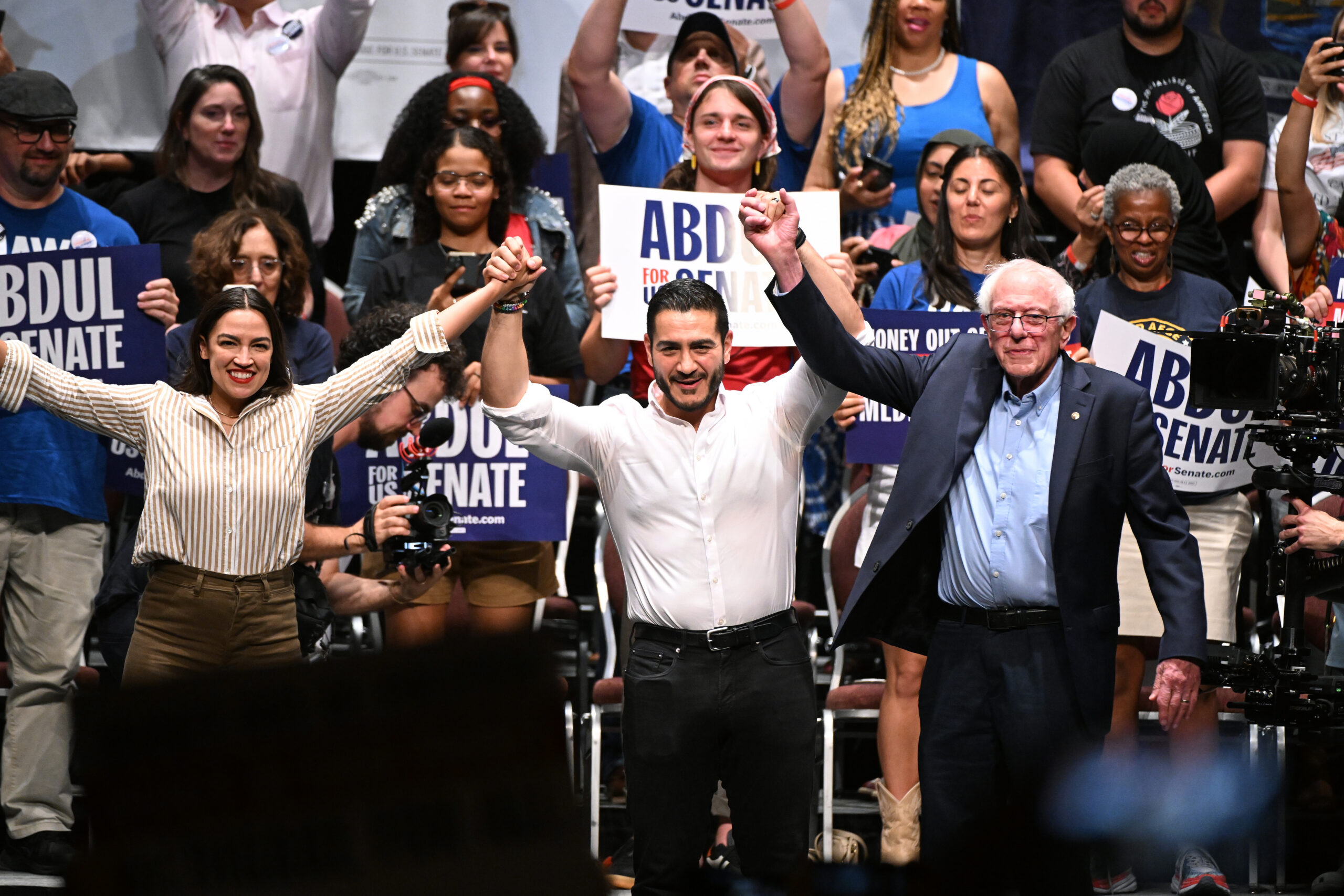

Republicans are sharing a resurfaced clip of Michigan Democratic U.S. Senate candidate Abdul El-Sayed discussing government control of private corporations — and they’re saying it shows his support for communism.
El-Sayed “says he is in favor of a communist-style government seizure of private companies,” read an Aug. 12 X post from the Republican National Committee.
The post included a 16-second clip of El-Sayed speaking during what looks like a podcast. In it, the host asks, “Are you in favor of public ownership models like the one Bernie introduced?”
“So, I want to actually take it a step further,” El-Sayed responds. “I agree that we need public ownership, but I also agree that we need some system of public control. Like, what is the point of democracy if it’s not to protect us from existential risk?”
🚨NEW
Michigan Democrat Abdul El-Sayed says he is in favor of a communist-style government seizure of private companies.
HOST: “Are you in favor of public ownership models?”
EL-SAYED: “I want to actually take it a step further…we need some system of public control.” pic.twitter.com/zUBHUdZtFm
— RNC Research (@RNCResearch) August 12, 2026
Communism involves complete government ownership of industry and government-directed economic planning, said Ronald Suny, a University of Michigan history and political science professor emeritus.
Watching the full podcast interview that the clip was taken from shows that’s not what El-Sayed was calling for.
The original video, a 50-minute interview on the June 12 episode of the “Head in the Office” podcast, shows El-Sayed was talking specifically about artificial intelligence companies. In a discussion about the Iran war, El-Sayed criticized President Donald Trump for attacking Iran, saying the ensuing rise in energy prices could destabilize major AI companies that Trump supports.
El-Sayed then said that as senator he’d want to impose significant federal oversight on data center development.
El-Sayed: If you’re going to build these things, union labor and all the jobs you said you’re going to provide. Number two, you cannot increase our electrical costs. Number three, you need to invest revenue in improving reliability and improving our grid. Number four, do not touch our water. Number five, there must be a community benefits agreement that is negotiated in good faith. And number six, we can shut you down if you don’t do this shit right.”
The comments captured in the RNC clip came shortly after that — highlighted here in bold type:
Host: “Are you in favor of public ownership models like the one Bernie introduced?”
El-Sayed: “I want to actually take it a step further. I agree that we need public ownership, but I also agree that we need some system of public control. Like, what is the point of democracy if it’s not to protect us from existential risk? And right now there is no regulation. And these super PACs are rendering AI potentially unregulatable into the future. You got two AI super PACs that are going to play in this race. For whom? Guess who?”
Host: “And they’re among the biggest spenders these days.”
El-Sayed: “$100 million super PACs. So one’s playing for one of my opponents, the other one’s playing for the other opponent.
Host: “Oh, really? I haven’t even heard about this.”
El-Sayed: “So big AI is already working to try and render this unregulatable. So I just think it’s really important for us to be thinking, what is democratic control over this industry? What does it look like? And I’m not the only one saying — like Dario Amodei, who’s the CEO of Anthropic, kind of came to the conclusion himself, that at some point we’re going to need public ownership of this. Because it’s just too big and just too dangerous. And so, you know, whether that means, like, public representation on boards or a public oversight body over all of these corporations, I just think this is potentially existential both for the social contract and for like existential risk itself, right?”
One note on that exchange: PolitiFact previously looked into El-Sayed’s claim that AI industry-funded super PACs were spending large amounts of money opposing him in Michigan’s primary election, but we found no trace of major AI-promoting super PACs supporting any Democratic primary candidate there.
And although El-Sayed joins U.S. Sen. Bernie Sanders, I-Vt., in calling for the U.S. government to take a stake in AI companies, the concept isn’t exclusive to the political left.
President Donald Trump has floated the idea, and his administration has participated in talks with AI companies about potentially transferring shares to the U.S. government, NOTUS reported in June. OpenAI CEO Sam Altman and Amodei, the Anthropic CEO, have both proposed methods for the public to share in the industry’s financial gains.
Trump also facilitated the U.S. government taking a 10% stake in chip manufacturer Intel in 2025 in an unusual deal that saw the government convert unpaid CHIPS Act funding and already awarded grants into $8.9 billion in Intel stock.
When PolitiFact asked for evidence that the policies El-Sayed discussed were “communist-style,” RNC spokesperson Hunter Lovell said El-Sayed’s policy is in line with a “radical socialist agenda.”
“Whether it’s demanding public control of private AI companies or eliminating private health insurance through Medicare for All, El-Sayed has made abundantly clear that he wants government bureaucrats controlling every aspect of Americans’ daily lives,” Lovell said.
An AI-funded sovereign wealth fund
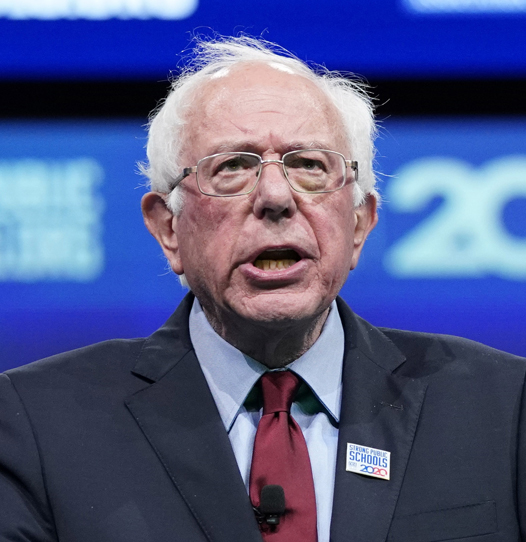
Sanders has proposed the U.S. government take 50% ownership of the major AI companies to finance a sovereign wealth fund. The U.S. stake would be funded through a one-time tax on the companies payable in newly issued shares.
Unlike other proposals that envision voluntary stock grants or the U.S. buying shares with taxpayer money, it would amount to a mandatory transfer of equity from current shareholders to the U.S. government.
That’s different from how countries generally set up state enterprises, University of Michigan philosophy professor Elizabeth Anderson said, because it’s presented as a tax and the companies wouldn’t be compensated for the transferred stocks. That “sounds like outright expropriation,” Anderson said, and she questioned whether it would be found constitutional. But she said it doesn’t amount to communism.
El-Sayed’s AI plan endorses Sanders’ bill, but adds more regulations. He would also require the top AI companies to register as public benefit corporations and adopt certain ethical standards. It would mandate a majority of their board seats be publicly appointed or democratically elected, and impose safety guidelines.
El-Sayed spokesperson Roxie Richner told PolitiFact El-Sayed isn’t calling for government ownership of private companies broadly, but for AI companies specifically because they were built on public data, and because of their uniquely transformative potential.
“Any suggestion that giving the public decision-making power over their own property and existential risk over the future is communism is not consistent with a baseline understanding of American civics or economics,” Richner said.
Is it a communist takeover?
The proposal would be a significant intervention in the U.S. economy, but it’s not communism.
Better terms for El-Sayed’s proposed policies are state capitalism or democratic socialism, experts said.
Socialism involves broad public ownership of the economy and minimizing the role of private capital. Democratic socialism in the U.S. is a broad umbrella that generally calls for establishing public ownership of large corporations and major industries through reforms, rather than violent revolution.
El-Sayed is backed by prominent democratic socialists such as Sanders and U.S. Rep. Alexandria Ocasio-Cortez, D-N.Y., but he has rejected the label and calls himself a capitalist who supports strong government regulations over corporations.
“State capitalism refers to state participation in the ownership of vital resources or those that are relatively new and require in the public interest a degree of state control lest their owners engage in activities that are harmful to public safety, security and sanity,” said Lewis Siegelbaum, a history professor at Michigan State University.
That setup is common in European countries, and even in some sectors in the U.S., experts said. Norway holds a majority stake in the oil company Equinor, and invests in other companies through its $2.3 trillion sovereign wealth fund. Several countries in Europe have full or majority ownership of airlines, railways, train companies, telephone companies and other industries.
Publicly-owned and operated electric and water companies, subway systems and research facilities are common in the U.S., experts said.
“These are all islands of socialism within a capitalist society,” Suny said of things like public utilities. “When they were originally proposed, at the end of the 19th century, beginning of 20th century, they were condemned as socialist.”
Our Sources
Email interview, Lewis H. Siegelbaum, Jack and Margaret Sweet Professor Emeritus of History, Michigan State University, Aug. 17, 2026
Email interview, Michael Kazin, professor of history, Georgetown University, Aug. 18, 2026
Email interview, Elizabeth Anderson, John Dewey Distinguished University Professor of Philosophy and Women’s and Gender Studies, University of Michigan, Aug. 18, 2026
Telephone interview, Ronald Grigor Suny, William H. Sewell Jr. Distinguished University Professor Emeritus of History and Political Science, University of Michigan, Aug. 18, 2026
Email interview with Hunter Lovell, RNC spokesperson
RNC Research, X post, Aug. 12, 2026
Head in the Office, Beating Establishment Politics & Phony Controversies with Abdul El-Sayed, June 12, 2026
Associated Press, Donald Trump, Bernie Sanders and Sam Altman are all talking about public ownership in AI, June 5, 2026
NOTUS, Senior U.S. Officials Eye Government Shares in AI Giants, June 4, 2026
Reuters, US to take 10% equity stake in Intel, in Trump’s latest corporate move, Aug. 22, 2025
Office of Sen. Bernie Sanders, Sanders Introduces Legislation to Create $7 Trillion AI Sovereign Wealth Fund, June 18, 2026
Associated Press, Bernie Sanders unveils plan to give the public direct ownership of AI companies, June 18, 2026
Office of Sen. Bernie Sanders, American A.I. Sovereign Wealth Fund Act, June 18, 2026
Abdul El-Sayed for U.S. Senate, First, Do No Harm: AI Under Democracy, June 29, 2026
Equinor, Our shareholders, accessed Aug. 19, 2026
Norges Bank Investment Management, The fund’s value, accessed Aug. 19, 2026
European Commission, State-Owned Enterprises in the EU: Lessons Learnt and Ways Forward in a Post-Crisis Context, July 2016
Britannica Money, Socialism | Definition, History, Types, Examples, & Facts, accessed Aug. 19, 2026
PolitiFact, What Trump’s communism claims miss about Democrats and democratic socialists, July 9, 2026
Democratic Socialists of America, DSA Program, accessed Aug. 19, 2026