U.S. Sen. Jon Ossoff “cast the deciding vote for the inflation disaster,” referring to the 2022 Inflation Reduction Act.

Was Jon Ossoff the ‘deciding vote’ in 2022 Inflation Reduction Act passage? We examine.
If your time is short
- U.S. Sen. Jon Ossoff supported the 2022 Inflation Reduction Act and championed portions of the bill.
- Vice President Kamala Harris cast the tie-breaking vote.
Four years after Congress narrowly approved the 2022 Inflation Reduction Act, U.S. Rep. Mike Collins, a Republican Senate hopeful in Georgia, blamed the measure for worsening inflation and pointed voters to incumbent Democratic Sen. Jon Ossoff’s support for the legislation.
Ossoff “cast the deciding vote for the inflation disaster that cost Georgia families at the gas pump, the grocery store, and the border,” Collins said in a television ad released June 17.
Collins spokesperson Corbin Keown clarified that the ad referred to the Inflation Reduction Act but did not respond when asked for the campaign’s reasoning that Ossoff cast the “deciding vote.”
PolitiFact has a long history of parsing how politicians use the phrase “deciding vote” in election messaging, going back to passage of the 2010 Affordable Care Act. A “deciding vote” implies that some votes count more than others. Ossoff’s vote for the bill was essential to its passage, but it was no more unique than the votes of 49 other Democrats who voted with him.
Vice President Kamala Harris cast the tie-breaking vote — a pivotal role Collins’ GOP allies acknowledged during the 2024 election.
Despite the Inflation Reduction Act’s name, the bill had little to do with inflation. As PolitiFact has reported, economists said an earlier Biden-era law, the 2021 American Rescue Plan Act, had a greater impact on inflation, with its pandemic-era infusion of cash directly to Americans and localities while supply lines were disrupted. The year-over-year inflation rate had declined by more than two-thirds since the 2022 bill passed, and many of the bill’s provisions were designed to be phased in over years..
What is this law and who supported it?
The Inflation Reduction Act is a major piece of legislation that affects climate change initiatives, healthcare and corporate taxation.
Republicans have said the law was “green corporate welfare” standing in the way of free market ideals. Democrats touted how it limited insulin costs and invested in American alternative energy companies.
When asked for comment about Ossoff having the “deciding vote,” Ossoff campaign spokesperson Ellie Dougherty said, “Through the Inflation Reduction Act, we capped the cost of insulin and out-of-pocket drug costs for seniors. The IRA has also created tens of thousands of new jobs across the state and supercharged economic development in Georgia.”
Ossoff wrote bills to close loopholes created by the legislation, including a portion of the law that provides a production tax credit for American solar energy manufacturers.
The vote was strictly on party lines, with 50 Democrats voting for the measure and 50 Republicans against. Harris cast the tie-breaking vote on Aug. 7, 2022.
GOP, Democrats noted Harris’ influence previously
Republicans emphasized Harris’ role in ensuring the law’s passage during the 2024 presidential election.
With Harris as the Democratic nominee, the House GOP issued an August 2024 press release titled “Kamala Harris Owns the Inflation Expansion Act After Casting Deciding Vote.”
Vice President J.D. Vance in September 2024 said: “Kamala Harris cast the deciding vote on the Inflation Explosion Act.”
Harris took credit, too, for breaking the tie. In an August 2024 post on Facebook, Harris wrote: “As Vice President, I was proud to cast the tie-breaking vote to pass the Inflation Reduction Act.”
Republicans, including Collins, have blamed the law for inflation. But inflation peaked around 9% annually in the summer of 2022, which was before the law passed. After the Inflation Reduction Act passed, inflation fell, though mostly for reasons other than the act itself.
An earlier law passed by Democrats — the American Rescue Plan Act, which Biden signed as a pandemic relief bill shortly after he took office in 2021 — is generally blamed for exacerbating inflation. Economists assigned more blame to post-pandemic supply chain backups and Russia’s invasion of Ukraine.
Our ruling
Collins said Ossoff “cast the deciding vote for the inflation disaster,” referring to the 2022 Inflation Reduction Act.
Ossoff supported the Inflation Reduction Act. Every Democratic vote was needed, but he was not the “deciding vote.” Harris, as vice president, came in to break the tie.
Despite its name, the law had little effect on inflation. Inflation had peaked by the time it passed, and many provisions required phasing in over several years.
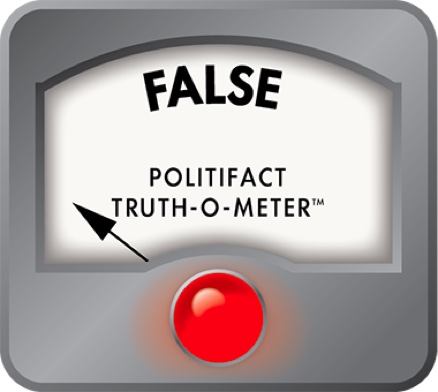
We rate the statement False.
PolitiFact Chief Correspondent Louis Jacobson contributed to this report.
Our Sources
Mike Collins campaign, press release, June 17, 2026
PolitiFact, “What makes a vote ‘the deciding vote’?,” Oct. 26, 2010
PolitiFact, “The deciding vote?” All 60 of them!” June 14, 2012
PolitiFact, “Fact-checking how much the Inflation Reduction Act affects taxes,” Oct. 19, 2023
United States House Committee on Ways & Means, fact sheet, accessed June 25, 2026
Competitive Enterprise Institute, “House Republican letter urges an end to all IRA handouts via the reconciliation bill,” May 5, 2025
The Union-Recorder, “Milledgeville Proves Rural America’s Solar Future Depends on Federal Support,” Feb. 21, 2026
Sen. Ossoff’s office, press release, Nov. 19, 2021
House GOP, press release, Aug. 16, 2024
PolitiFact, “Republicans use sleight of hand to blame Inflation Reduction Act for boosting prices,” Sept. 25, 2024
Kamala Harris Facebook, post, Aug. 16, 2024
Congressional record, H.R. 5376, accessed June 25, 2026