Stand up for the facts!
Our only agenda is to publish the truth so you can be an informed participant in democracy.
We need your help.
I would like to contribute

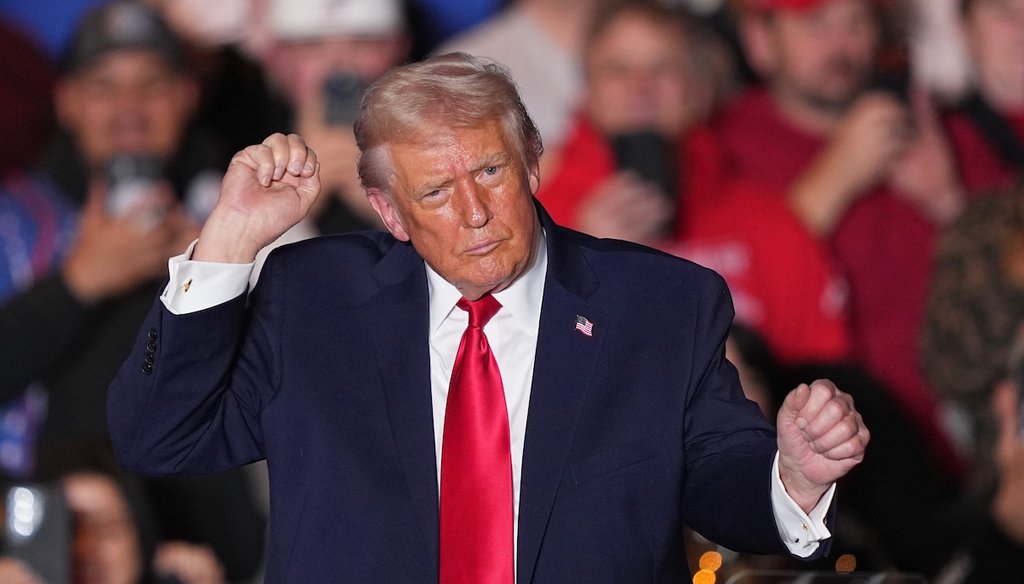
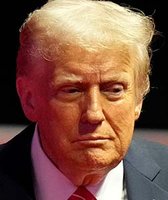
President Donald Trump dances to music after speaking at the Mount Airy Casino Resort in Mount Pocono, Pa., on Dec. 9, 2025. (AP)

For the first time in months, President Donald Trump held a campaign-style rally, traveling to a Mount Pocono, Pennsylvania, casino to talk about the economy amid growing consumer concerns about affordability that Trump has tried to paint as a hoax and a Democratic issue.
In his roughly 100-minute speech, he talked about his love of the word "tariff" and zeroed in on the "fake news" reporters covering the event. At times, supporters chanted "four more years," although experts have told PolitiFact another Trump candidacy would violate the 22nd Amendment’s clear intent.
Trump’s Dec. 9 comments touched on other high-profile recent topics. As Minnesota is in the news for a fraud scandal involving Somalis, he attacked Rep. Ilhan Omar, D-Minn., who is Somali, saying she "does nothing but bitch. She's always complaining." The crowd responded, "Send her back." Omar is a U.S. citizen, as are the majority of Somalis in Minnesota.
And amid his recent focus on former President Joe Biden’s use of an autopen, Trump mused about whether Federal Reserve Board members appointed by his predecessor were serving illegally. There’s no way to nullify presidential actions signed by autopens, legal experts say.
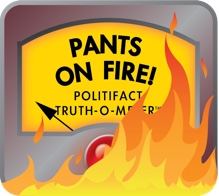
Trump also repeated his Pants on Fire claim that every strike on a "narcoterrorist" boat in the Caribbean saves 25,000 American lives.
We fact-checked several of Trump’s statements about the economy.
Trump: The U.S. is "right around $18 trillion" in promises of new investment. "We could hit $20 trillion in the first year" of my presidency.
Trump has said that since he took office in January, the U.S. has attracted between $18 trillion and $22 trillion in new investment. But the White House website documents a smaller number — $9.6 trillion — and the investments listed on the website include aspirational, multi-year goals that may not come to fruition and future purchases or sales of products, rather than only capital investments.
In Pennsylvania, Trump also said, "I went to Saudi Arabia, Qatar and (the United Arab Emirates). I brought back $4 trillion." These commitments are among the highest-dollar commitments on the White House list, but the list cites $3.2 trillion, lower than what Trump said, and that number still requires a major caveat. The Qatar and the UAE commitments are multiple times larger than their countries’ annual gross domestic product, which calls the pledges’ feasibility into question.
Trump: "It was just reported that four states had $1.99 a gallon" for gasoline.
This cherry-picks a small number of gas stations in three states.
The current national average gasoline price is $3.07 per gallon, according to the federal government’s Energy Information Administration. The American Automobile Association said the states with the lowest average statewide gasoline prices are Oklahoma at $2.38, Texas at $2.49, Arkansas at $2.52 and Colorado at $2.53.
According to Patrick De Haan of the gasoline price comparison site Gas Buddy, Oklahoma, Colorado and Texas have a few dozen stations with prices below $1.99 a gallon. These are a fraction of all U.S. stations, which number well over 100,000.
Trump: "Our prices are coming down tremendously from the highest prices in the history of our country."
This is misleading.
Overall inflation on Trump’s watch is right where it started. According to the Bureau of Labor Statistics’ consumer price index, year-over-year inflation in January 2025, when he took office, was 3%, and in the most recent month available, September, it was also 3%. (The government shutdown delayed more recent inflation data.)
When using the inflation rate minus food and energy, the rate has declined modestly. This rate was 3% year over year in September, lower than the 3.3% rate in January 2025. Economists sometimes prefer this measurement because it smooths out the price volatility in the food and energy sectors.
Trump’s statement about the highest prices in U.S. history is inaccurate in two ways.
The highest year-over-year inflation rate under Biden was around 9% in summer 2022. That was the highest in about 40 years, but the record-high U.S. inflation rates were recorded in the 1970s and early 1980s, when the inflation rate often hovered between 12% and 15%.
In addition, Trump ignores that during the final two-plus years of Biden’s tenure, inflation fell significantly. By Biden’s final full month in office, December 2024, the year over year inflation rate was 2.9%, meaning it fell by about two-thirds from its Biden-era peak and was slightly lower than the most recent rate recorded under Trump.
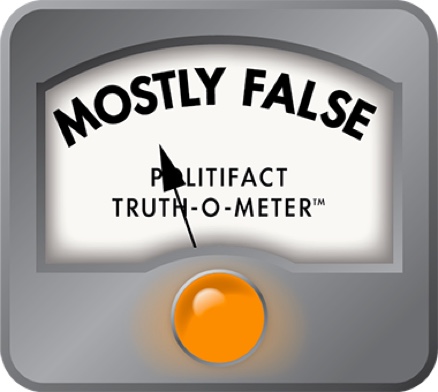
Trump: The One Big Beautiful Bill Act in 2025 enacted the "biggest tax cuts ever."
This is Mostly False.
We examined the tax revenue decreases from major laws passed since 1980. (Most tax laws prior to 1980 either raised taxes or cut them modestly.) We looked at tax cuts as a percentage of gross domestic product, which evens out differences over time.
President Ronald Reagan signed the 1981 law with the biggest tax savings. That law cut taxes by 3.5% of the nation’s cumulative five-year GDP.
A 2012 bill passed by the Republican Congress and signed by President Barack Obama ranked second. That bill, which cut taxes by 1.7% of GDP, extended the tax cuts passed in 2003 under President George W. Bush.
Based on initial projections, Trump’s 2025 law ranks third at 1.4% of GDP. Trump’s 2017 law ranks fourth at 1%, tied with a 2010 law Obama signed that extended Bush’s 2001 tax cuts.
However, the bottom-line impact on Americans’ tax liabilities beginning in 2026 might not be dramatic as these rankings suggest, because the 2025 bill extended the cuts from Trump’s 2017 bill, which would have expired otherwise. So people are already paying the lower tax rates and won’t necessarily see additional tax cuts.
The 2025 law adds some new tax breaks, such as for income from tips and overtime and for Americans 65 and older.
If considering only the new tax cuts and not the renewal of the 2017 tax cuts, then Trump’s 2025 law would tie for sixth biggest cut ever at 0.5% of GDP.
Trump: The Big Beautiful BIll Act included a provision for "no tax on Social Security for our great seniors."
This is Mostly False.
Because of a procedural quirk, Republican lawmakers were unable to include a complete elimination of taxes on Social Security benefits when crafting the legislation. Instead, the House and Senate agreed to workarounds that produced significant, but not full, overlap between people who would benefit from the tax break and people who receive Social Security payments.
A representative from the Joint Committee on Taxation, the bipartisan body of Congress that analyzes proposed tax legislation, estimated that 24 million Americans could still pay some amount of tax on their Social Security benefits.
Trump: Under Biden, "migrant workers and illegal aliens got 100%" of new jobs, "but since I took office, 100% of all net job creation has gone to American citizens."
This needs context.
The number of native-born Americans working since he took office in January has risen by 2.58 million, a 2% increase. During that same period, the number of foreign-born workers has decreased by 1 million, a 3.1% decline. (A caveat: The data for these two statistics tends to be what economists call "noisy," because unlike other employment statistics, these metrics are not seasonally adjusted.)
The problem with Trump’s statement is attributing the foreign-born employment data only to "migrant workers and illegal aliens." There is no statistical category for "migrant" or "illegal alien" employment. The available statistics for "foreign born" includes large numbers of naturalized U.S. citizens, permanent residents and other immigrants legally in the U.S.
Our Sources
Sources linked in article
Browse the Truth-O-Meter
More by Louis Jacobson