Stand up for the facts!

Our only agenda is to publish the truth so you can be an informed participant in democracy.
We need your help.

More Info

I would like to contribute

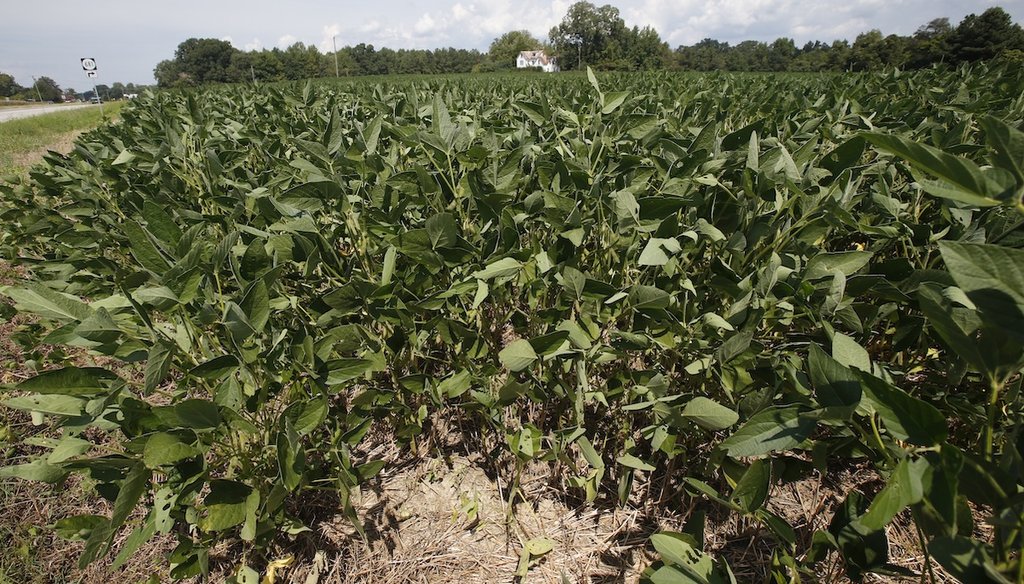
Soybean plants are pictured in fields in front of a farm house in Locust Hill, Va., Sept. 7, 2018. (AP) Soybean plants are pictured in fields in front of a farm house in Locust Hill, Va., Sept. 7, 2018. (AP)

Soybean plants are pictured in fields in front of a farm house in Locust Hill, Va., Sept. 7, 2018. (AP)

Amy Sherman
By Amy Sherman December 16, 2025

If Your Time is short

PolitiFact names 2025 the Year of the Lies, and this is one story of our multipart series. Read more.

In November, all of Randy Richards’ soybeans remained in storage on the land he farms just outside of Hope, North Dakota.

In 2024 and 2023 and many years before, that was not the case. Richards would have sold at least half of his soybeans to a local grain elevator and then, his crop might have ended up transported by train to the Pacific northwest and shipped to China, along with at least half of North Dakota’s soybeans.

What was typical for Richards and other farmers blew up in 2025 with Trump's tariff strategy and subsequent trade war.

Richards, one of the family members who runs Richards & Judisch Farms, rents land to grow soybeans, corn and other crops. A third-generation, 71-year-old farmer, Richards has worked the land since he was a young child.
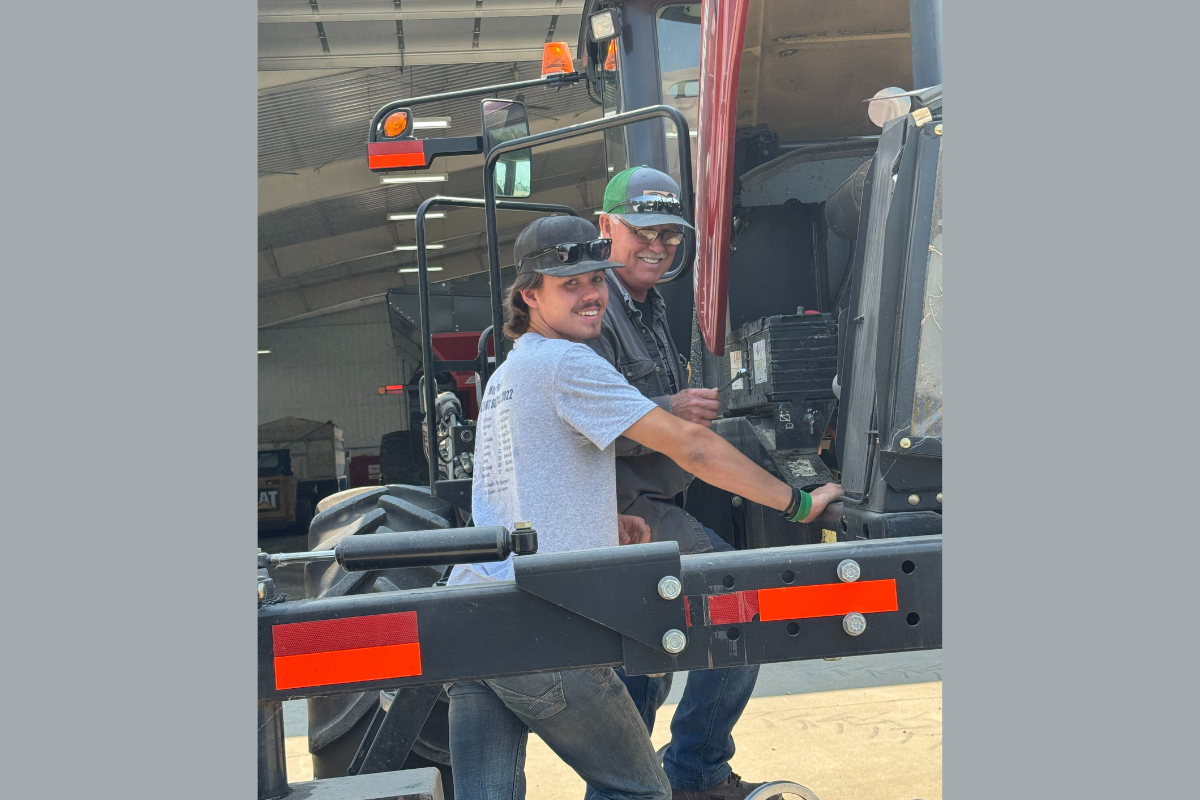
Randy Richards, right, and his grandson. (Photo courtesy of Richards family)

In January, when Trump took office, soybean prices in the Northern Plains, which includes North Dakota, stood at $9.50 per bushel, said Shawn Arita, a North Dakota State University agribusiness expert and former U.S. Department of Agriculture economist. After Trump levied tariffs on China — the largest market for U.S. soybeans — soybean prices tanked, crashing below $8.50 per bushel in the Northern Plains in early September. 

Today, soybean prices are $10.10 per bushel, Arita said. It costs U.S. farmers more than $12 per bushel, on average, to grow them.

China retaliated against Trump’s tariffs and bought soybeans from Argentina and Brazil instead. That was particularly painful because farmers have long relied on international trade: Roughly 20% of all U.S. agricultural production is exported.

"Those sales are often what make the difference between profit and loss at the farm level," Faith Parum, an American Farm Bureau Federation economist, wrote in October. Parum wrote that soybean markets became "the clearest signal of stress in U.S. agricultural trade."

Soybean farmers across the Midwest found themselves in limbo. 

As of November, "Most all of my neighbors that I know of in my area here in Hope, their soybeans are in their bins," Richards said. "Nobody sold any because the price isn't very good."

Ian Sheldon, an Ohio State University agricultural trade expert, said when China stopped importing U.S. soybeans in May, it put downward pressure on U.S. soybean prices. 

Trump has falsely said tariffs are paid by foreign countries, including in his inaugural speech, when he said the U.S. will "tariff and tax foreign countries to enrich our citizens" and "massive amounts of money (will pour) into our treasury coming from foreign sources."

His insistence that foreign governments are paying the tariffs is not how it works. U.S. businesses pay import taxes to the federal government. In the past, foreign companies sometimes lowered their prices to absorb some of the tariffs. But studies showed that during the first Trump administration, tariffs "were passed almost entirely through to US firms or final consumers," the Tax Foundation concluded

We asked the White House for evidence that foreign countries are paying the tariffs rather than U.S. importers.

Spokesperson Kush Desai said, "The Administration has consistently maintained that the cost of tariffs will ultimately be borne by the foreign exporters who rely on access to the American economy, the world’s biggest and best consumer market. If Americans were solely paying the price of tariffs, foreign countries would not have rushed to the table to strike trade deals to reduce their tariff rates and industry titans would not have committed to investing trillions in American manufacturing."

In the lead-up to April 2 — what Trump called "Liberation Day," when he rolled out "reciprocal" tariffs with countries that have trade imbalances with the U.S. — Trump appealed directly to U.S. farmers.

"To the Great Farmers of the United States: Get ready to start making a lot of agricultural product to be sold INSIDE of the United States," he wrote March 3 on Truth Social. "Tariffs will go on external product on April 2nd. Have fun!" 

The next day, Caleb Ragland, American Soybean Association president and a Kentucky soy farmer, said, "Tariffs are not something to take lightly and 'have fun' with." Ragland said he voted for Trump in 2016, 2020 and 2024.

Commerce Secretary Howard Lutnick said in April on CNBC that because of the tariffs, "I expect most countries to start to really examine their trade policy towards the United States of America, and stop picking on us." 

Instead, China stopped purchasing U.S. soybeans in May and didn’t resume until October.

A few days after "Liberation Day," Agriculture Secretary Brooke Rollins said on CNN, "We are unleashing a new golden age, and we will see an economy that will benefit not just every corner of America, but our farmers and our ranchers and the people that have been left behind for far too long by both Republicans and Democrats."

Farm groups didn’t see it that way. They pleaded with Trump to secure a trade deal with China and with congressional leaders to "educate the White House on production agriculture." 

American Farm Bureau Federation President Zippy Duvall said on "Liberation Day" that Trump’s tariffs would drive up supply costs, and retaliatory tariffs from other nations would put American farmers at a disadvantage in the global market. He said tariffs threaten farmers’ competitiveness in the short term and also could cause long-term losses in market share. 

Trump’s tariffs are not solely responsible for farmers’ challenges. In recent years, they have faced rising costs for essential items such as fertilizer. And in North Dakota, where Richards farms, June storms significantly damaged crops and farm buildings.

As his soybeans sit in storage, Richards said he and other farmers are "waiting and hoping and praying" that agreements Trump said have been negotiated will improve the outlook.

Richards farms land less than a mile from the city of Hope, home to about 300 people. Sometimes in tough times, he said he tells people, "I live just beyond Hope." 

"There is always hope in Hope. It's really being strained now."

Economists: U.S. companies and consumers pay first

Besides the soybean price crash, Richards has felt the tariff pinch in other ways.

Every purchase this year was more expensive, he said. The bearing for his combine used to harvest crops. The steel shovels for his digger. The new tire for a tractor.

Other farmers are feeling the strain. Farm production expenses are expected to rise by $12 billion this year compared with last year, the American Soybean Association wrote in December.

"Farmers are facing elevated prices for land, machinery, seeds, pesticides and fertilizers," the association wrote.

Virtually all economists, citing years of data, say much of the cost of tariffs is passed on to consumers through higher prices.

According to the Budget Lab at Yale, the effect of this year’s U.S. tariffs and foreign retaliation placed a 16.8% overall average effective tariff rate on consumers, the highest in 90 years.

The tariffs represent a $1,700 loss for the average U.S. household, the lab said. Researchers arrived at the figure based on a projected 1.2% increase in consumer prices from tariffs and assuming that it is passed on to consumers. 

Uncertainty looms for farmers

Farmers paid close attention in October, when Trump said he had struck a trade deal with China. 

The White House said China would suspend retaliatory tariffs. China also agreed to purchase at least 12 million metric tons of U.S. soybeans during the last two months of 2025 and at least 25 million metric tons in each of 2026, 2027 and 2028. CNBC News reported Dec. 9, citing NBC News analysis, that China’s purchases have fallen well short of the 2025 goal. 

Before the 2018 trade war, Arita said, China purchased 30 to 36 million metric tons a year.

After Trump’s announcement, soybean futures climbed above $11.50 per bushel — the highest level in more than a year — reflecting improved export prospects, Arita said. Futures prices are not a guarantee that farmers will receive that amount, though. 

"Our Farmers will be very happy!" Trump wrote. "In fact, as I said once before during my first Administration, Farmers should immediately go out and buy more land and larger tractors."

The president’s comments, Richards said, are "as far from the truth as you can get." 

Many farmers are struggling with cash flow, based on land rent payments and rising input costs. 

A November survey of agricultural economists by the publication Farm Journal found that 41% said farmers are delaying decisions because of uncertainty. 

Jackson Takach, chief economist for Federal Agricultural Mortgage Corporation, known as Farmer Mac, told Farm Journal the economic stress is highest in parts of the country where soybeans are farmers’ No. 1 crop.

When the Trump administration said Dec. 8 it will provide $12 billion in relief funding to farmers, officials blamed former President Joe Biden and not the current administration’s tariffs.

Rollins told reporters, "There is almost zero evidence, if any evidence" that farms’ economic challenges have "anything to do with these trade renegotiations."

Scott Lincicome, a Cato Institute international trade expert, said Rollins is "totally wrong."

"Chinese purchases of soybeans effectively stopped when Trump's trade wars started," he said. The combination of lower U.S. crop prices as a result of tariffs and increased costs to farmers from tariffs on things they purchase caused what Lincicome called a "government-grown" crisis.

The federal relief will cover only a fraction of the losses. North Dakota State University’s Agricultural Risk Policy Center estimated crop losses at $44 billion.

The U.S. government said it expects to pay farmers by the end of February. 

Richards wishes it wasn’t necessary.

"Do I want a government check?" Richards said. "Hell no. I want my money to come from the market, coming from somebody giving me a fair price for my product."

PolitiFact Researcher Caryn Baird contributed to this article.

READ MORE: What to make of an abysmal year for truth? PolitiFact names 2025 the Year of the Lies

READ MORE: Year of the Lies: How Trump’s talk about Tylenol, autism and vaccines affected one pediatrician

READ MORE: Year of the Lies: ‘Worst of the worst’? ICE deports brothers after years of check-ins, good conduct

Sign Up For Our Weekly Newsletter

Our Sources

National Association of State Departments of Agriculture, Coalition letter emphasizing the necessity for a trade policy that supports the growth of American agriculture, April 1, 2025

North Dakota Farmers Union, Watne calls on Congressional delegation to act, Oct. 24, 2025

American Soybean Association, "Tariffs Are Not ‘Fun’ & Farmers Are Frustrated," March 4, 2025

American Soybean Association, Soybeans Without a Buyer: The Export Gap Hurting U.S. Farms, Aug. 20, 2025

American Soybean Association, ASA Responds to Argentina Soybean Actions, Sept. 24, 2025

American Soybean Association, The Rising Cost Squeeze: Soybean Farmers Face a Third Year of Losses, Dec. 3, 2025

The Free Press, I’m a Soybean Farmer Who Voted for Trump. I’m Begging the President to End the Trade War. April 10, 2025

Farm Bureau, Additional Tariffs will Take Toll on America’s Farmers, April 2, 2025

Farm Bureau, Agricultural Trade: China Steps Back from U.S. Soybeans, Oct. 2, 2025

North Dakota State University, NDSU Agricultural Trade Monitor, November 2025

The Budget Lab at Yale, State of U.S. Tariffs, Nov. 17, 2025

Tax Foundation, Who Pays Tariffs? Americans Will Bear the Costs of the Next Trade War, Feb. 19, 2025

Tax Foundation, Trump Tariffs: Tracking the Economic Impact of the Trump Trade War, Dec. 1, 2025

Tax Policy Center, Tracking the Trump Tariffs, Dec. 11, 2025

Cato Institute, Trump’s Tariff War Is Leaving Ohio Farmers in the Red and China in Driver’s Seat, Nov. 18, 2025

Roll Call, Speech: Donald Trump Holds a Campaign Rally in Mosinee, Wisconsin, Sept. 7, 2024

Roll Call, Speech: Donald Trump Delivers His Inaugural Address at the U.S. Capitol, Jan. 20, 2025

Roll Call, Remarks: Donald Trump Holds a Bilateral Lunch with Anthony Albanese of Australia, Oct. 20, 2025

Roll Call, Remarks: Donald Trump Announces Deals to Lower Some Prescription Drug Prices, Nov. 6, 2025

Roll Call, Press Briefing: Brooke Rollins Speaks to Reporters Outside the White House, Dec. 8, 2025

President Donald Trump, Truth Social post, March 3, 2025

President Donald Trump, Truth Social post, Oct. 30, 2025

White House, Fact Sheet: President Donald J. Trump Strikes Deal on Economic and Trade Relations with China, Nov. 1, 2025

U.S. Department of Agriculture, Trump Administration Announces $12 Billion Farmer Bridge Payments for American Farmers Impacted by Unfair Market Disruptions, Dec. 8, 2025

City of Hope, North Dakota, Website, Accessed Nov. 26, 2025

CNN State of the Union, Transcript, April 6, 2025

Valley News Live, VNL's Cream of the Crop: Richards & Judisch Farms, Jun. 20, 2023 

Farm Journal, USDA Signals Possible Trade Aid Soon, Economists Warn It Could Keep Input Prices High, Nov. 25, 2025

Farm Journal, From Harvest to Hardship: Farmers Struggle With Cash-Flow Crunch, Dec. 10, 2025

Politico, Senate rejects Trump’s global tariffs, the final vote in a series of rebukes, Oct. 30, 2025

Reuters, China to buy 12 million metric tons of US soybeans this season, Bessent says, Oct. 30, 2025

Reuters, ​​China's largest US soybean buy in 2 years buoys prices, triggers sales by struggling farmers, Nov. 21, 2025

CNBC, Agriculture Secretary Rollins on affordability: Americans will see real relief ‘very, very soon’ Nov. 24, 2025

CNBC, Watch CNBC’s full interview with Treasury Secretary Scott Bessent, Nov. 25, 2025

CNBC, China is buying U.S. soybeans again — but falling short of goal set by Trump trade agreement, Dec. 9, 2025

Investigate Midwest, GRAPHIC: Trump support grew in America’s top farming counties despite first-term trade war, Nov. 13, 2024

Investigate Midwest, US farmers face $44 billion in losses as costs rise and markets shrink, Oct. 28, 2025

Politico, Soybeans sacrificed in Trump’s China gamble, Sept. 28, 2025

CNN, Fact check: Trump and Vance keep falsely describing how tariffs work, Sept. 9, 2024

CNN, Fact check: Trump falsely claims he warned Americans during his campaign of a tariff 'transition period' May 1, 2025

Cato Institute, America’s Latest Farmer Crisis Is Government-Grown, Sept. 10, 2025

Washington Post The Fact Checker, The false things Trump said about tariffs during his announcement, April 3, 2025

Factcheck.org, Recapping Trump’s Deceptive Tariff Claims, Aug. 13, 2025

PolitiFact, Fact-checks about trade, 2025

PolitiFact, Trump blows past 60% tariff promise on China, setting 145% rate, April 11, 2025

Telephone interview, Randy Richards, farmer in North Dakota, Nov. 21, 2025

Email interview, Shawn Arita, associate director and associate research professor

Agricultural Risk Policy Center, North Dakota State University, Nov. 20, 2025

Email interview, Scott Lincicome, vice president of general economics and Cato’s Herbert A. Stiefel Center for Trade Policy Studies, Dec. 9, 2025

Email interview, Ian Sheldon, professor and Andersons Chair of Agricultural Marketing, Trade and Policy, Dec. 12, 2025

Email interview, Kush Desai, White House spokesperson, Dec. 14, 2025

Browse the Truth-O-Meter

More by Amy Sherman

Year of the Lies: Farmer says some Trump tariff statements ‘as far from the truth as you can get’