Get PolitiFact in your inbox.

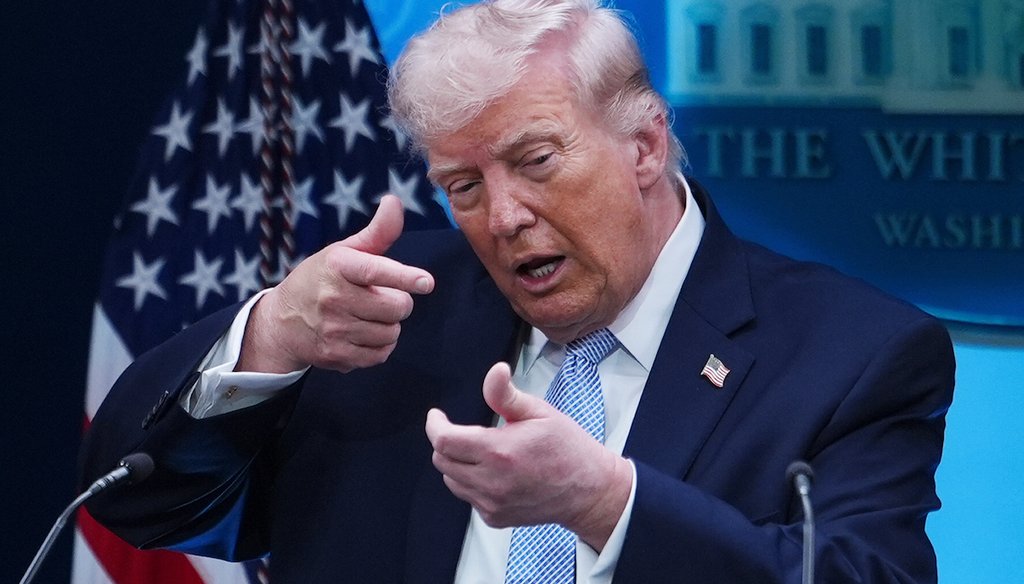
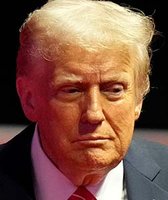
President Donald Trump pretends to aim a sniper gun while speaking with reporters in the James Brady Press Briefing Room at the White House, April 6, 2026, in Washington. (AP)



President Donald Trump praised the rescue of two U.S. service members and declared victory in the war with Iran, while also threatening to take out the country’s civilian infrastructure if the countries don’t reach a deal by April 7 that includes reopening the Strait of Hormuz.
Trump said April 6 at the White House that the U.S. has a plan in which "every bridge in Iran will be decimated by 12 o'clock tomorrow night (and) every power plant in Iran will be out of business, burning, exploding and never to be used again." He added: "We don’t want that to happen."
Trump skirted a question about whether such a strike would violate the Geneva Conventions. Bombing civilian infrastructure typically amounts to a war crime under international law.
We fact-checked two statements by Trump about Iran’s air-defense capabilities and what he once wrote about Osama bin Laden before the 9/11 terrorist attacks.
Trump says Iran has "no anti-aircraft weaponry," days after dual air attacks
Trump said Iran is "at the weakest point they've ever been. They have no navy, they have no air force, they have no anti-aircraft weaponry, they have no radar. They have no communication."
Trump and Defense Secretary Pete Hegseth have said this many times, but it appears at odds with the fact that Iran shot down two U.S. military aircraft — an F-15E fighter jet and an A-10 attack plane — in separate incidents in Iran between April 2 and 3.
Both crew members of the F-15E, which crashed inside Iran, were rescued. The A-10 pilot navigated the damaged plane to Kuwaiti airspace before ejecting and was subsequently rescued.
Two U.S. Black Hawk helicopters involved in search and rescue efforts were also struck by Iranian fire, NBC News reported. The service members were unharmed, U.S. officials said.
White House spokesperson Anna Kelly told PolitiFact in an email that "Iranian ballistic missile and drone attacks are down 90%, their navy is wiped out, two-thirds of their production facilities are damaged or destroyed, and the United States and Israel have overwhelming air dominance over Iran." She did not answer our questions about how Iran was able to shoot down the two U.S. aircrafts if it had no anti-aircraft weaponry.
On April 4, Iran’s military said it used a new air defense system to target U.S. aircraft, Time Magazine reported. "The enemy should know that we will achieve the complete control of the sky of our country with new air defence systems built by the young scientists and proud youth of this country," a spokesperson for Iran’s Khatam al-Anbiya joint military command said on Iranian state media.
Israel said it destroyed most of Iran’s Russian-made S-300 missile system during its June 2025 attack, and both the U.S. and Israel spent the beginning of the current war bombing the country’s air defenses.
Iran has hidden some of its arsenal underground to preserve its capabilities, and while some underground bunkers may appear damaged, Iran has been able to dig out launchers and fire them again.
Iran also may have access to the Third Khordad surface-to-air missile systems, experts told The New York Times, which can be based on trucks and are easily moved and concealed.
"Make no mistake, there still are select surface-to-air missile systems that can work. Plus (man-portable air-defense systems), those shoulder-launched missiles that if you’re flying at a low enough altitude could still pose a threat," Behnam Ben Taleblu, senior director of the Iran program at the Foundation for Defense of Democracies, a hawkish think tank, told Fox News on April 3.
Michael O’Hanlon, director of foreign policy research at the Brookings Institution, told PolitiFact that Tableau’s explanation was plausible. "The simplest interpretation is that President Trump was referring to radar-guided surface-to-air missiles, not shoulder-launched, man-portable, infrared-guided, low altitude interceptors," he said.
Iran entered a multi-million dollar arms deal with Russia to acquire thousands of shoulder-fired missiles capable of targeting low-flying planes and drones. Russia has also supplied Iran with intelligence on the locations of U.S. warships, aircraft and other military assets, according to news reports.
"Iran doesn't need sophisticated missile defenses to hit low flying planes," said Barbara Slavin, a fellow at the Stimson Center, a foreign-policy think tank.
Trump says his book called for killing Osama bin Laden before 9/11
While speaking about his first-term actions on Iran, including the military strike that killed Iranian Gen. Qassem Soleimani, Trump brought up bin Laden.
"If you read my book, I said you gotta take him out, one year before the World Trade Center came down," Trump said.
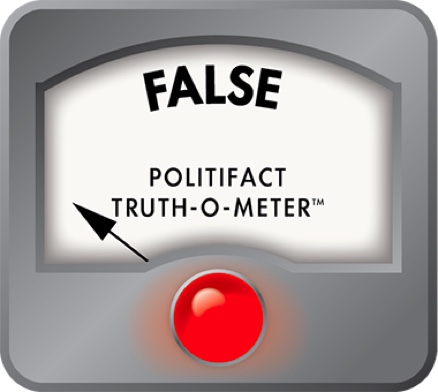
Trump has repeated versions of this misleading statement for a decade. But he didn’t warn in his book that the U.S. should kill bin Laden.
Bin Laden is mentioned once in Trump’s 2000 book, "The America We Deserve," specifically in a passage criticizing former President Bill Clinton’s approach to national security. Trump wrote that the U.S. isn’t "playing the chess game to end all chess games anymore. We’re playing tournament chess — one master against many rivals. One day we’re assured that Iraq is under control, the UN inspectors have done their work, everything’s fine, not to worry. The next day the bombing begins."
The book continues: "One day we’re told that a shadowy figure named Osama bin Laden is public enemy number one, and U.S. jet fighters lay waste to his camp in Afghanistan. He escapes back under some rock, and a few news cycles later, it’s on to a new enemy and a new crisis."
Trump’s reference to bin Laden relates to the Aug. 20, 1998, U.S. bombing of his terrorist training camps in Afghanistan and Sudan. Clinton said it was retaliation for terrorist bombings earlier that month on U.S. embassies in Kenya and Tanzania.
Trump devoted a chapter in his book to terrorism and warned broadly that America could be attacked, but he did not call for taking out bin Laden. He wrote that the U.S. "must prepare for the real possibility that somewhere, sometime, a weapon of mass destruction will be carried into a major American city and detonated."
RELATED: Is it a war crime to bomb civilian infrastructure, as Donald Trump has threatened?
Our Sources
C-SPAN, President Trump Holds News Conference After U.S. Airmen Rescued in Iran, April 6, 2026
Truth Social, President Donald Trump post, April 5, 2026
PolitiFact, Again, Trump boasted that he called to take out Osama bin Laden in 2000. He didn’t, Oct. 28, 2019
ABC News, 'No air defenses': Trump, Hegseth touted American dominance in Iran before jet was downed, April 3, 2026
NBC News, U.S. fighter jet downed over Iran, one pilot rescued, official says, Updated April 4, 2026
X.com, Behnam Ben Taleblu interview with Fox News, April 3, 2026
Time Magazine, Trump Claimed Total Control of Iran's Airspace. Then Two Warplanes Were Downed, April 4, 2026
Financial Times, Iran agreed to secret shoulder-fired missile deal with Russia, Feb. 22, 2026
The New York Times, Iran’s Defenses Have Been Struck, but They Can Still Fire Back, Updated April 5, 2026
The New York Times, Iran Is Quickly Repairing Missile Bunkers, U.S. Intelligence Says, April 3, 2026
The Washington Post, Russia is providing Iran intelligence to target U.S. forces, officials say, March 6, 2026
Email interview with Barbara Slavin, fellow at the Stimson Center, a foreign-policy think tank, April 6, 2026
Email interview with Michael O’Hanlon, director of research in foreign policy at the Brookings Institution, April 6, 2026
White House, statement to PolitiFact, April 6, 2026
Browse the Truth-O-Meter
More by Louis Jacobson