Get PolitiFact in your inbox.

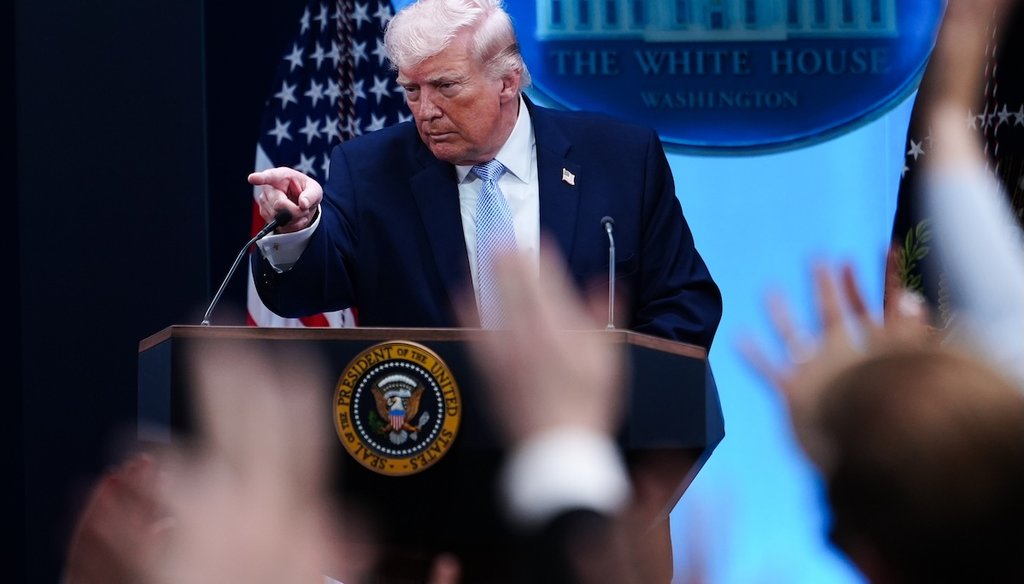
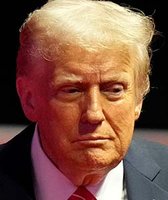
President Donald Trump speaks with reporters in the James Brady Press Briefing Room at the White House, April 6, 2026, in Washington. (AP)


President Donald Trump expressed support for the Iranian people while also threatening to wipe them out.
"A whole civilization will die tonight, never to be brought back again," Trump posted April 7 on Truth Social, 12 hours before his deadline for Iran to make a deal or face a massive attack on civilian infrastructure.
Trump concluded his post: "God Bless the Great People of Iran!"
His statement was one of many examples of times he has contradicted himself on the objectives and strategy for the war the U.S. and Israel launched Feb. 28. Here are five contradictions.
War won or war ongoing?
Over the last month, Trump has repeatedly said the U.S. won the war while U.S. military action continued.
On Air Force One on March 7, Trump told reporters, "We're winning the war by a lot. We've decimated their whole evil empire. It'll continue, I'm sure, for a little while."
Days later at a Kentucky rally, Trump said the U.S. won "in the first hour." He also said, "We got to finish the job, right?"
On March 15, when asked if he was ready to officially declare victory against Iran, Trump said "no" and, "They're decimated … But I'm still not declaring it over."
On Easter Sunday, Trump wrote on Truth Social that April 8 "will be Power Plant Day, and Bridge Day, all wrapped up in one, in Iran. There will be nothing like it!!! Open the F—--’ Strait, you crazy bastards, or you’ll be living in Hell - JUST WATCH!"
But at a press conference the next day, he again said the U.S. had already achieved victory. "We won, OK? They are militarily defeated."
RELATED: Trump's press conference: Fact-checking what he said on Iran’s air defenses, his bin Laden warning
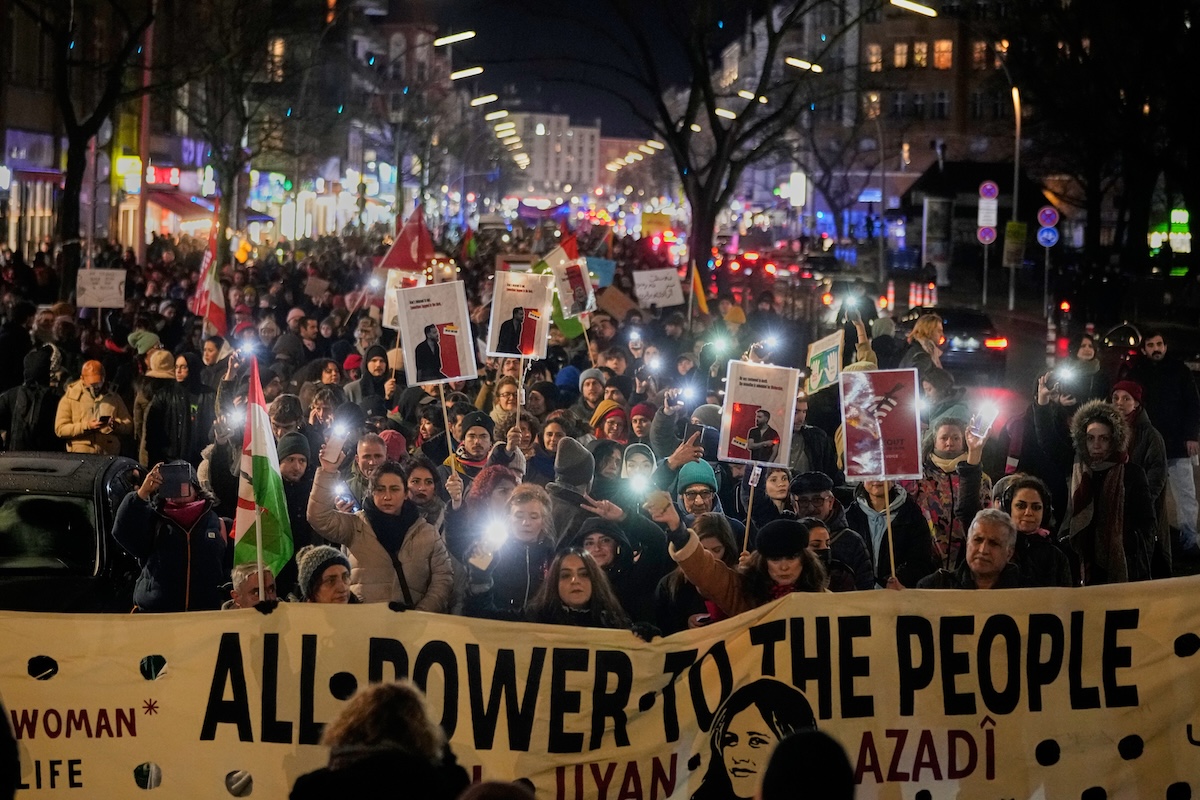
People take part in a rally in support of anti-government protests in Iran, Berlin Germany, June 14, 2026. (AP)
Supporting people of Iran but also threatening them
Trump has often said he backs the Iranian people.
In January, he warned Iran that if its government killed peaceful protesters, the U.S. would come to protesters’ rescue.
In his first remarks after the initial U.S.-Israel attack, Trump said the Iranian regime had recently killed tens of thousands of protesters. He addressed the people of Iran: "When we are finished, take over your government. It will be yours to take. This will be probably your only chance for generations."
At an April 6 press conference, a reporter asked Trump whether delivering on his threat to destroy infrastructure would end up punishing the Iranian people for the regime’s actions.
Trump said the Iranian people "would be willing to suffer that in order to have freedom." He said numerous messages intercepted from Iranians said "please keep bombing."
After consistently expressing support for Iranians, Trump then issued a dire warning April 7.
"A whole civilization will die tonight, never to be brought back again. I don’t want that to happen, but it probably will," he posted on Truth Social. "However, now that we have Complete and Total Regime Change, where different, smarter, and less radicalized minds prevail, maybe something revolutionarily wonderful can happen, WHO KNOWS? We will find out tonight, one of the most important moments in the long and complex history of the World. 47 years of extortion, corruption, and death, will finally end. God Bless the Great People of Iran!"
We asked the White House how that message squared with Trump’s stated support for the Iranian people.
"The Iranian regime has until 8PM Eastern Time to meet the moment and make a deal with the United States. Only the President knows where things stand and what he will do," press secretary Karoline Leavitt said in an email.
Asking other countries to help reopen Strait of Hormuz, and saying help is not needed
Trump repeatedly called on allies to support the U.S. in reopening the Strait of Hormuz.
The narrow passage of water that connects the Persian Gulf and the Gulf of Oman is the primary route Middle Eastern countries use to ship crude oil and petroleum products from the Persian Gulf to the rest of the world. About one-fifth of the world’s crude oil supply flows through the strait which is largely at a standstill amid the fighting.
Most of the oil the U.S. imports does not come from the strait. Therefore, Trump has insisted, "We don't need it."
"And the countries of the world that do receive oil through the Hormuz Strait must take care of that passage," Trump said during an April 1 prime time address to the nation. He added, "Go to the strait and just take it, protect it, use it for yourselves."
At the same time, Trump has offered assurances that the U.S. alone will secure the strait and does not require the help of any other country.
"Did we need them?" Trump said during a March 26 cabinet meeting. "No. I never thought we needed them. I was more doing a test."
RELATED: Ask PolitiFact: What is the Strait of Hormuz and how does it affect oil prices?
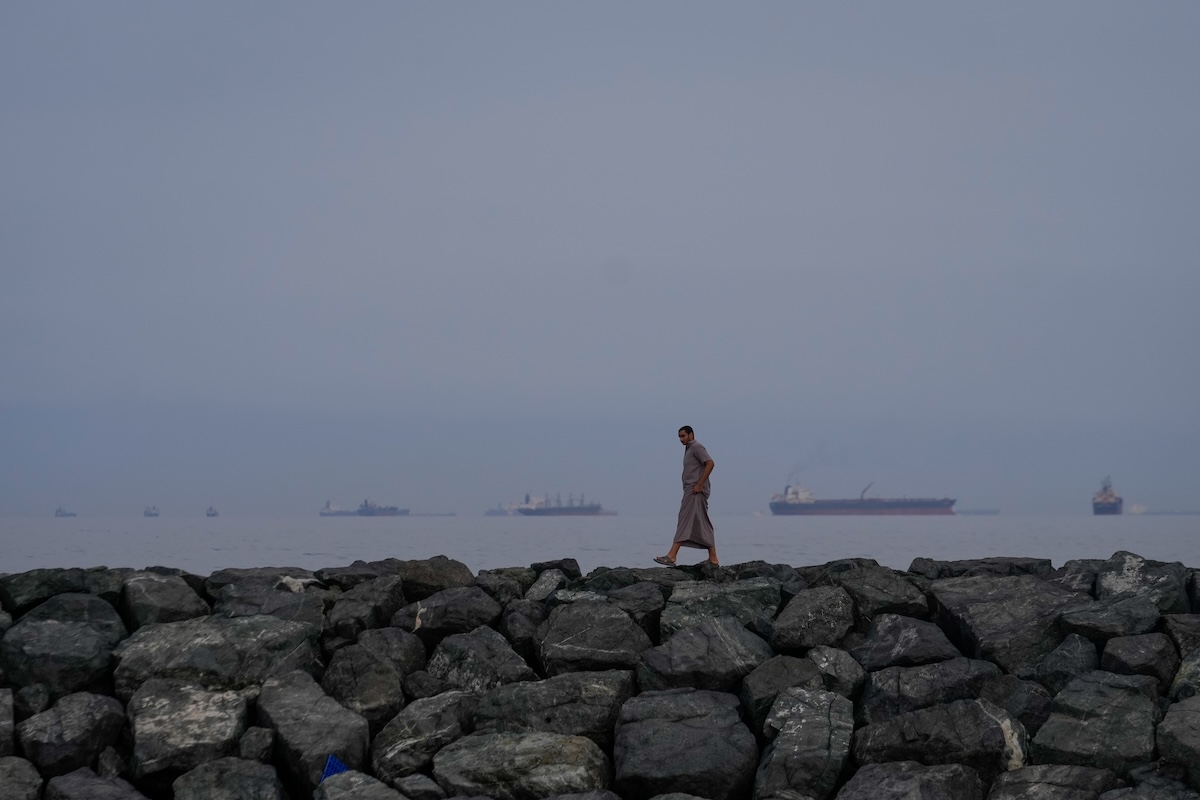
A man walks along the shore as oil tankers and cargo ships line up in the Strait of Hormuz, as seen from Khor Fakkan, United Arab Emirates on March 11, 2026. (AP)
Saying war will end when Strait of Hormuz reopens, then saying it will open naturally at war’s end
Trump has repeatedly threatened Iran with mass destruction and devastation if it does not reopen the Strait of Hormuz.
"If Iran doesn’t FULLY OPEN, WITHOUT THREAT, the Strait of Hormuz, within 48 HOURS from this exact point in time, the United States of America will hit and obliterate their various POWER PLANTS, STARTING WITH THE BIGGEST ONE FIRST!," Trump wrote on Truth Social on March 21.
He’s pushed back his deadlines several times, but ramped up the threats.
On April 1, he wrote on Truth Social that the U.S. would not consider a ceasefire until the "Hormuz Strait is open, free, and clear."
He has also signaled that the strait’s opening may not be required for the war to end.
"The hard part is done, so it should be easy," Trump said during the April 1 address. "And, in any event, when this conflict is over, the strait will open up naturally. It'll just open up naturally."
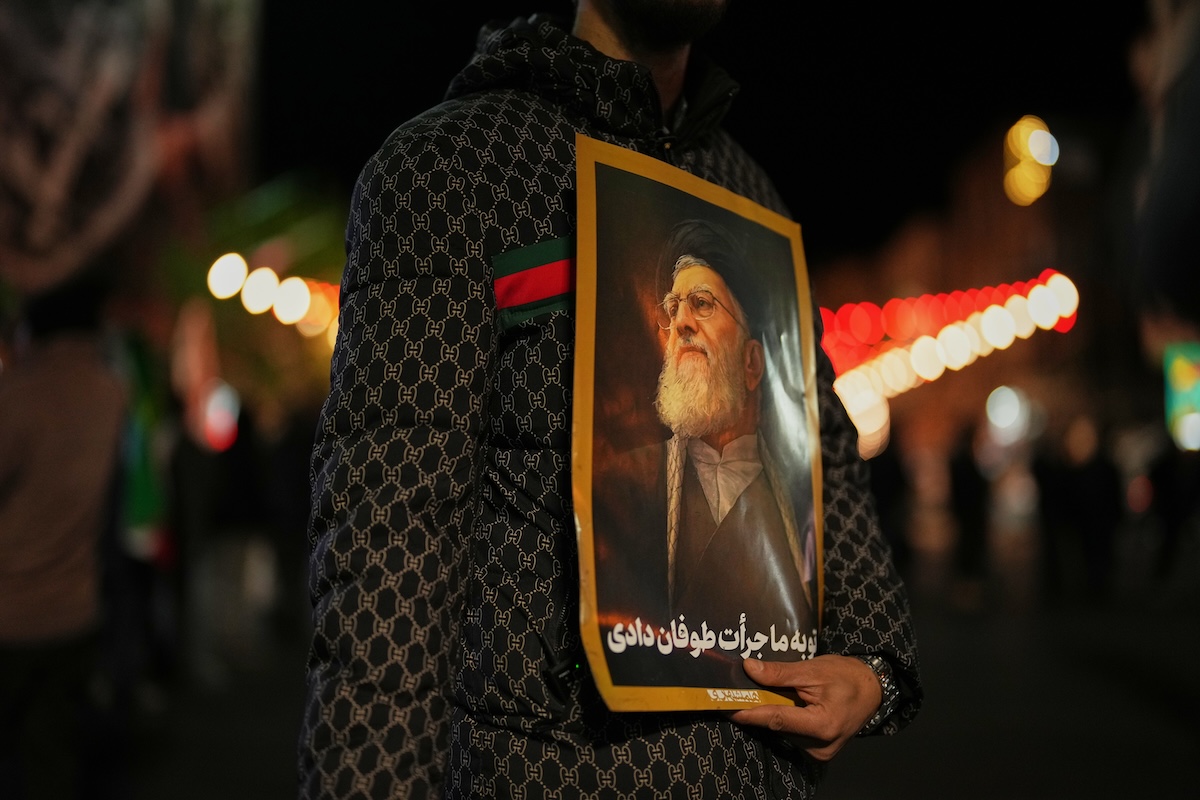
A man holds a picture of the late Iran's Supreme Leader Ayatollah Ali Khamenei during a pro-government gathering in a square in Tehran, Iran, April 5, 2026. (AP)
Opposing U.S.-forced regime change verses touting it in Iran
Trump has changed his rhetoric about U.S. involvement in foreign regime change.
In 2016 while campaigning, Trump called for abandoning what he said was a failed policy of regime change.
In 2024, he said it was not the U.S. military's role "to wage endless regime change, wars."
After the U.S. struck Iran’s nuclear sites in 2025, Trump floated the idea of regime change in a Truth Social post, but when asked about it later he took a dim view, saying regime change creates chaos.
Trump repeatedly said in March that regime change had occurred in Iran.
Aboard Air Force One on March 29, Trump said, "We've had regime change, if you look already, because the one regime was decimated, destroyed. They're all dead. The next regime is mostly dead. And the third regime, we're dealing with different people than anybody's dealt with before."
But his April 7 Truth Social post takes aim at the longstanding regime.
In it, Trump vowed that "47 years of extortion, corruption, and death, will finally end."
RELATED: Is it a war crime to bomb civilian infrastructure, as Donald Trump has threatened?
RELATED: Following Trump’s Iran social media post, could the 25th Amendment be invoked against him?
Our Sources
President Donald Trump, Truth Social, April 7, 2026
President Donald Trump, Truth Social, April 5, 2026
President Donald Trump, Truth Social, April 1, 2026
President Donald Trump, Truth Social, March 21, 2026
President Donald Trump, Truth Social, Jan. 2, 2026
Roll Call, Press Conference: Donald Trump Holds a Press Conference at the White House, April 6, 2026
Roll Call, Remarks: Donald Trump Signs an Executive Order on Elections, March 31, 2026
Roll Call, Press Gaggle: Donald Trump Speaks to Reporters On Board Air Force One, March 7, 2026
Roll Call, Remarks: Donald Trump Meets with Oil and Gas Executives at the White House, Jan. 9, 2026
Fox News, A timeline of Trump’s escalating deadlines on Iran and the Strait of Hormuz, April 7, 2026
PBS News, 3 times Trump has given Iran deadlines and then delayed them, April 7, 2026
PolitiFact, Trump, Hegseth say US has accomplished regime change in Iran. Has it? April 1, 2026
PolitiFact, How long will the Iran war last? See Trump’s timeline shift, March 30, 2026
PolitiFact, Trump criticized regime change as 'reckless' policy for years. Now he wants it in Iran. March 3, 2026
PolitiFact, Ask PolitiFact: What is the Strait of Hormuz and how does it affect oil prices?, March 11, 2026
Email interview, Karoline Leavitt, White House press secretary, April 7, 2026