Stand up for the facts!
Our only agenda is to publish the truth so you can be an informed participant in democracy.
We need your help.
I would like to contribute

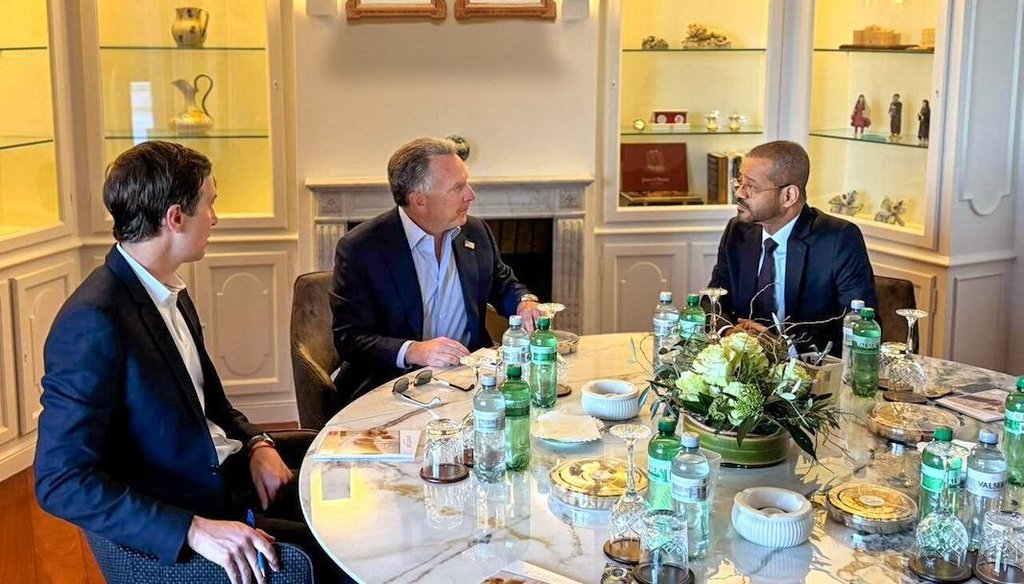
Oman's Minister of Foreign Affairs Sayyid Badr bin Hamad Al Busaidi, right, meets with White House special envoy Steve Witkoff, center, and Jared Kushner, as part of Iranian-American negotiations, in Geneva, Switzerland, Feb 26, 2026. (AP)

If Your Time is short
-
Trump administration envoy Steve Witkoff and Iranian negotiators met Feb. 26 in Geneva, Switzerland, to reach a deal about Iran’s nuclear program.
-
President Donald Trump said in June the U.S. had "obliterated" three Iranian nuclear sites. But in November, the White House tweaked that language, saying the strikes "significantly degraded Iran’s nuclear program."
-
Public information is sparse about the status of Iran’s current nuclear program.
As President Donald Trump considers a military strike on Iran, his envoy Steve Witkoff said Iran is on track to quickly have material needed to produce a nuclear bomb.
"They are probably a week away from having industrial grade bomb making material, and that's really dangerous," Witkoff told Fox News’ Lara Trump, the president’s daughter-in-law, Feb. 21.
Trump said Feb. 19 he was giving Iran 10 days to reach a deal on Iran’s nuclear program. The Trump administration has amassed military power, including ships and aircraft, in the region for potential military action.
Witkoff and Iranian negotiators met Feb. 26 in Geneva, Switzerland, to continue talks that began earlier in the month.
In June 2025, Trump said the U.S. strikes that month had "obliterated" Iran’s nuclear program when it hit three sites, a comment he repeated during his Feb. 24 State of the Union address. But in November, the White House used softer language, saying Operation Midnight Hammer "significantly degraded Iran’s nuclear program."
When PolitiFact asked the White House to square Trump’s remarks about obliteration with Witkoff’s comment about Iran being a week away from having bomb making material, the White House referred us to press secretary Karoline Leavitt’s Feb. 24 remarks.
Leavitt said the June operation "did in fact obliterate Iran's nuclear facilities," however, "That does not mean that Iran may never try again to establish a nuclear program."
Witkoff’s comments portray the status of Iran’s nuclear program as settled. It isn’t. There is still a lot of uncertainty, including about the extent of the program’s destruction, its supply of uranium and Iran’s desire to pursue enrichment.
The International Atomic Energy Agency, which tracks Iran’s nuclear program, has been unable to access the sites the U.S. bombed. In 2018, Trump withdrew from the Iran nuclear deal, which had allowed monitoring of the country’s nuclear program. This means experts lack confirmed, independent information about the status of Iran’s efforts.
What are the obstacles for Iran to produce a nuclear bomb?
Enriching uranium is the first step in building a nuclear bomb, which also requires a delivery vehicle such as a ballistic missile. Centrifuges are the machines used to enrich uranium.
Brendan Green, a University of Cincinnati associate professor and expert on nuclear strategy, said Witkoff is operating under the assumption that Iran’s enriched uranium was not destroyed by Operation Midnight Hammer. Iran would also need a sufficient number of centrifuges to enrich uranium.
"Public information about both of these key premises is totally sparse," Green said in an email. "I think that a one week estimate is reasonable IF the preconditions of having the uranium and the centrifuges are met. I do not know if those have been met."
Before June, Iran had accumulated a significant amount of highly enriched uranium, said Michael Singh, a managing director at The Washington Institute for Near East Policy.
Using the centrifuges Iran operated in the past, it would take just a few days to enrich one bomb’s worth of that highly enriched uranium to "weapons-grade."
"This is likely where Witkoff’s one-week timeline comes from," Singh said.
However, experts don’t know how much of that highly enriched uranium Iran has access to because most was likely buried under rubble.
Singh said as far as he knows, Iran is not currently operating any centrifuges and thus cannot further enrich uranium.
"However, we can be relatively sure that Iran has centrifuges hidden somewhere that likely were not struck in the June attacks," Singh said. The International Atomic Energy Agency has limited visibility into Iran’s centrifuge production activities.
Joseph Rodgers, an expert on nuclear issues at the Center for Strategic and International Studies, said satellite imagery suggests that two of the three sites the U.S. struck in June have resumed operations.
"These strikes, coupled with Israeli targeted assassinations of Iranian nuclear scientists and Israeli strikes on the Arak reactor, dealt a significant blow to Iran’s nuclear enterprise," Rodgers said. The Arak reactor is a heavy water reactor in Iran.
Daryl Kimball, executive director of the Arms Control Association, said it would take Iran years to fully rebuild the enrichment plants hit in June and "most likely take months — not a week — for Iran to enrich small amounts of uranium to bomb-grade … and to process it into enough metal for a single weapon."
David Albright, a former United Nations weapons inspector and president of the Institute for Science and International Security, which analyzes nuclear issues, told The Wall Street Journal Iran’s program has stalled.
"Viewing the satellite imagery and monitoring the Iranian nuclear sites, we don’t see any evidence that they are trying to reconstitute their nuclear-weapons program," Albright said. "They are essentially on hold."
Politicians and experts have predicted timelines about Iran’s nuclear program for decades
In 1992, Benjamin Netanyahu, then a member of Israel’s Knesset, said Iran was three to five years from producing a nuclear weapon.
In 2022, during the Biden administration, a State Department official estimated that Iran needed as little as one week to produce enough weapons-grade uranium for one nuclear weapon. A May 2025 Defense Intelligence Agency assessment gave a similar timeframe.
Shawn Rostker, a research analyst at the Center for Arms Control and Non-Proliferation, said he is skeptical of Witkoff’s "week away" statement.
"While Iran has enriched uranium beyond what is needed for civilian purposes, any precise breakout timeline is murky and highly assumption-based, and we don’t have high confidence in estimates like that right now," Rostker said. "The more important issue is not arguing over speculative timelines, but urgently pursuing serious diplomacy to reduce risks and keep this crisis from spiraling further."
RELATED: Ask PolitiFact: What was the Iran nuclear deal and why did Trump drop out?
RELATED: Ask PolitiFact: Was Iran ‘weeks away’ from having a nuclear weapon, as Trump said?
Our Sources
Fox News, Witkoff warns Iran is ‘a week away’ from 'bomb-making material' as Trump weighs action, Feb. 22, 2026
White House, National Security Strategy, November 2025
C-SPAN, White House Press Secretary Remarks to Reporters, Feb. 24, 2026
Congressional Research Service, Iran and Nuclear Weapons Production, June 24, 2025
Council on Foreign Relations, What Are Iran’s Nuclear and Missile Capabilities? Feb. 6, 2026
CNN Wire, Trump said Iran's nuclear program was 'obliterated.' So why is he looking to strike again? Feb. 24, 2026
CNN, Exclusive: Early US intel assessment suggests strikes on Iran did not destroy nuclear sites, sources say, Feb. 25, 2026
CBS, Iran nuclear material "still there, in large quantities," IAEA chief says, calling for urgent deal with U.S. Feb. 19, 2026
AP, Trump administration hits Iran with new sanctions as nuclear talks near, Feb. 24, 2026
UPI, ''Ayatollah'' bomb in production for Iran, April 24, 1984
Institute for Science and International Security, Iran Threat Geiger Counter: A Probabilistic Approach; What is the probability that Iran will build nuclear weapons? Feb. 20, 2026
The Center for Iranian Studies, Netanyahu's nuclear gamble: The risks of escalation with Iran, March 27, 2025
TF1Info, EXCLUSIVE - Rafael Grossi on LCI: "Most of Iran's nuclear material is still where it was," Feb. 18, 2026
Oman foreign minister Badr Albusaidi, X post, Feb. 26, 2026
Associated Press, Iran’s Arak heavy water reactor, hit by an Israeli airstrike, was part of Tehran’s nuclear deal, June 19, 2025
Wall Street Journal, White House Says Iran Is Close to Weapons-Grade Nuclear Material. Experts Say No. Feb. 25, 2026
PolitiFact, Too soon for final ruling on nuclear Iran, but progress is being made, Oct. 18, 2013
Email interview, Daryl G. Kimball, executive director, Arms Control Association, Feb. 25, 2026
Email interview, Joseph Rodgers, deputy director and fellow, Center for Strategic and International Studies, Feb. 19 and 25, 2026
Email interview, Michael Singh, managing director, The Washington Institute for Near East Policy, Feb. 25, 2026
Email interview, Eliana Johns, senior research association, Federation of American Scientists, Feb. 25, 2026
Email interview, Shawn Rostker, research analyst at the Center for Arms Control and Non-Proliferation, Feb. 25, 2026
Email interview, Brendan Green, University of Cincinnati associate professor, Feb. 25, 2026