Get PolitiFact in your inbox.

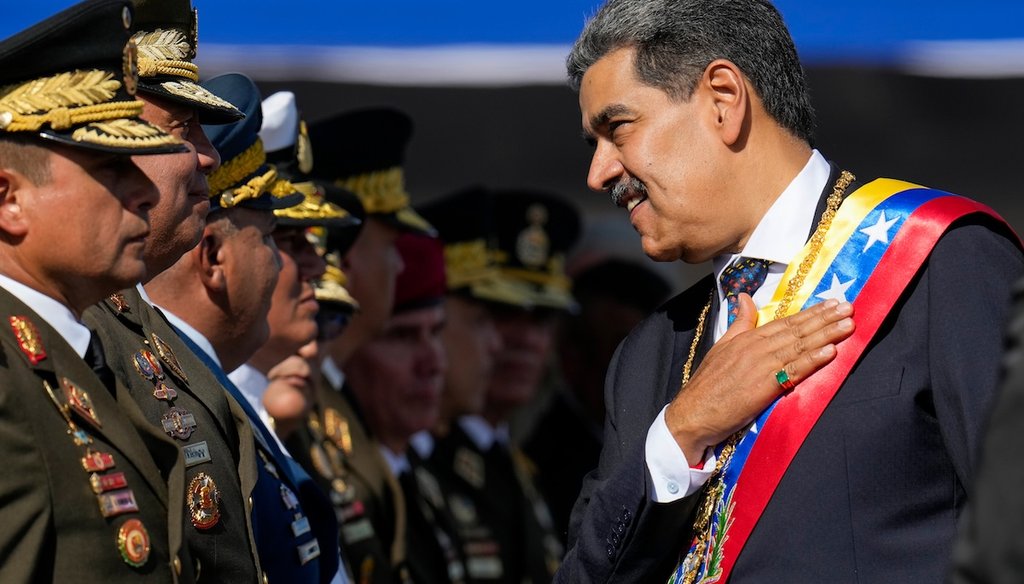
Venezuela's President Nicolás Maduro places his hand over his heart while talking to high-ranking officers during a military ceremony on his inauguration day for a third term, in Caracas, Venezuela, Jan. 10, 2025. (AP)
Ousted Venezuelan leader Nicolás Maduro and his wife Cilia Flores pled not guilty to drug trafficking charges Jan. 5 in New York federal court.
"I’m innocent. I am not guilty. I am a decent man, the president of my country," Maduro told the judge.
U.S. troops captured Maduro and Flores at their home in Caracas, Venezuela, in the early hours of Jan. 3 and transferred them to the U.S.
The Justice Department first indicted Maduro in 2020 for alleged drug-related actions dating to 1999. A newly unsealed and updated indictment filed in the Southern District of New York charges Maduro and two co-defendants with narcoterrorism conspiracy and he, Flores and the four other co-defendants with cocaine importation conspiracy and possession of machine guns.
The indictment calls Maduro an illegitimate leader who transported cocaine under Venezuelan law enforcement protection, enriching his family and cementing power.
"This cycle of narcotics-based corruption lines the pockets of Venezuelan officials and their families while also benefiting violent narco-terrorists who operate with impunity on Venezuelan soil and who help produce, protect, and transport tons of cocaine to the United States," the indictment says.
In August, the Trump administration offered a $50 million reward for information leading to Maduro’s arrest or conviction.
The U.S. government’s indictment focuses on cocaine and weapons and is silent about other topics Trump has cited to justify pressure on Venezuela in recent months, such as oil and fentanyl.
The case of Manuel Noriega of Panama, whom the U.S. ousted from power to face drug charges 36 years ago, offers some precedent about the U.S. government’s strategy and challenges.
Here’s what to know about the government’s case and what could come next.
Nicolás Maduro and his wife are set to make his first appearance Monday in a U.S. courtroom on the narco-terrorism charges the Trump administration used to justify capturing him. pic.twitter.com/5xvkaCVyoy
— The Associated Press (@AP) January 5, 2026
What does the indictment say Maduro did?
In addition to Maduro and Flores, others named as co-defendants include Minister of the Interior Diosdado Cabello and Maduro's son, Nicolás, who is a member of Venezuela’s National Assembly. Hector Rusthenford Guerrero Flores, the leader of Venezuelan prison gang Tren de Aragua, was added as a codefendant in the indictment.
According to the indictment, Maduro "engaged in a relentless campaign of cocaine trafficking … resulting in the distribution of thousands of tons of cocaine to the United States."
When he was Venezuela's foreign affairs minister, Maduro issued diplomatic passports to known drug traffickers to help with moving drugs from Mexico to Venezuela, the indictment says.
It also says Maduro and his wife accepted hundreds of thousands of dollars in bribes and "ordered kidnappings, beatings, and murders against those who owed them drug money or otherwise undermined their drug trafficking operation."
The indictment focuses on cocaine trafficking and does not mention fentanyl, a potent synthetic opioid responsible for most drug overdose deaths in the U.S. Without evidence, Trump has said the boats his administration has struck off of Venezuela’s coast were carrying fentanyl. However, most illicit fentanyl in the U.S. comes from Mexico.
In his comments about Maduro’s capture, Trump also accused Maduro of stealing and seizing American oil.
"The defense will certainly argue that this is what the case is really about, not drug trafficking," David Oscar Markus, a Miami-based criminal defense attorney, said. "It gives the defense a hook on both pretrial motions and jury arguments."
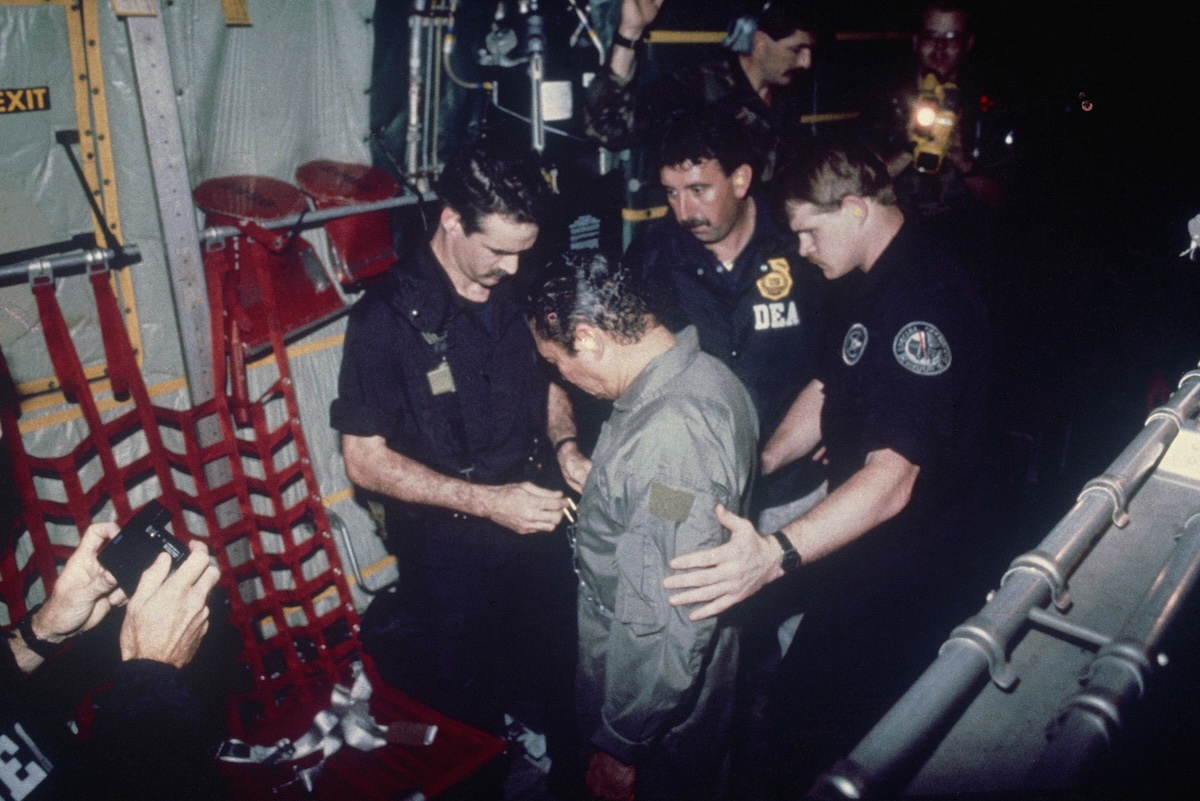
In this Jan. 4, 1990 file photo, Panamanian dictator Manuel Noriega watches as U.S. Drug Enforcement Agents place chains around his waist aboard a C-130 transport plane. (AP)
How can the U.S. indict a foreign leader?
The Trump administration might have relied on a 1989 memo by then Assistant Attorney General William Barr giving the FBI authority to arrest people for violating U.S. law even if it contravenes international law. It was written months before the U.S. invaded Panama to capture Noriega.
In 1989, President George H.W. Bush sent U.S. forces into Panama to seize Noriega, the country’s strongman, after his indictment by a U.S. grand jury on drug-related charges. (Noriega’s status as head of government was contested in Panama, and the U.S. did not recognize his status.)
After turning himself in and being extradited to Florida, Noriega was tried and convicted on eight counts of drug trafficking, money laundering and racketeering. He was sentenced to 40 years in prison.
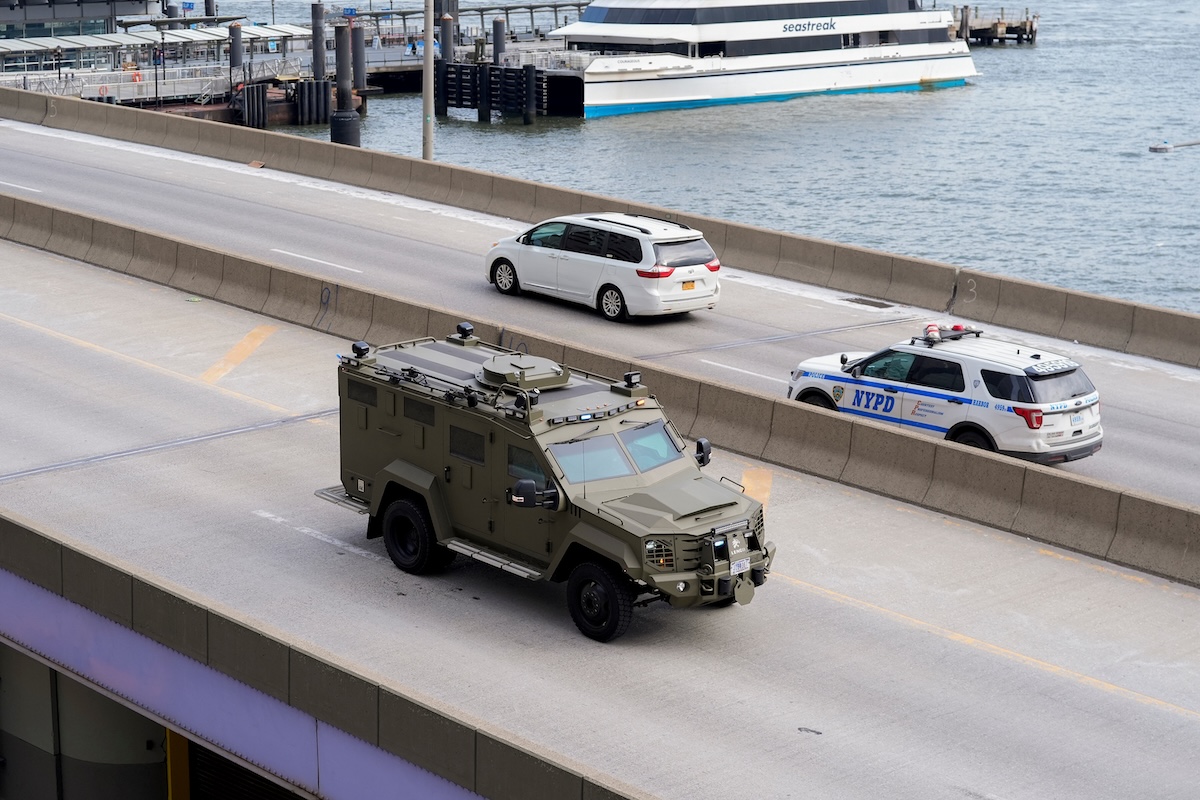
An armored vehicle leaves Manhattan Federal Court where Venezuelan President Nicolás Maduro was arraigned with his wife Cilia Flores, Jan. 5, 2026, in New York. (AP)
What are the biggest challenges prosecutors could face?
Maduro might try to claim "head of state immunity."
Under international law, heads of state are generally entitled to absolute immunity in other nations’ courts, Curtis A. Bradley, University of Chicago law professor, said.
However, the U.S. government doesn’t recognize Maduro as the lawful head of state, so U.S. courts likely would not grant him head of state immunity. U.S. courts tend to defer to the executive branch about whether to confer immunity.
"Sure, he can claim it," said Dick Gregorie, a retired federal prosecutor who indicted Noriega. "Is that going to work? I don’t think so."
An appeals court panel upheld Noriega’s conviction in 1997, dismissing his argument that his position as head of state should have preempted his prosecution.
Even if Maduro’s capture violated international law, it would not be a basis for dismissing prosecution, per the "Ker-Frisbie doctrine" of U.S. law. In 1992, for example, the Supreme Court in United States v. Alvarez-Machain found that a Mexican national’s abduction from his home did not prohibit his U.S. trial.
Jon May, a former Noriega defense attorney, said that prosecutors face a general challenge of relying on witnesses who could have credibility issues.
"The challenge of building a case like this comes down to corroboration," May said.
Gregorie said that the biggest problem in the case will be discovery, which likely includes intelligence information about Maduro and witnesses.
What are the next steps in the prosecution?
Federal Judge Alvin Hellerstein set the next court hearing for March 17. Maduro’s defense attorney is Barry Pollack, who also represented WikiLeaks founder Julian Assange.
Markus predicted that the start of a multi-month trial is at least a year away.
PolitiFact Staff Researcher Caryn Baird contributed to this article.
RELATED: Fact-checking Donald Trump following U.S. attacks on Venezuela and capture of Nicolás Maduro
Our Sources
U.S. District Court Southern District of New York, Maduro indictment, January 2026
State Department, Nicolás Maduro Moros, Aug. 7, 2025
The New York Times, Venezuelan Leader Maduro Is Charged in the U.S. With Drug Trafficking, March 26, 2020
PolitiFact, Tren de Aragua: What we know about the Venezuelan gang Donald Trump promised to deport, Nov. 1, 2024
U.S. Department of Justice, Nicolás Maduro Moros and 14 Current and Former Venezuelan Officials Charged with Narco-Terrorism, Corruption, Drug Trafficking and Other Criminal Charges, March 26, 2020
PolitiFact, Fact-checking Donald Trump: Has each boat strike off the coast of Venezuela saved 25,000 lives?, Oct. 16, 2025
AP, Maduro’s case will revive a legal debate over immunity for foreign leaders tested in Noriega trial, Jan. 4, 2026
Georgetown law professor Steve Vladeck, 200. Five Questions About the Maduro Arrest Operation, Jan. 3, 2026
Assistant Attorney General William Barr, Authority of the Federal Bureau of Investigation To Override International Law In Extraterritorial Law Enforcement Activities, June 21, 1989
Just Security, International Law and the U.S. Military and Law Enforcement Operations in Venezuela, Jan. 5, 2026
U.S. District Court Southern District of Florida, United States v Noriega, June 8, 1990
CNN’s Natasha Bertrand, X post, Jan. 3, 2026
PolitiFact, Trump’s pardon comments omit why former Honduran president Juan Orlando Hernández was prosecuted, Dec. 1, 2025
PolitiFact, The US attacked Venezuelan boats it says are carrying drugs. Is Venezuela sending drugs to the US? Sept. 22, 2025
Email interview, David Oscar Markus, criminal defense lawyer in Miami, Jan. 5, 2026
Email interview, Curtis A. Bradley, University of Chicago Law School professor, Jan. 5, 2026
Email interview, Anthony Clark Arend, Georgetown professor of government and foreign service, Jan. 5, 2026
Telephone interview, Jon May, criminal defense attorney, Jan. 5, 2026
Telephone interview, Dick Gregorie, retired federal prosecutor, Jan. 5, 2026