Stand up for the facts!
Our only agenda is to publish the truth so you can be an informed participant in democracy.
We need your help.
I would like to contribute

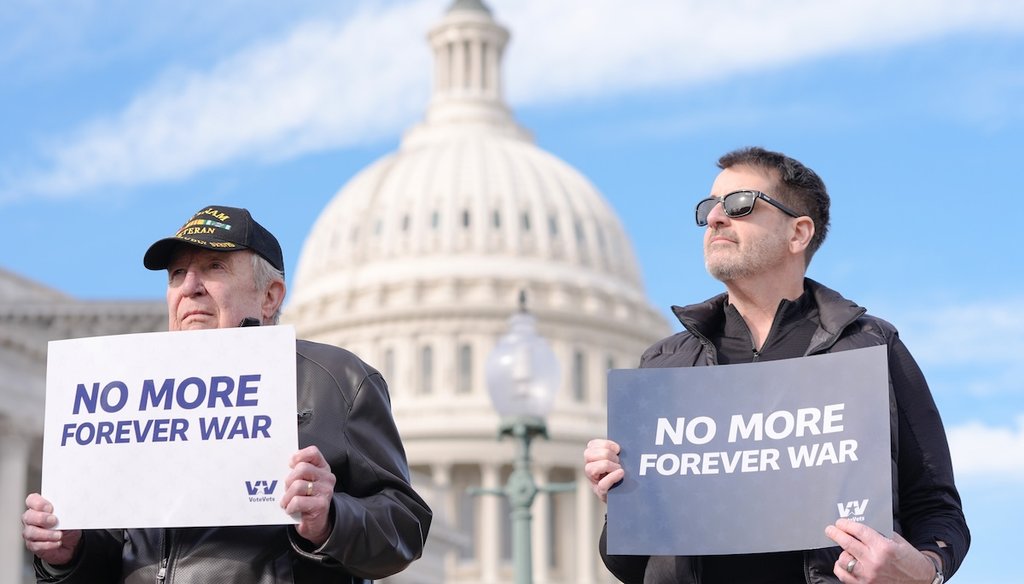
People hold signs during a news conference on the Venezuela War Powers Resolution on Capitol Hill on Jan. 22, 2026. (AP)

U.S. military action has once again prompted some members of Congress to fight the Trump administration over who has the authority to wage war.
On Feb. 28, the U.S. and Israel began a military operation against Iran that killed the country’s supreme leader, Ayatollah Ali Khamenei. The operation is ongoing.
Sen. Tim Kaine, D-Va., who has partnered in recent months with Sen. Rand Paul, R-Ky., to author a war powers resolution on Iran, said shortly after the attacks that he wants the Senate to immediately vote on the measure.
Rep. Ro Khanna, D-Calif., who authored a similar resolution in the House with Rep. Thomas Massie, R-Ky., said March 1 on NBC’s "Meet the Press," that "the point of this resolution is to say we do not want another war in the Middle East, or at least (that) Congress should opine on that."
The House and Senate could vote on the measure as early as March 4.
The odds of either measure succeeding are low. Even if a resolution passed both chambers, President Donald Trump could veto it, and it’s unlikely that both chambers would muster the two-thirds vote required to overturn his veto. No war powers resolution veto has ever been overridden.
"Party loyalty is a powerful force on Capitol Hill, and Republican leaders in the House and Senate will be strongly incentivized to let the Trump White House use military force without congressional approval," Matthew Green, a Catholic University political scientist, told PolitiFact last year.
The issue of waging war could test Trump’s support within his own party. Some high-profile figures within Trump’s MAGA movement — including former Rep. Marjorie Taylor Greene, R-Ga., and commentator Tucker Carlson — opposed an Iran attack. Trump campaigned on keeping the U.S. out of wars.
Khanna predicted on "Meet the Press" that the House vote is "going to be very close."
Overlapping authorities for declaring war
Article I, Section 8 of the U.S. Constitution assigns Congress the right to declare war. But the last time Congress declared war was at the beginning of World War II, when Franklin Roosevelt was president.
Since then, presidents have generally initiated military action using their constitutionally granted powers as commander in chief without an official declaration of war.
In August 1964, President Lyndon B. Johnson asked Congress to back his effort to widen the U.S. role in Vietnam. He received it with enactment of the Tonkin Gulf Resolution, which passed both chambers of Congress, including the Senate, with only two dissenting votes.
As the Vietnam War turned sour, lawmakers became increasingly frustrated at their secondary role in sending U.S. troops abroad. So in 1973, Congress passed the War Powers Resolution, which was enacted over President Richard Nixon’s veto.
The resolution required that, in the absence of a declaration of war, the president must report to Congress within 48 hours of introducing armed forces into hostilities and must terminate the use of U.S. armed forces within 60 days unless Congress permits otherwise. If approval is not granted and the president deems it an emergency, then an additional 30 days are granted for ending operations.
Presidents have not been eager to cede their presidential power to Congress, so they have generally followed the act’s requirements while framing any entreaties to Congress about military force as a voluntary bid to secure "support" for military action — action that’s often under way or planned imminently — rather than "permission."
Authorizations for the use of military force
In recent decades, congressional consent has usually been accomplished by the passage of an "authorization for the use of military force," a legislative vehicle that "has become the modern version of a declaration of war," Mark F. Cancian, a senior adviser at the Center for Strategic and International Studies, a national security think tank, told PolitiFact last year.
Presidents who have received such authorizing legislation include Ronald Reagan (to oversee the handover of the Sinai Peninsula from Israel to Egypt, and separately to participate in a deployment to Lebanon that ended with a suicide attack that killed 241 American service members); George H.W. Bush (to oust Iraq’s Saddam Hussein from Kuwait); Bill Clinton (for military action in Somalia); and George W. Bush (to enter Afghanistan after the 9/11 attacks, and separately to oust Hussein from power in what would become the Iraq War).
The post-9/11 authorization from 2001 is among the most controversial, because presidents of both parties have used its broad wording to support military action against a wide array of targets, using language that approves efforts "to prevent any future acts of international terrorism against the United States."
Almost a quarter century later, the 2001 authorization remains in force, despite being repealed in 2023 by the Senate in a bipartisan 66-30 vote. (The House did not concur.)
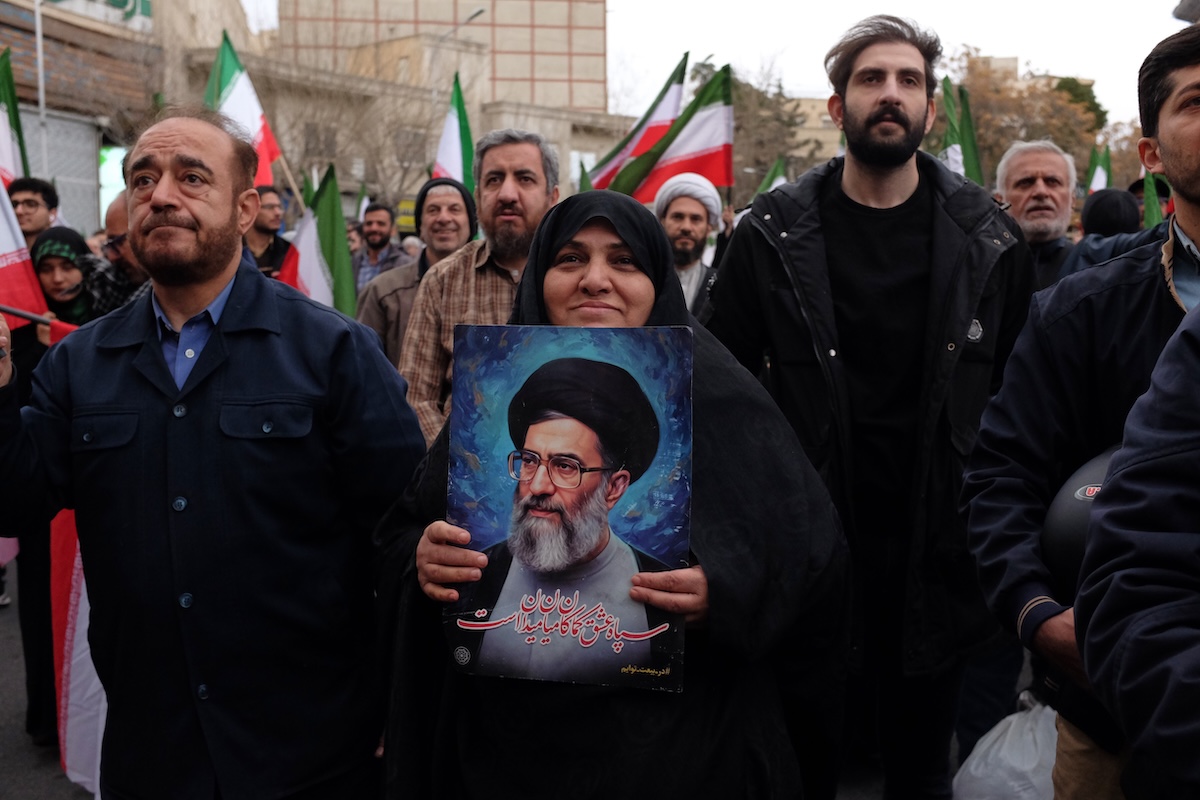
A woman holds a picture of Iranian Supreme Leader Ayatollah Ali Khamenei during a pro-government demonstration against U.S. and Israeli strikes in Tehran, Iran, on Feb. 28, 2026. (AP)
War powers under Trump
During Trump’s first term, Congress passed two resolutions to limit his war powers, although neither had enough votes to overcome Trump’s veto. One, in 2019, was to end U.S. support for Saudi Arabia’s war in Yemen The other, in 2020, was to block further U.S. action after Trump ordered a strike that killed a top Iranian official, Qasem Soleimani. During Trump’s second term, the House and Senate have both been under Republican control.
As a result, Congress hasn’t done much to curb his war powers, and the number of Republicans willing to buck the president over war powers has decreased.
In June 2025, the Senate voted against advancing a war powers resolution on Iran.
A subsequent resolution, on Trump’s decision to use military force to arrest Venezuelan leader Nicolás Maduro, narrowly failed. "This is one of the most dangerous efforts that Trump is undertaking in the second term: trying to normalize war without Congress, trying to normalize the idea that a president can just do whatever they want when it comes to foreign policy," Sen. Andy Kim, D-N.J., told The Washington Post after the Feb. 28 strikes on Iran.
In the run-up to a new vote on an Iran war powers resolution, most Democrats are expected to back it while most Republicans are expected to vote against it.
However, a few members of both parties are either bucking their party or have their votes in play. In the Senate, Democrat John Fetterman of Pennsylvania strongly supports the strikes against Iran, while Republican Rand Paul opposes them. In the House, Democrats Josh Gottheimer of New Jersey, Greg Landsman of Ohio and Jared Moskowitz of Florida have expressed concerns about joining the rest of their party in supporting a resolution. Republican Rep. Warren Davidson of Ohio has been skeptical of a resolution.
Neither chamber is expected to pass a resolution by a veto-proof majority.
"Gang of Eight" briefings
One way in which the most recent strikes against Iran have hewed more closely to historical pattern is in advance notice for members of Congress.
There has been a longstanding precedent of informing the "Gang of Eight" — the top Democrat and Republican in the House and Senate, and the top Republican and Democrat on the chambers’ respective intelligence committees — before undertaking sensitive military action.
Until the most recent attack on Iran, the second Trump administration had not conducted such briefings, including for the June 2025 bombing of Iranian nuclear facilities and the January capture of Maduro. (Before the 2025 Iran bombing, the White House informed only top Republican leaders in Congress before the attack, CNN reported.)
For the Feb. 28 Iran strikes, however, Secretary of State Marco Rubio did meet with the Gang of Eight, hours before Trump’s Feb. 24 State of the Union address, four days before the attack began.
RELATED: Could Iran ‘soon’ hit US with long-range missile? Experts doubt Trump as US bombs Iran.
Our Sources
Sources linked in article.
Browse the Truth-O-Meter
More by Louis Jacobson