Stand up for the facts!
Our only agenda is to publish the truth so you can be an informed participant in democracy.
We need your help.
I would like to contribute

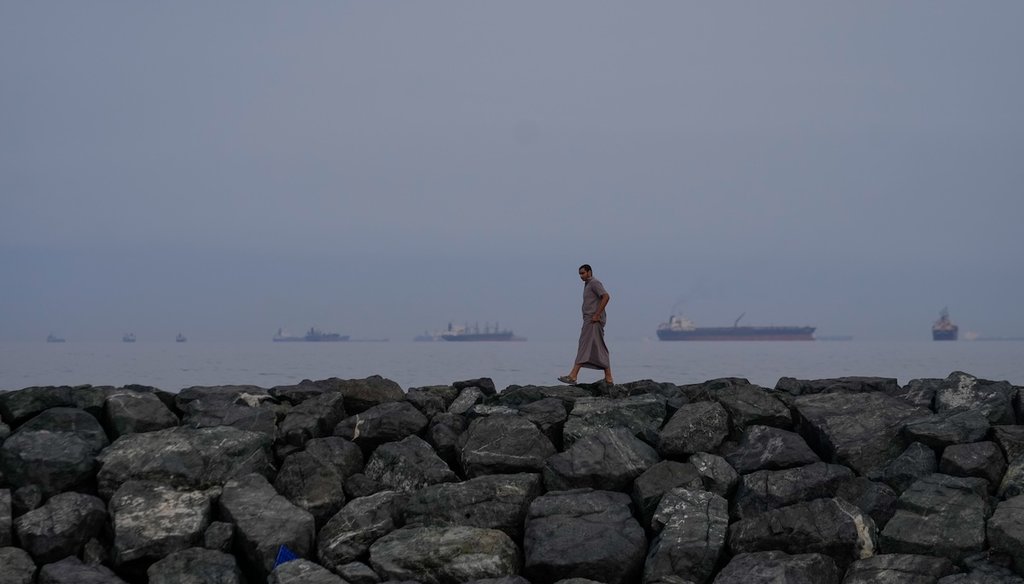
A man walks along the shore as oil tankers and cargo ships line up in the Strait of Hormuz, as seen from Khor Fakkan, United Arab Emirates on March 11, 2026. (AP)


Since the U.S. launched airstrikes on Iran, consumers have watched crude oil and gasoline prices spike.
Between Feb. 27, the day before the strikes began, and March 9, the U.S. price of crude oil — the material that’s refined into gasoline — shot up from $67 a barrel past $90 a barrel, before settling slightly below the $90 mark later in the week.
In turn, gasoline prices rose from about $2.94 a gallon in the days before the war began to $3.60 by March 11.
These price increases worried many Americans who remembered how a gasoline price spike in 2022 following Russia’s invasion of Ukraine helped boost inflation to levels not seen in four decades.
A reader asked PolitiFact several questions about the war and its impact on U.S. consumers. We’ll tackle them here.
How reliant is the U.S. on oil flowing through the Strait of Hormuz? How reliant are other countries?
The Strait of Hormuz is a narrow passage of water that connects the Persian Gulf and the Gulf of Oman. It is 21 miles wide at its narrowest point with a 2-mile wide shipping lane in either direction. It is the primary route Middle Eastern countries use to ship crude oil and petroleum products from the Persian Gulf to the rest of the world.
About one-fifth of the world’s crude oil supply flows through the strait, but it’s at a standstill amid the fighting, with Iran threatening to fire on ships and news reports that the country may be laying mines in the thoroughfare.
By the numbers, the U.S. relies on this oil less than other countries do. The U.S. Energy Information Administration estimated that in 2024, about 84% of it went to Asia, mostly to China, India, Japan and South Korea. The strait’s closure would also affect Middle Eastern oil producers’ ability to get their product to market; Saudi Arabia exports about 40% of the oil that passes through the strait. Qatar, the United Arab Emirates, Kuwait and Iraq also export the majority of their oil through the strait.
But just because the U.S. doesn’t take much of the strait’s oil directly doesn’t mean it won’t be affected. That’s because oil is priced internationally: When the price rises for some, it rises for all.
"When the price of crude goes up, it doesn’t matter if you produce oil or not — the cost of making gasoline goes up and the price at the pump does too," said Severin Borenstein, University of California-Berkeley business administration and public policy professor.
Oil isn’t the only commodity affected. So is liquefied natural gas, which is a big export for Qatar. As U.S. producers fill the gap, prices could eventually rise for U.S. consumers, said Hugh Daigle, University of Texas-Austin associate professor of petroleum and geosystems engineering. "This is also a problem for Europe, as it has become big liquefied natural gas importers since Russia invaded Ukraine."
Middle Eastern nations have alternative routes such as pipelines to get their oil through, but their capacity doesn’t match the strait’s.
Another alternative: When Iran targeted ships in the Strait of Hormuz in the 1980s, the U.S. Navy escorted ships through the passage. That could happen again, but experts said it’s unlikely to return the flow of oil to its usual level.
The cost of a single escort would exceed the value of the cargo it was meant to protect, Jeff Currie of Carlyle, a private-equity firm, told The Economist.
Could the U.S. come to the rescue by producing more oil?
For all the rhetoric among politicians about maximizing U.S. drilling at home, the industry has been cautious about making new drilling investments. Companies want to be assured of prices high enough to maximize their investment returns.
Until the Iran war, crude oil prices were relatively low, making new investments look less appealing. Prices have risen since then. The question is whether they will stay high enough — and for long enough — to convince oil companies that it’s worth shelling out for additional drilling.
Borenstein said the crude oil spot price, or what it costs to buy oil in the short term, has spiked. But futures prices haven’t gone up by nearly as much. That means that the market expects prices to drop significantly from today’s level by a year from now, limiting the appetite for new drilling investments.
"White House announcements that the war is ‘very complete’ or that it will be ‘over soon’ suggest a quick resolution, which is keeping enthusiasm for new drilling down," said Clark Williams-Derry, an oil and gas industry analyst at the Institute for Energy Economics and Financial Analysis.
The Baker-Hughes count of U.S. oil rigs in use, a standard metric for new oil drilling, rose modestly between Feb. 27 and March 6, and the level is 13% below what it was when Trump was sworn in to his second term.
Even if the U.S. were to produce more oil, it still wouldn’t isolate the U.S. from global effects.
Although the U.S. theoretically produces enough crude oil to satisfy its consumption needs, it can’t refine all of the crude oil it produces.
Crude is graded by its weight and its "sweetness," a measure of the oil’s sulfur content. Most U.S.-produced oil is "light" and "sweet," and although some U.S. refineries can process it, many cannot.
These other refineries are built to process heavier, less sweet crude (also called heavy, sour crude) from the Middle East and other overseas suppliers. That’s a holdover from past decades, when the U.S. was primarily importing its crude.
This mismatch keeps the U.S. from simply using its own crude production to serve all its domestic needs. Changing the mix of refineries to accommodate U.S.-produced crude oil would be expensive and take years to complete.
So the U.S. is exporting a lot of its domestically produced crude on the international market, but it still must import a substantial amount of oil for domestic use.
"While the U.S. is a major producer of oil and gas, these are global markets and the U.S. can’t be fully insulated," Rachel Ziemba, the head of Ziemba Insights, a political risk consulting firm, told PolitiFact in early March.
How helpful are oil stockpiles in making up the difference?
Stockpiles can help, to a point.
The oil for the global market that’s being blocked from the strait amounts to about 20 million barrels a day. The International Energy Agency announced March 11 that it is preparing to release 400 million barrels.
Mathematically, this is 20 days’ worth of oil blocked in the strait — but it’s more complicated than that. It will take time to carry out these releases, and it’s unclear whether releasing that much oil would negatively impact the structural integrity of the repositories, which are often underground.
The longer the strait disruption goes, "the harder it gets to replace the lost oil traffic through inventories," Borenstein said.
The United States’ Strategic Petroleum Reserve, which dates from a 1973 and 1974 Middle East oil embargo, has a capacity of more than 700 million barrels, stored in underground salt domes in Louisiana and Texas.
Currently, the reserve holds about 415 million barrels. That’s about equal to 20 days of U.S. demand or about four days of global demand, Daigle said.
Joe Biden oversaw the release of a net 243 million barrels from the reserve during his presidency, much of it responding to price hikes after Russia invaded Ukraine.
Trump promised to refill the reserve "immediately" after taking office, but he’s put back only about 20 million barrels so far, partly for technical reasons. The reserve needs $100 million in repairs before the facility can be fully refilled, Energy Secretary Chris Wright said in April 2025. Studies conducted about a decade ago warned that the reserve facility was reaching or exceeding its expected lifespan, E&E News reported.
"This is exactly the sort of situation the reserve was designed for, but the past few years of low oil prices were a missed opportunity to replenish the reserves after the large drawdown in 2022," Daigle said.
Could access to Venezuelan oil make a difference?
U.S. activities in Venezuela — including the capture of Venezuelan president Nicolas Maduro in January and the seizure of some tankers carrying Venezuelan oil — are likely adding to the world supply in small amounts.
"The oil in the seized Venezuelan tankers totals something in the low tens of millions of barrels," Daigle said. "It’s not nothing, but that’s a day or two of U.S. consumption. Also, Venezuelan crude is typically heavy and sour, so it can only be processed by a subset of global refineries."
There are also questions about the potential for increased output from Venezuela. They involve high up-front costs for building out infrastructure and concerns about the country’s political and economic stability.
What can be done about price gouging?
Currently, 39 states, the District of Columbia and multiple U.S. territories have laws or regulations that prevent price gouging during emergencies and disasters, according to the National Conference of State Legislatures.
Most price-gouging laws require a declaration of a national or statewide emergency; some state laws specify that gasoline prices cannot surge during a "market emergency." No states have declared such emergencies in this war.
States such as California and Alabama cap price increases between 10 to 25%, while others compare what the seller paid for the product with what they charged the consumer to determine whether the consumer was charged an excessive amount.
There is currently no federal price gouging law, despite hundreds of attempts to pass one in Congress in recent decades.
Critics of price-gouging laws have said that setting the price artificially lower than the market rate will lead to shortages and potentially to rationing.
Our Sources
California Legislative Information, Penal Code 396, accessed March 11, 2026
Congress.gov, price gouging search, accessed March 11, 2026
Congress.gov, Price Gouging Prevention Act of 2025, accessed March 11, 2026
Justia U.S. Law, 2024 Code of Alabama, accessed March 11, 2026
U.S. Energy Information Administration, "Amid regional conflict, the Strait of Hormuz remains critical oil chokepoint," June 16, 2025
U.S. Energy Information Administration, "Weekly U.S. Ending Stocks of Crude Oil in SPR," accessed March 11, 2026
National Conference of State Legislatures, "Price Gouging State Statutes," January 21, 2025
Strauss Center, "Strait of Hormuz- Tanker War," accessed March 11, 2026
World O Meter, "Oil Reserves by Country (2025)," accessed March 11, 2026
The American Oil and Gas Reporter, "U.S. Rig Count," accessed March 11, 2026
Google maps, Strait of Hormuz, accessed March 11, 2026
Al Jazeera, "Can Iran really shut down the Strait of Hormuz?," June 23, 2025
CBS News, "Iran signaling it may deploy mines to disrupt Strait of Hormuz, U.S. sources say," March 10, 2026
CBS News, "Strait of Hormuz could be vulnerable to Iran retaliation. Here’s what to know about the vital oil trade route," June 23, 2025
CBS News, "International Energy Agency to release 400 million barrels of oil in move to lower energy prices," March 11, 2026
CNN, "What is the Strait of Hormuz and why is it so significant?" June 23, 2025
E&E News, "Aging caverns imperil Trump push to refill petroleum reserve," June 13, 2025
Reuters, "U.S. lawmakers, officials, Trump, on oil reserve release," Nov. 23, 2021
The Economist, "Donald Trump’s options to cool oil prices are solely limited," March 10, 2026
The Independent, "How Iran’s ‘complete control’ of the Strait of Hormuz is wreaking havoc on the world’s oil and gas supply," March 4, 2026
PolitiFact, "No significant refill yet for Strategic Petroleum Reserve, but new law set to advance Trump’s pledge," July 7, 2025
PolitiFact, "Fact-checking Donald Trump on promised U.S. oil company investment in Venezuela," Jan. 5, 2026
Email interview with Hugh Daigle, associate professor of petroleum and geosystems engineering at the University of Texas-Austin, March 11, 2026
Email interview with Clark Williams-Derry, energy finance analyst at the Institute for Energy Economics and Financial Analysis, March 11, 2026
Interview with Severin Borenstein, professor of business administration and public policy at the University of California-Berkeley Haas School of Business, March 11, 2026
Browse the Truth-O-Meter
More by Louis Jacobson