Get PolitiFact in your inbox.

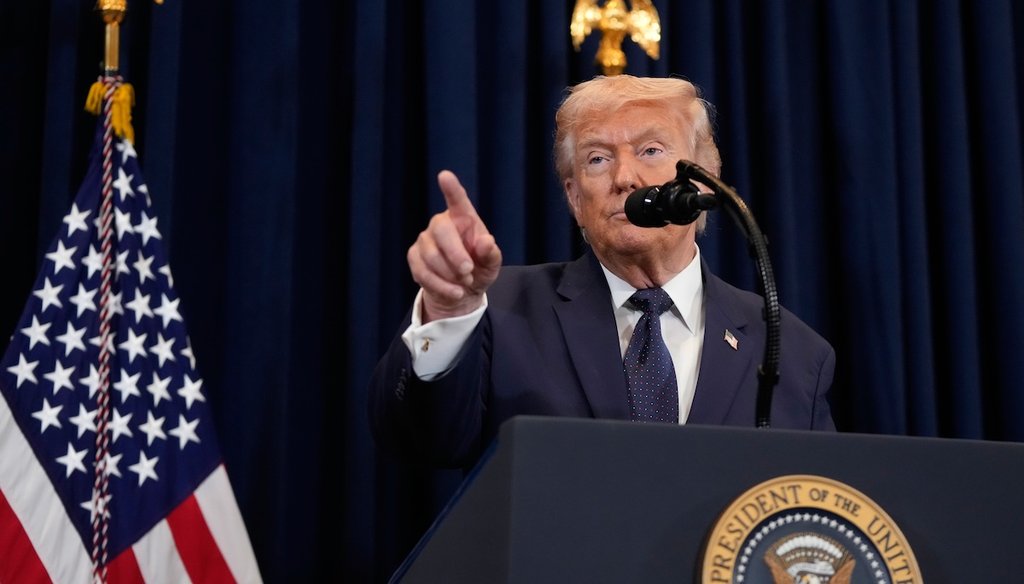
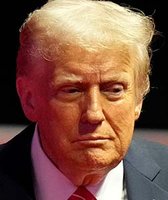
President Donald Trump speaks at a news conference, March 9, 2026, at Trump National Doral Miami in Doral, Fla. (AP)


If Your Time is short
-
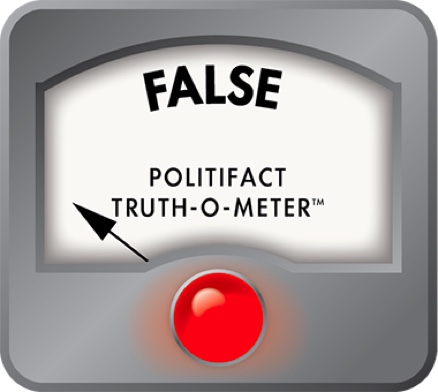
President Donald Trump said Iran was responsible for the missile that struck a girls’ school in the country's southern city of Minab.
-
News researchers and journalists analyzed the attack using open-source information and found evidence that a Tomahawk hit the area around the school. The U.S. is the only country involved in this war that has Tomahawks.
When President Donald Trump said Iran was responsible for the missile strike on a girls’ elementary school, he preempted an ongoing military investigation and contradicted forensic analyses by multiple news outlets.
"In my opinion, based on what I've seen, that was done by Iran," Trump told reporters March 7. "Because they are very inaccurate, as you know, with their munitions. They have no accuracy whatsoever. It was done by Iran."
Defense Secretary Pete Hegseth, who was standing alongside Trump on Air Force One, told reporters, "We're certainly investigating. But the only, the only side that targets civilians is Iran."
When we asked the White House for evidence of Trump’s claim, a spokesperson pointed us to Trump’s subsequent comments that Tomahawks are sold and used by other countries, including Iran.
Iran hasn’t taken responsibility for the attack at the Shajareh Tayyebeh school in the country's southern city of Minab, and government officials for Iran’s health and foreign ministry have blamed the U.S. and Israel.
The U.S. military says it’s investigating the matter. "Whatever the report shows, I’m willing to live with that report," Trump said March 9.
Asked for comment, an official at the Department of Defense’s United States Central Command told PolitiFact, "it would be inappropriate to comment given the incident is under investigation."
Journalists and researchers from Bellingcat, The New York Times, The Associated Press and CNN analyzed satellite images, verified videos and U.S. statements about military positioning and found that the U.S. likely carried out the attack.
"Where things happen that need to be investigated, we will investigate," Hegseth said in a March 10 press conference. "Open source is not the place to determine what did or did not happen."
But experts said open-source intelligence — which is collected from publicly available sources — has become invaluable in surfacing information during conflict, especially when conflicting information arises.
What news organizations’ analyses have found and how they did it
Bellingcat, an investigative collective that partners with news organizations, was the first to analyze footage that shows a Tomahawk missile striking an area adjacent to the girls’ school.
Carlos Gonzales, Bellingcat’s head of research, told PolitiFact his team had been following the situation in Iran since January, when Iranian authorities responded with deadly force to wide anti-government protests. Bellingcat monitored how weapons and armament were building up around the region.
As the strike on the girls’ school drew widespread news coverage, it was challenging to know who was responsible, he said. Bellingcat’s findings were limited by the lack of evidence about the weapon used, until the researchers saw a video released by Iran’s semiofficial Mehr news agency. It showed a Tomahawk, a U.S-made missile that no other nation fighting in the Iran war has.
Japan, the United Kingdom, Australia and the Netherlands also have Tomahawks, but they’re not involved in the war.
The Bellingcat team corroborated the footage with what is known about the attack. They matched elements in the video to satellite imagery, manually comparing features such as trees, buildings, walls, power poles and cables. That analysis confirmed that the video was shot in the school’s direction.
Bellingcat researchers also analyzed shadows in the footage to determine the time of day, and whether it corresponded with the time of the strikes. "We do those ancillary checks to make sure that the video, for example, is not from another time or from another location," Gonzales said.
Finally, they looked for any indication that the video was generated with artificial intelligence or altered in other ways. In this case, they found no irregularities.
The video doesn’t show the strike that hit the school, but a plume of large smoke can be seen from the school’s vicinity. Gonzales said his team concluded that "the missile impacted an area that is adjacent to the school," and that the school was likely struck in the same attack.
Gonzales said his team’s investigation raises questions about culpability that the U.S. government should answer. "Our job is to actually raise important questions," he told PolitiFact.
The New York Times separately analyzed satellite images, social media posts and verified videos to determine the school had been damaged by a precision strike that happened during attacks on an adjacent naval base. The Times found that U.S. forces were likely to have conducted the strike, referring to official statements about military operations at the same time.
One national security expert the Times interviewed said the school was likely hit by mistake as a misidentified target. A review of satellite images from 2013 showed the school building had previously been part of an Iranian naval base. By 2016, the building was partitioned and disconnected from the base.
The New York Times later followed up on its analysis using images from Iran’s state broadcaster that showed fragments of a missile near the mostly destroyed school, and found that the fragments contained a Defense Department code.
Open-source intelligence and news investigations play an important role in documenting war
Digital technology tools such as satellite imagery and virtual private networks have become essential to reporting on remote conflict zones, including verifying and preserving information, said Alexa Koenig, a University of California, Berkeley Law research professor.
While open-source information used to come from newspapers, the radio and television, it now includes social media posts, government websites and other internet sources. Satellite imagery became commercially available in the 2000s, creating a boon in digital open-source information for nongovernment entities such as human rights researchers, journalists and lawyers, Koenig said.
In 2011, activists leveraged digital resources during the Arab Spring, a pro-democracy movement that involved multiple Arab countries under authoritarian regimes. Koenig said people used social media and smartphones to capture images and help the movement gain worldwide attention.
Digital open-source investigation methods have become more mainstream since then, used by organizations such as Amnesty International and the International Criminal Court. It also helped newsrooms uncover details about high-profile U.S. incidents, such as immigration officials’ killings of Renee Good and Alex Pretti in Minnesota.
Visual investigations have proven crucial in verifying claims of atrocities that governments attempt to spin or discredit, said Georgia Edwards, evidence and investigations senior program coordinator for Witness, a global organization helping people harness video documentation in defense of human rights.
These processes have also allowed newsrooms to conduct investigations into wartime events, such as strikes on hospitals in Gaza and Kyiv.
"News organizations play a powerful and essential role in advancing accountability for war crimes," Koenig said. "Since cases can take years — sometimes even decades — to build, reporting that takes place quickly can help ensure there's an historic record that can provide critical clues to the who, what, when, where, why and how something happened when law finally catches up."
PolitiFact Researcher Caryn Baird contributed to this report.
Our Sources
Video interview, Carlos Gonzales, Bellingcat head of research, March 9, 2026
Email interview, Alexa Koenig, University of California, Berkeley research professor of law and Human Rights Center co-faculty director, March 9, 2026
Email interview, Georgia Edwards, evidence and investigations senior program coordinator for WITNESS, March 10, 2026
Statement from United States Central Command, March 9, 2026
Email exchange with the White House, March 9, 2026
Roll Call, Press Gaggle: Donald Trump Speaks to Reporters On Board Air Force One - March 7, 2026
C-SPAN, President Trump Holds News Conference on Iran War, March 9, 2026
C-SPAN, User Clip: Trump: "Numerous other nations have Tomahawks", March 9, 2026
PolitiFact, Iran has not claimed responsibility for deadly strike on girls’ school, despite social media claims, March 2, 2026
United Nations, UN experts strongly condemn deadly missile strike on girls’ school in Iran, call for independent investigation, March 6, 2026
C-SPAN, Defense Secretary Hegseth and Joint Chiefs Chair Caine on U.S. Military Operations in the Middle East, March 10, 2026
Bellingcat, Video Shows US Tomahawk Missile Strike Next to Girls’ School in Iran, March 8, 2026
The New York Times, Analysis Suggests School Was Hit Amid U.S. Strikes on Iranian Naval Base, March 5, 2026
The New York Times, U.S. Tomahawk Hit Naval Base Beside Iranian School, Video Shows, March 8, 2026
The Associated Press, New footage raises likelihood the US struck an Iranian school where a blast killed at least 165, March 9, 2026
CNN, Analysis suggests US was responsible for deadly strike on Iranian elementary school, March 6, 2026
PolitiFact, Ask PolitiFact: How did U.S. actions contribute to economic and political upheaval in Iran?, Feb. 27, 2026
PolitiFact, Trump says Iran has Tomahawks, the weapon experts say destroyed an Iranian school. That’s unproven, March 10, 2026
Council on Foreign Relations, The Strait of Hormuz: A U.S.-Iran Maritime Flash Point, March 2, 2026
The New York Times, Fragments of U.S.-Made Missile Seen in Photos Taken by Iran Near Deadly School Strike, March 9, 2026
University of Washington News, New study quantifies use of social media in Arab Spring, Sept. 12, 2011
The New York Times, Video Analysis of ICE Shooting Sheds Light on Contested Moments, Jan. 15, 2026
CNN, How two federal agents escalated an encounter with Alex Pretti into a deadly shooting, Jan. 29, 2026
The New York Times, Videos Contradict Israel’s Rationale for Deadly Hospital Attack, Aug. 31, 2025
Bellingcat, Russian Missile Identified in Kyiv Children’s Hospital Attack, July 9, 2024