Stand up for the facts!
Our only agenda is to publish the truth so you can be an informed participant in democracy.
We need your help.
I would like to contribute

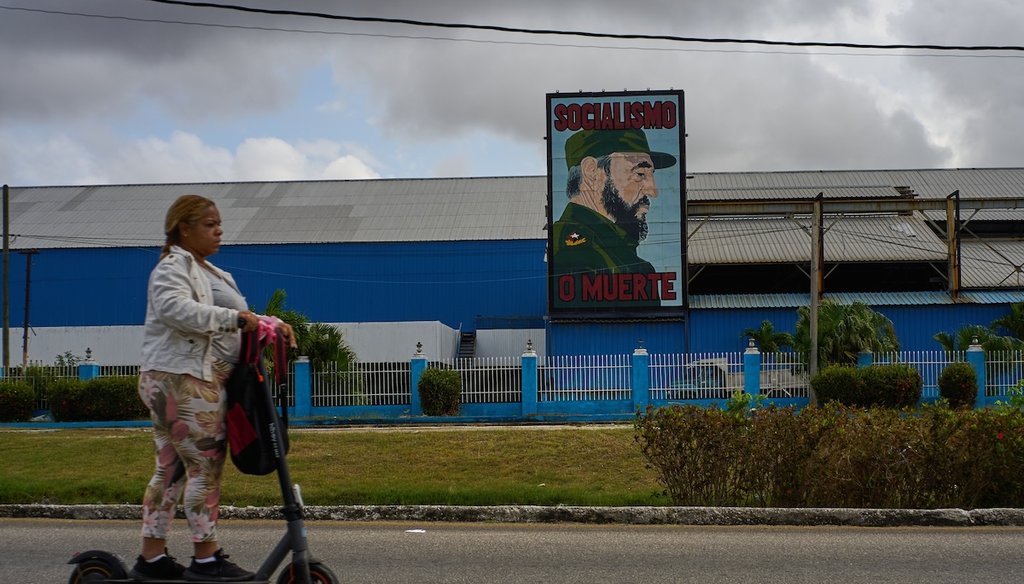
A woman rides an electric scooter past an image of the late Cuban leader Fidel Castro, with the caption "Socialism or Death", in Havana, Cuba, on March 19, 2026. (AP)


Since the U.S. government captured Venezuelan leader Nicolás Maduro in January, the U.S. has blocked oil shipments from Venezuela to Cuba. Venezuela was previously Cuba’s main petroleum supplier, and Trump has threatened other countries with tariffs if they sell fuel to Cuba.
The U.S. and Cuba have been at odds — economically and sometimes militarily — since the Cuban revolution led by Fidel Castro in 1959. But the current crisis is among the most difficult Cuba has faced since then.
The blockade has pushed Cuba’s economy to collapse. The island has spiraled into a worsening humanitarian crisis, with electrical grid failure, hospitals canceling surgeries, and schools and businesses closing.
Trump has warned for months about the possibility of "taking Cuba."
"Whether I free it, take it, I think, I could do anything I want with it," Trump told reporters March 16.
Cuba’s deputy foreign minister, Carlos Fernández de Cossío, responded that the country is preparing for "the possibility of military aggression."
Cuban President Miguel Díaz-Canel, meanwhile, said his government has started talking with the Trump administration. He said the talks are aimed at finding ways to resolve the countries’ bilateral problems. Díaz-Canel floated allowing Cubans living abroad to invest in Cuba’s economy. His government also said it was planning to release 51 political prisoners.
But the Cuban regime seems unwilling to give up its decades-long monopoly on power, even as the Trump administration tries to push the president out, according to The New York Times.
"The nature of the Cuban government, the structure of the Cuban government and the members of the Cuban government are not part of the negotiation," Fernández de Cossío said on NBC’s "Meet the Press." "That is something that no sovereign country negotiates."
With the possibility of U.S. military action against Cuba looming — along with the potential for Cuba’s government and economy to collapse — we considered key questions about the island and its relationship to the U.S.
How did Cuba get here?
The current energy squeeze was triggered by a U.S. oil blockade, but over the long term, significant blame for Cuba’s dire economy falls on the Cuban government itself, experts said.
"At its core lies a rigid, socialist, centralized economic model marked by extensive nationalization, a bloated public sector, and deep resistance to reform," said Cristina Lopez-Gottardi Chao, an assistant professor and Cuba scholar at the University of Virginia. "The leadership’s reluctance to liberalize likely stems from concerns that meaningful market reforms could create independent centers of power and erode the regime’s control over society."
The Cuban government and military have long influenced or controlled major economic sectors, and one of the most important — tourism — failed to recover from the COVID-19 pandemic, she said. The situation worsened in recent months with the U.S. military action against Venezuela.
Would the U.S. gain economically from a significant change in Cuba’s government?
Experts widely agree the U.S. likely would see only modest economic benefits from Cuba’s government changing.
"Cuba is a small market for U.S. products and exports almost nothing," said Sebastian A. Arcos, interim director of Florida International University’s Cuban Research Institute.
While a new government could mean U.S. companies could invest in Cuba for the first time in decades, "Cuba has little in the way of natural resources," said Will Freeman, a Latin America Studies fellow at the Council on Foreign Relations think tank. "There is potential in the tourism sector, but only if infrastructure and the energy grid are revamped, which is a big undertaking with no clear financing source."
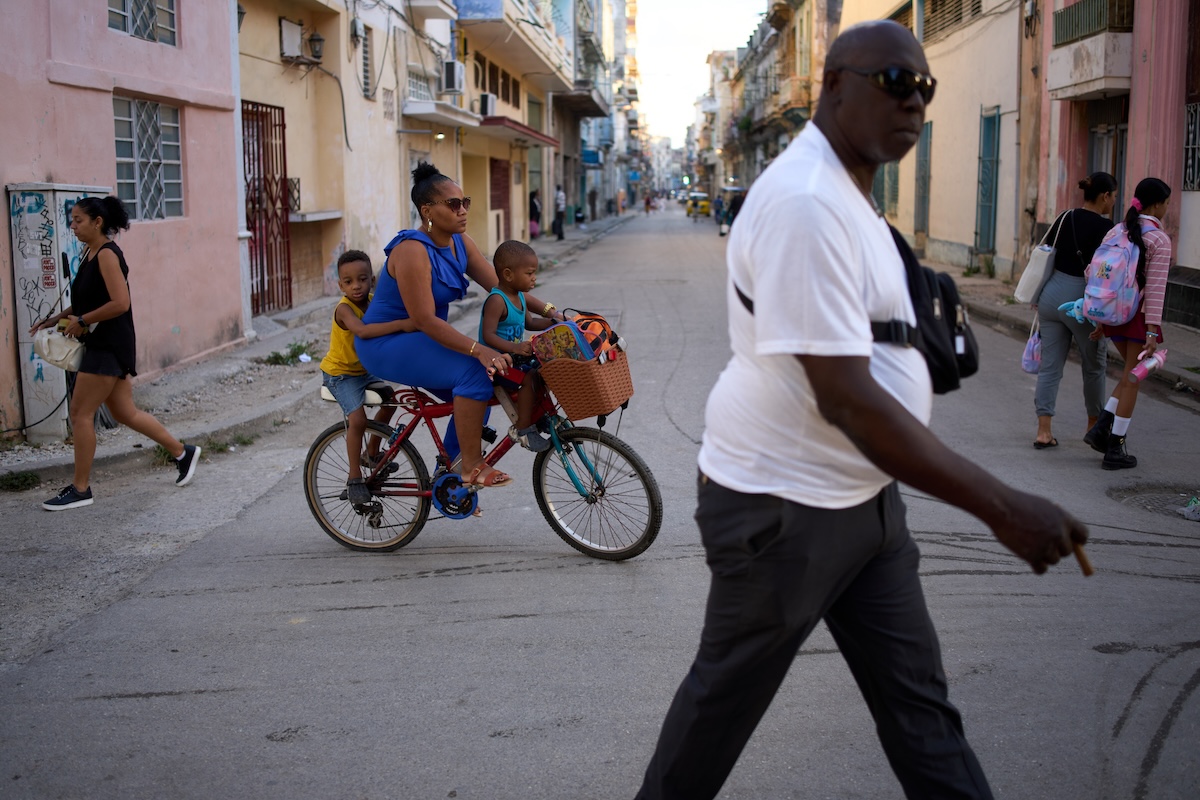
People make their way through Havana, Cuba, on March 25. (AP)
Would a change in Cuba’s government impact geopolitics?
Cuba "has been a determined enemy of the U.S., one that has welcomed and collaborated with strategic enemies of the U.S.," Arcos said. It has also sheltered U.S. criminals and spied on the U.S.
A friendlier government in Havana would help secure vital shipping lanes that carry a large amount of U.S. trade, said Jorge Duany, former director of the Cuban Research Institute.
Preventing a humanitarian crisis in Cuba — and promoting democracy and human rights — also advances U.S. geopolitical interests, said Theodore Henken, a Baruch College sociologist and anthropologist who has studied Cuba.
Regime change could lead to the resolution of decades-old claims of property seized from Cubans who fled the communist takeover, a dispute valued in the billions of dollars.
However, some experts argue that potential U.S. gains are overstated. Aside from boosting the Trump administration’s embrace of right-leaning leaders in Central America and stripping China of listening stations it’s believed to have on the island, "The fact is that today, Cuba is relatively unimportant geopolitically," Henken said.
What are the risks to the U.S. of continuing to increase pressure on Cuba?
Continued U.S. economic pressure likely would lead to more deaths, hunger and failing hospitals "No modern economy can function without fuel," Arcos said.
For the U.S., the biggest direct impact from an intensifying humanitarian crisis would be instability or state collapse leading to mass emigration. That would run counter to the Trump administration’s high-priority effort to curb illegal immigration, and would most directly burden Florida, Trump’s home state.
The sudden fall of the Cuban government might "create a chaotic power vacuum, which could provoke a prolonged, bloody, and expensive U.S. intervention," Duany said.
Our Sources
Roll Call, Donald Trump Signs a Fraud Task Force Executive Order in the Oval Office, March 16, 2026
NBC News, Cuba's deputy foreign minister says its military is preparing for possible 'aggression' from the U.S., March 22, 2026
The New York Times, Cuba Pledges to Release 51 Prisoners Amid U.S. Pressure, March 12, 2026
The New York Times, Trump’s Next Target: ‘Taking Cuba’, March 17, 2026
The Chicago Council on Global Affairs, Why Trump Is Focused on Cuba, March 18, 2026
WBUR, Why Trump wants to ‘take’ Cuba, March 19, 2026
Email interview with Jorge Duany, former director of Florida International University’s Cuban Research Institute, March 24, 2026
Email interview with Sebastian A. Arcos, interim director of Florida International University’s Cuban Research Institute, March 24, 2026
Email interview with Cristina Lopez-Gottardi Chao, assistant professor and Cuba scholar at the University of Virginia’s Miller Center, March 25, 2026
Email interview with Theodore Henken, sociologist and anthropologist at Baruch College, March 24, 2026
Email interview with Richard Feinberg, professor of international political economy at the University of California-San Diego, March 24, 2026
Email interview with Will Freeman, fellow for Latin America Studies at the Council on Foreign Relations, March 24, 2026
Browse the Truth-O-Meter
More by Louis Jacobson