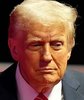
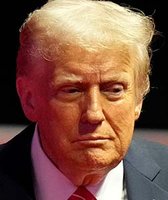
Crime in Minneapolis “is down 25, 30% because we’ve removed thousands of criminals from the area.”

Our only agenda is to publish the truth so you can be an informed participant in democracy.
We need your help.

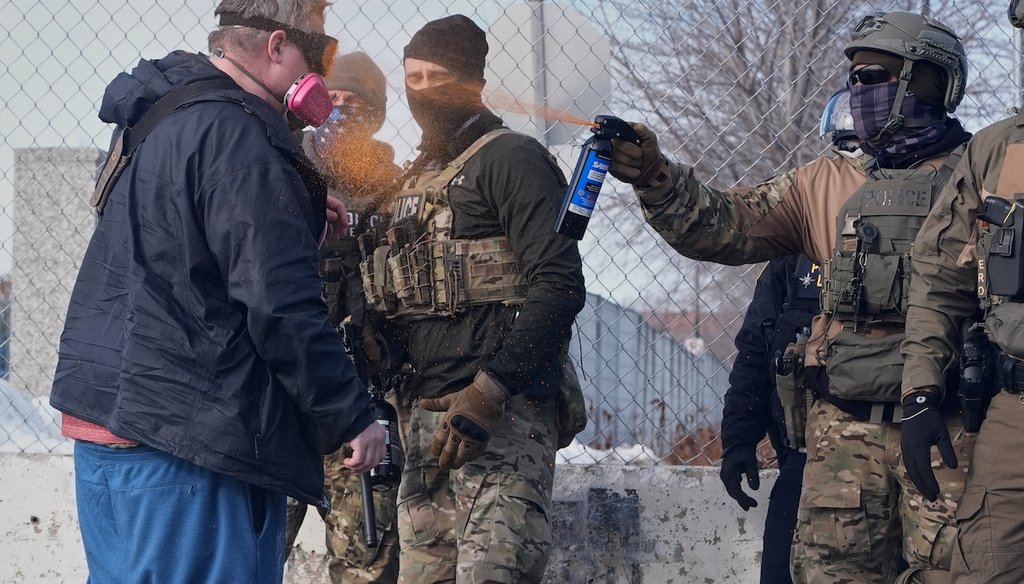
A federal immigration officer deploys pepper spray as protesters demonstrate against Immigration and Customs Enforcement (ICE) after Renee Good, who was fatally shot by an ICE officer last week, Jan. 12, 2026, in Minneapolis. (AP)

Year-to-date figures show Minneapolis burglaries and robberies dropped during the federal immigration enforcement surge. Assaults and motor vehicle thefts increased.
Minneapolis crime has decreased in recent years, mirroring national trends. Experts warn against drawing conclusions from only weeks of crime data.
The administration said it arrested more than 4,000 immigrants in Minnesota, but it didn’t provide details on all of them. The White House didn’t prove that the drop in crimes were due to those arrests.
President Donald Trump said his immigration enforcement operation led to a crime drop in Minneapolis.
In a pre-Super Bowl interview, NBC’s Tom Llamas asked Trump about immigration enforcement weeks after agents fatally shot two Americans, Renee Good and Alex Pretti, in Minneapolis.
"The crime numbers in Minnesota, in Minneapolis in particular, are down 25, 30% because we’ve removed thousands of criminals from the area," Trump said. "These are hardened criminals that came in, many of them — most of them came in through an open border."
The Trump administration launched Operation Metro Surge in late 2025 in Minnesota with the stated goal of arresting people in the U.S. illegally.
Federal immigration agents arrested more than 4,000 immigrants during the operation, the White House said Feb. 4. But it did not say how many of those arrests were in Minneapolis or how many of the people detained had criminal histories. Media reports show that some people arrested in the course of the operation, or another federal operation, held legal status, were U.S. citizens or had pending asylum cases.
Although some Minneapolis crime has recently declined in the short timeframe Trump highlighted, these numbers had already been coming down prior to the operation. There is no data credibly linking those declines to the federal immigration arrests. Other crime, meanwhile, has gone up in the period Trump described.
White House border czar Tom Homan said the federal operation will wind down there over the next week.
Asked for data behind Trump’s claim, a White House spokesperson pointed to the Minneapolis police crime dashboard showing the number of homicides, burglaries and robberies during January and early February 2026 compared with 2025.
Here’s what data from Jan. 1 through Feb. 4, the date of Trump’s interview, show:
134 burglaries in 2026, down from 219 in 2025, a decline of 39%
71 robberies in 2026, down from 95, a decline of 25%.
Two homicides in 2026, down from five, both numbers too small to be considered statistically significant.
However, the city homicide data the White House relied upon doesn’t capture the fatal shootings of two U.S. citizens by federal immigration agents. Homicide refers to the death of a person by another; it does not automatically mean that a crime occurred.
The medical examiner ruled Good and Pretti’s killings were homicides, but the city’s dashboard reflects only deaths investigated by the police department.
Although the decline in burglaries and robberies matched Trump’s percentages, some other offenses increased: assaults were up by 11% and motor vehicle theft by 26%.
We asked the White House what evidence it has that the declines it cited are because of its immigration enforcement arrests. They provided no evidence.
"Removing dangerous criminals from the streets obviously means less crime is being committed," White House spokesperson Abigail Jackson said.
Crime experts pointed to several problems with Trump’s statement:
The short timeframe. Comparing about a month across two years is statistically meaningless, said James Densley, a criminology professor at Metropolitan State University in St. Paul. "Crime is seasonal, lumpy, and volatile in small time frames. A single week of warm or cool weather, a gang conflict resolution, or even random variation can swing these numbers dramatically."
Crime was already dropping in Minneapolis. Violent crime peaked in 2021 and 2022 and has since fallen. That mirrors national trends, regardless of immigration enforcement. The Minnesota Star Tribune found in the fall of 2025 that robberies and burglaries were lower than in 2019, and that the tally of gunshot victims had also dropped.
No proof immigrants are the reason for the decline. For the federal arrests to drive the drops in burglary and robbery would require evidence that a substantial share of those crimes were committed by immigrants. The Trump administration has cited examples of people who had committed crimes, but hasn’t provided details on all 4,000 people it arrested. That means we don’t know how many of those immigrants had criminal histories, and whether they were recent or had committed crimes such as robberies or burglaries.
There are reasons to be skeptical about the administration’s repeated characterization that the people they are arresting as part of the immigration crackdown represent "worst of the worst" offenders. PolitiFact found in December that nearly half of all immigrants in ICE detention have neither a criminal conviction nor pending criminal charges. Of the immigrants with criminal convictions, 5% have been convicted of violent crimes such as murder or rape, according to the Cato Institute, a libertarian think tank.
In Minnesota, the state Department of Corrections, which oversees the state prisons, said that the federal government had spread misinformation about noncitizens. State officials didn’t find criminal history for some people named by Homeland Security while others had misdemeanor convictions or remained in prison. If someone was still behind bars in January, they could not have committed burglaries and robberies.
Another problem with Trump’s statement is that federal immigration enforcement caused public safety threats in addition to the two U.S. citizens who were fatally shot. University of Minnesota sociologist Michelle Phelps said families of color have gone into hiding in response to the immigration enforcement, producing conditions that can create their own public safety issues. Such conditions include school absenteeism, rent insecurity and business instability.
Some crime could have dropped because people stayed home to avoid federal agents. Criminologists have known for decades that visible, aggressive law enforcement suppresses crime in the short term, Densley said.
"Flood a neighborhood with federal agents and marked vehicles, and people alter their routines," he said. "They stay inside. They avoid public spaces. Fewer people on the street means fewer opportunities for crime."
The surge of enforcement likely reduced crime reporting by people in targeted communities, University of Minnesota sociology professor Chris Uggen said.
PBS’ Margaret Hoover asked Minneapolis Police Chief Brian O’Hara if the city’s crime had decreased because of Trump.
O’Hara, who criticized the federal operation, attributed the yearslong crime drop to partnerships with other law enforcement agencies, including federal, to pursue gang members committing gun crimes and carjackings, and working together with community groups.
"That’s something that was happening a few years ago. It's not something that happened or started happening a couple of weeks ago," O’Hara said.
The police department said Jan. 22 that during the federal immigration surge, local police made 849 arrests.
RELATED: Is Donald Trump right that the U.S. crime rate is at its lowest in 125 years?
Trump said crime in Minneapolis "is down 25, 30% because we’ve removed thousands of criminals from the area."
Some crimes in Minneapolis have declined, but their downward trend predated the immigration crackdown. Robberies and burglaries are down year to date in the ballpark Trump cited while assaults and motor vehicle thefts increased. The White House also said that homicides were down, omitting the fatal shootings of Pretti and Good by immigration officers.
Trump is citing a very short time frame of about five weeks. And he provided no evidence that arresting immigrants is the reason for the crime drop.
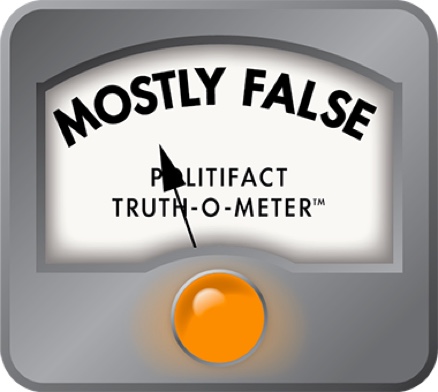
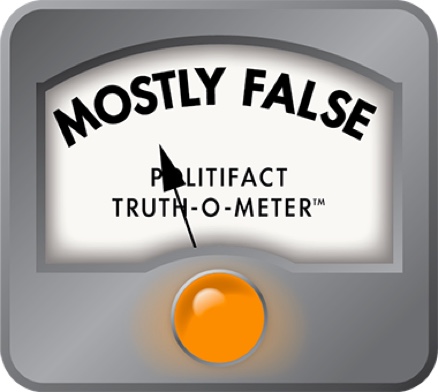
We rate this Mostly False.
Staff writer Grace Abels contributed to this fact-check.
RELATED: All of our fact-checks about Minnesota and immigration
NBC, Read the full transcript: President Donald Trump interviewed by 'NBC Nightly News' anchor Tom Llamas, Feb. 4, 2026
Minneapolis police, Crime dashboard, Accessed Feb. 10, 2026
White House, New Milestone in Operation Metro Surge: 4,000+ Criminal Illegals Removed from Minnesota Streets, Feb. 4, 2026
U.S. Customs and Immigration Enforcement, ICE arrests dozens of criminal illegal aliens convicted of murder, child rape and more in sanctuary state Minnesota, Jan. 10, 2026
Minnesota Star Tribune, Minneapolis crime is falling in 2025, even amid high-profile violence, Oct. 7, 2025
Minnesota Star Tribune, ICE says it has arrested 10,000 ‘criminal illegal aliens’ in Minnesota, but offers little proof, Jan. 23, 2026
Minnesota Star Tribune, Violent crime is down in Minneapolis, but police overtime is up amid ICE surge, Jan. 24, 2026
WCCO, Federal pursuit ends in crash that injures 1 in St. Paul, police say, Feb. 11, 2026
PBS, Firing line with Margaret Hoover, Feb. 6, 2026
PBS, WATCH: Border czar Tom Homan announces end to immigration crackdown in Minnesota, Feb. 12, 2026
MPR, Some criminals ICE takes credit for arresting were already in Minnesota prisons, Jan. 17, 2026
KARE 11, 'Worst of the Worst' website draws scrutiny, Feb. 6, 2026
MPR, ‘ICE is here!’ Refugee family with legal status unsettled by early morning arrest, Jan. 21, 2026
PolitiFact, Trump leaders say Minnesota officials withhold detained immigrants from ICE. Is that true? Jan. 26, 2026
White House press office, Statement to PolitiFact, Feb. 10, 2026
Email interview, White House spokesperson Abigail Jackson, Feb. 11, 2026
Email interview, Michelle S. Phelps, sociology professor, University of Minnesota, Feb. 11, 2026
Email interview, Ryan Larson, assistant professor of criminology, Hamline University, Feb. 11, 2026
Email interview, James Densley, professor and Department Chair, School of Criminology and Criminal Justice, Metropolitan State University, Feb. 11, 2026
Email interview, Sergeant Garrett Parten, Minneapolis police spokesperson, Feb. 11, 2026
Email interview, Christopher Uggen, professor in Sociology, Law, and Public Affairs at the University of Minnesota, Feb. 12, 2026






In a world of wild talk and fake news, help us stand up for the facts.