
“More Americans are working today than at any time in the history of our country.”

Our only agenda is to publish the truth so you can be an informed participant in democracy.
We need your help.

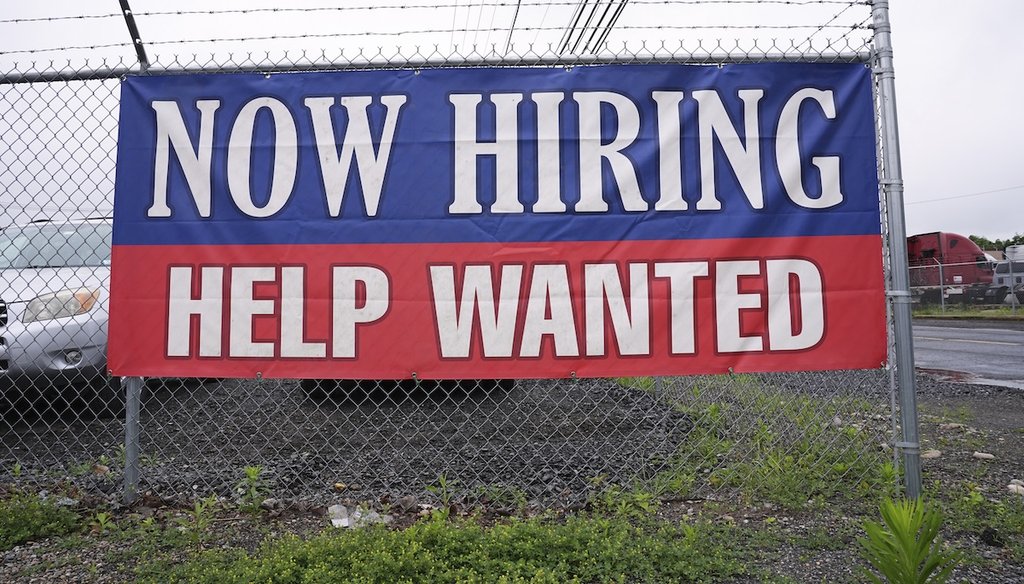
A hiring and help wanted sign in Morrisville, Pa., on June 9, 2025. (AP)

The employment peak came in January 2026, and dropped the following month. However, population growth drives this metric, so economists do not consider it a meaningful statistic.
Two other statistics — the labor force participation rate and the employment-population ratio — are relatively high by historical standards but not at their all-time highs.
In his second term, Trump’s job creation is drastically underperforming his predecessors — Barack Obama, Joe Biden and himself in his first term.
When it comes to the economy, President Donald Trump often celebrates how many people are working.
"More Americans are working today than at any time in the history of our country," Trump said at a Saudi investment conference in Florida on March 27.
Trump has made this case in at least four previous speeches this year.
In January, U.S. employment hit an all time high. But raw employment numbers are driven by overall population growth, so any president can claim an all-time high during their tenure.
A more telling statistic about employment trends during Trump’s second term is that the past year-plus has seen the weakest job creation record in 16 years.
For nearly nine decades, nonfarm employment — the federal Bureau of Labor Statistics’ standard employment measure — has risen steadily. It has dipped during recessions, but within a couple of years, the statistic returns to its previous peak and then exceeds it, until the next recession.
In February, 158.5 million Americans were working, according to the bureau. That was down slightly from the 158.6 million people working in January. The January total is the highest ever.
To support Trump’s statement, the White House pointed us to a different statistic: the labor force participation rate for prime-age workers, people ages 25 to 54. This metric shows what percentage of a given population is either working or looking for work; using a 25-to-54 age range filters out any skew from the baby boomers who are retiring in large numbers every month.
Like nonfarm employment, the labor force participation rate for prime-age workers isn’t the highest ever, but it’s close. In February, 83.9% of prime-age workers were working or looking for work; the all-time high was 84.6% for a month in 1999.
"With labor force participation for prime-age Americans at a 25-year high, thanks to this administration’s pro-growth agenda, that puts American workers first," White House spokesperson Kush Desai said. "More Americans than ever before are working or coming off the sidelines to look for work."
Because the labor force participation rate counts both workers and people who are looking for work, this isn’t the most direct way of testing Trump’s statement about people with jobs. A more direct way is through a third statistic: the employment-population ratio for prime-age workers. This metric divides the number of workers by that age group’s population.
This statistic is also close to an all-time high. In February, 80.7% of prime-age workers were employed; the all-time record was 81.9% in early 2000. It has largely stalled since early 2023, under both Trump and his predecessor, President Joe Biden.
Bottom line: Three employment metrics show relatively high levels and rates of employment today, but none is currently at a historic record.
Other federal data undercuts the notion that the U.S. job market is strong. Monthly employment changes during Trump’s second term are more negative than they were during other recent presidencies, including his initial term.
In the fall of 2010, the recovery from the 2007-09 Great Recession began to heat up. And nearly every month for the next 14 years — from October 2010 to December 2024 — jobs increased month over month, not including three months during the 2020 COVID-19 pandemic.
This represented most of Barack Obama’s presidency, all of Trump’s first term (minus the three pandemic months), and all of Biden’s.
By contrast, since Trump’s second term began in January 2025, the government has released data for 14 months — and six of them have seen monthly job losses.
Another way to slice the data is to look at the average job gains for each president. For a fair comparison, we did not calculate periods of recession, when jobs plummet, or immediate recoveries, when jobs spike.
We looked at four periods: Obama’s third and fourth year, Obama’s second term, Trump’s prepandemic period and Biden’s final three years, which were largely after the pandemic. Each period saw an average monthly employment increase of between 176,000 and 236,000.
Trump’s second term is a distinct outlier: The average monthly gain has been less than 11,000.

Douglas Holtz-Eakin, president of the center-right American Action Forum, said the employment picture is even worse than that, because only one sector — health care — has been keeping the second-term Trump employment figures above water.
"We have a golden age for the home health aide, but most people are working in industries that are shrinking," Holtz-Eakin said. "If you’re thinking about the average worker, it’s not good."
Trump said, "More Americans are working today than at any time in the history of our country."
The employment peak came in January 2026, though it dropped the following month. However, population growth primarily shapes this metric, so economists do not consider it a meaningful statistic.
Two other statistics — the labor force participation rate and the employment-population ratio — are relatively high, but not at their all-time highs.
A more relevant yardstick shows Trump’s second term underperforming his predecessors Obama, Biden and himself from his first term. After 14 years of almost uninterrupted monthly job gains, almost half of Trump’s months in office have seen job losses.
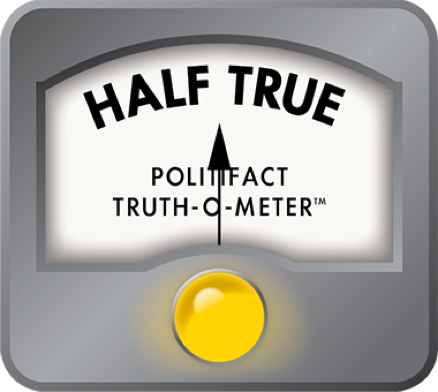
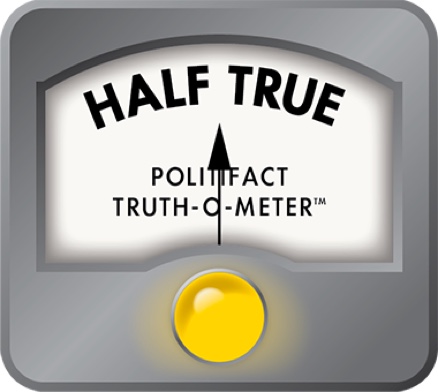
The statement is partially accurate but leaves out important details or takes things out of context. We rate it Half True.
Donald Trump, remarks at a Saudi investment conference, March 27, 2026
Donald Trump, various remarks and speeches, January-March 2026
Federal Reserve Bank of St. Louis, nonfarm employment, accessed March 31, 2026
Federal Reserve Bank of St. Louis, labor force participation rate for prime-age workers, accessed March 31, 2026
Federal Reserve Bank of St. Louis, employment-population ratio for prime-age workers, accessed March 31, 2026
Federal Reserve Bank of St. Louis, health care employment, accessed March 31, 2026
Email interview with Dean Baker, co-founder of the Center for Economic and Policy Research, March 31, 2026
Interview with Douglas Holtz-Eakin, president of the American Action Forum, March 31, 2026













In a world of wild talk and fake news, help us stand up for the facts.