Stand up for the facts!
Our only agenda is to publish the truth so you can be an informed participant in democracy.
We need your help.
I would like to contribute
Trump restores and expands his first-term travel bans

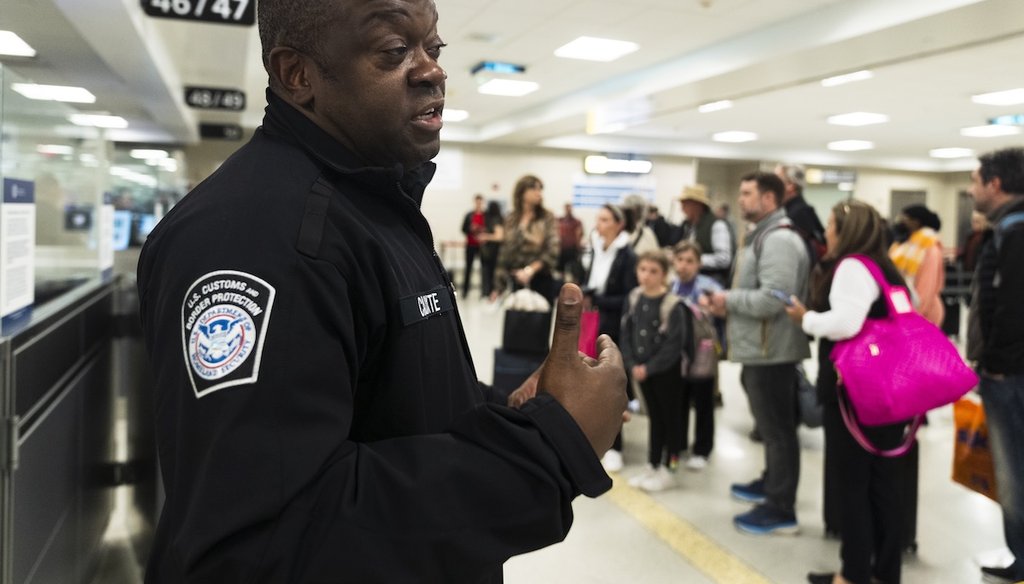
Customs Border Protection's Port of Washington Dulles Director Mark Calixte inside Washington Dulles International Airport on April 1, 2024. (AP)

During his second term, President Donald Trump has not only reimposed the travel bans that provoked a lengthy court battle during his first term but has expanded their scope.
During his first term, Trump imposed travel bans on seven countries through a series of executive orders, suspending visas for nationals of the countries for 90 days. After a legal battle, the Supreme Court ruled that the president can issue a travel ban under certain circumstances.
When Joe Biden became president in 2021, he revoked Trump's travel bans. Then, as a presidential candidate in 2024, Trump promised to restore them if he returned to the White House.
Trump has done more than that during his second term: He's not only reimposed travel bans but expanded their scope to 19 nations, up from the seven listed in his initial first-term policy.
Critics of Trump's initial travel ban in 2017 called it a "Muslim travel ban" because it targeted seven predominantly Muslim countries: Iran, Iraq, Syria, Libya, Somalia, Sudan and Yemen. Iraq was later removed from the list in an updated travel ban. After the Supreme Court's ruling, five Muslim-majority nations were ultimately restricted, along with other countries, such as North Korea and Venezuela.
The second-term bans are broader. In June, Trump sought to restrict entry into the U.S. for nationals of 12 countries: Afghanistan, Burma, Chad, Republic of the Congo, Equatorial Guinea, Eritrea, Haiti, Iran, Libya, Somalia, Sudan and Yemen. Seven other countries were partially restricted.
An updated list in December added seven countries, and people with Palestinian Authority documents, to the total ban list. In addition, 20 countries were partially restricted in the December executive action.
The Cato Institute, a libertarian think tank, said the new travel restriction would bar one in five immigrants who would otherwise be allowed in the U.S. legally from entering the U.S. In total, Cato estimated that nearly 400,000 legal immigrants would be rejected over three years.
Separately, Trump also paused immigrant visas for dozens of countries. Effective Jan. 21, immigrants who are citizens of 75 countries are no longer able to receive immigrant visas. (Tourist visas were not affected.)
The Catholic Legal Immigration Network and other groups filed a complaint on Feb. 2 against suspending visa processing for 75 countries. The lawsuit is currently active.
Trump has not only resurrected the travel bans withdrawn by Biden but has expanded the number of countries affected. We rate this a Promise Kept.
Our Sources
Supreme Court of the United States, "Trump, President of the United States, et al. v. Hawaii et al." June 26, 2018
Immigration History, Muslim Travel Ban, accessed on Mar. 3, 2026
PolitiFact, "Trump's travel restrictions survive Supreme Court, fall short of promised Muslim ban," Nov. 14, 2018
NAFSA, "Archive: First Trump Administration Travel Bans," Dec. 26, 2024
NAFSA, "Travel Bans and Restrictions," Dec. 17, 2025
The White House, "RESTRICTING THE ENTRY OF FOREIGN NATIONALS TO PROTECT THE UNITED STATES FROM FOREIGN TERRORISTS AND OTHER NATIONAL SECURITY AND PUBLIC SAFETY THREATS," June 4, 2025
The White House, "RESTRICTING AND LIMITING THE ENTRY OF FOREIGN NATIONALS TO PROTECT THE SECURITY OF THE UNITED STATES," Dec. 16, 2025
CATO Institute, "New Ban Bars 1 in 5 Legal Immigrants, Even Citizens' Spouses & Kids," Dec. 17, 2025
U.S. Department of State, "Immigrant Visa Processing Updates for Nationalities at High Risk of U.S. Public Benefits Reliance," Feb. 2, 2026
United States District Court Southern District of New York, "Complaint for Vacatur, Declaratory and Injunctive Relief," Feb. 2, 2026
National Immigration Law Center, "CLINIC v. Rubio," Mar. 2, 2026