Stand up for the facts!
Our only agenda is to publish the truth so you can be an informed participant in democracy.
We need your help.
I would like to contribute
Supreme Court rolls back nationwide block on birthright citizenship order, legal fight continues

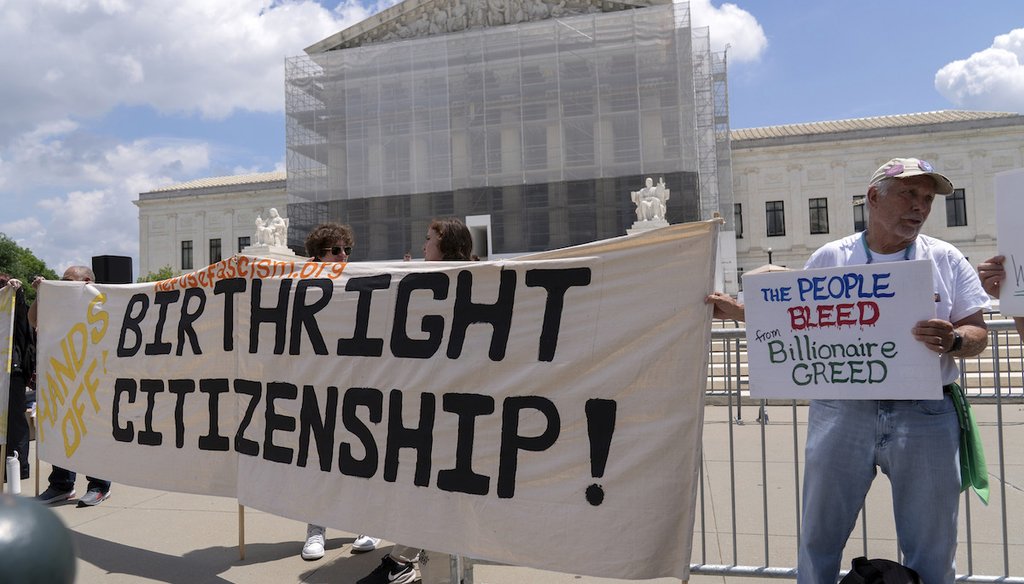
Demonstrators holds up a banner during a citizenship rally outside of the Supreme Court in Washington, May 15, 2025. (AP)

In a June 27 decision, the U.S. Supreme Court opened the door for children born in the U.S. to certain immigrant parents to be denied birthright citizenship in some parts of the country.
Birthright citizenship is the longstanding practice of conferring citizenship on anyone born in the United States, including when the parents are noncitizens.
The court's decision in Trump v. Casa Inc. did not not address the constitutionality of Trump's executive order to end birthright citizenship for the children of noncitizens. Instead it addressed whether lower court judges had the authority to block the policy nationwide.
In a 6-3 opinion, the Supreme Court found that lower courts in Maryland, Massachusetts and Washington "likely" exceeded their authority by blocking the policy nationwide.
The court granted the Trump administration's request to narrow the scope of the lower courts' injunctions. An injunction is a legal pause on the order. It's now up to the lower courts to assess the scope of the injunctions.
"I expect that there will be a lot of litigation in the next 30 days which could well halt implementation of the executive order," said Gabriel Chin, University of California Davis law professor. "This decision by no means indicates that the executive order will ultimately take effect."
For 30 days from the Supreme Court's decision, Trump can't implement his policy, giving the lower courts time to reevaluate. Immigration law experts said that for the plaintiffs, which include 22 states, immigration organizations and several individuals, the policy would remain blocked even after 30 days. That's because the court's opinion said the lawsuit plaintiffs must still be covered by the injunction.
For the other 28 states that didn't sue, it's possible that Trump's order could move forward after 30 days.
Soon after the decision, immigrant rights advocates filed class action lawsuits against the Trump administration, challenging the law on behalf of people who would be denied citizenship under Trump's order.
A class action offers legal protection to people who are not formal plaintiffs. Lawyers can establish a "class" of people by proving the law would similarly affect the whole group. Then, the results of a lawsuit can apply to all people in that class.
Under the Supreme Court ruling, it is now harder for courts to issue injunctions that legally protect people or groups other than the plaintiffs. However, a class action lawsuit, if successful, could have a similar effect as a nationwide injunction.
"Class certification process is both time consuming and costly which is why the nationwide injunction allows for a faster remedy under urgent circumstances," said immigration lawyer Rekha Sharma-Crawford.
Although the justices didn't decide what limits — if any — birthright citizenship should have, some legal experts expressed concern about the decision's practical effects.
Children born in the states that have challenged Trump's order as plaintiffs in the lawsuit "are likely U.S. citizens," said University of North Carolina law professor Michael Gerhardt. "But in other districts that have upheld the order, babies born to non-citizens are effectively stateless and vulnerable to further attacks on their legal status."
If Trump's order goes into effect in any jurisdiction, it'd be "highly disruptive," Peter Spiro, Temple University law professor, said. "Birthright citizenship shouldn't depend on where you're born, and the meaning of the 14th Amendment should be nationally consistent."
The Constitution's "full faith and credit clause," which requires states to respect other states' laws and legal judgments, is also at issue if states apply Trump order's differently, experts said.
"If a child is a citizen in 22 states, then under the full faith and credit clause, they should be a citizen for all states," Sharma-Crawford said. "Whether the federal government will recognize them as such remains a question that will likely land back in front of the court in due course."
Legal experts offered differing assessments on whether this ruling means the justices will lean toward overturning automatic birthright citizenship.
George Mason University law professor Ilya Somin said the ruling on the procedural question means "little or nothing" about the substantive question of whether there should be limits on birthright citizenship.
But Gerhardt said the ruling "suggests the real possibility" that the justices could go along with "dismantling" birthright citizenship in a future challenge.
The court has not ruled on the merits of Trump's attempt to end birthright citizenship, but the court's decision lets the administration eventually move forward with its policy at least in some states. For this reason, Trump's promise to end birthright citizenship remains In the Works.
PolitiFact Chief Correspondent Louis Jacobson contributed to this report.
Our Sources
Email interview with Gabriel "Jack" Chin, Professor of Law, and Director of Clinical Legal Education at UC Davis School of Law, June 27, 2025
Email interview with Peter Spiro, Professor of Law at Temple University Law School, June 27, 2025
Email interview with Rekha Sharma-Crawford, immigration lawyer, June 27, 2025
Email interview with Ilya Somin, George Mason University law professor, June 27, 2025
Email interview with Michael Gerhardt, University of North Carolina law professor, June 27, 2025
Press conference with lawyers from CASA, June 27, 2025
CBS News, "Supreme Court, in birthright citizenship case, limits judges' use of nationwide injunctions," June 27, 2025
White House,
"Protecting The Meaning And Value Of American Citizenship," Jan. 20, 2025
U.S. Supreme Court, "Trump v. CASA," June 27, 2025
SCOTUSblog, "Supreme Court sides with Trump administration on nationwide injunctions in birthright citizenship case," June 27, 2025
ACLU, "Barbara v. Donald J. Trump,"
CourtListener, "Trump v. Casa: Emergency motion," June 27, 2025
Casa, "Homepage," accessed June 27, 2025
Cornell Law," full faith and credit," accessed June 27, 2025
CBS News, "Trump asks Supreme Court to intervene in cases challenging birthright citizenship order," March 13, 2025
CBS News, "Trump's birthright citizenship order blocked by Maryland and Washington judges," Feb. 7, 2025
The Washington Post, "Supreme Court limits nationwide orders that have blocked Trump's birthright citizenship ban," June 27, 2025
White House, "Protecting The Meaning And Value Of American Citizenship," Jan. 20, 2025
KQED, "What the Supreme Court's Latest Ruling Means for Birthright Citizenship," June 27, 2025
The New York Times, "Supreme Court Live Updates: Trump Hails Win on Birthright Citizenship," June 27, 2025
NPR, "Supreme Court limits nationwide injunctions in birthright citizenship order,"June 27, 2025
YouTube, "President Trump Holds a Press Briefing," June 27, 2025
THe Associated Press, "Supreme Court limits nationwide injunctions, but fate of Trump birthright citizenship order unclear," June 27, 2025
U.S. Supreme Court, "Request for Partial Stay," March 13, 2025
PolitiFact, "Donald Trump is reiterating his promise to overturn birthright citizenship. Can he do it?," Nov. 10, 2024
NBC News, "Supreme Court curbs injunctions that blocked Trump's birthright citizenship plan," June 27, 2025