Stand up for the facts!
Our only agenda is to publish the truth so you can be an informed participant in democracy.
We need your help.
I would like to contribute
Supreme Court rules against Trump on birthright citizenship, blocking key campaign promise

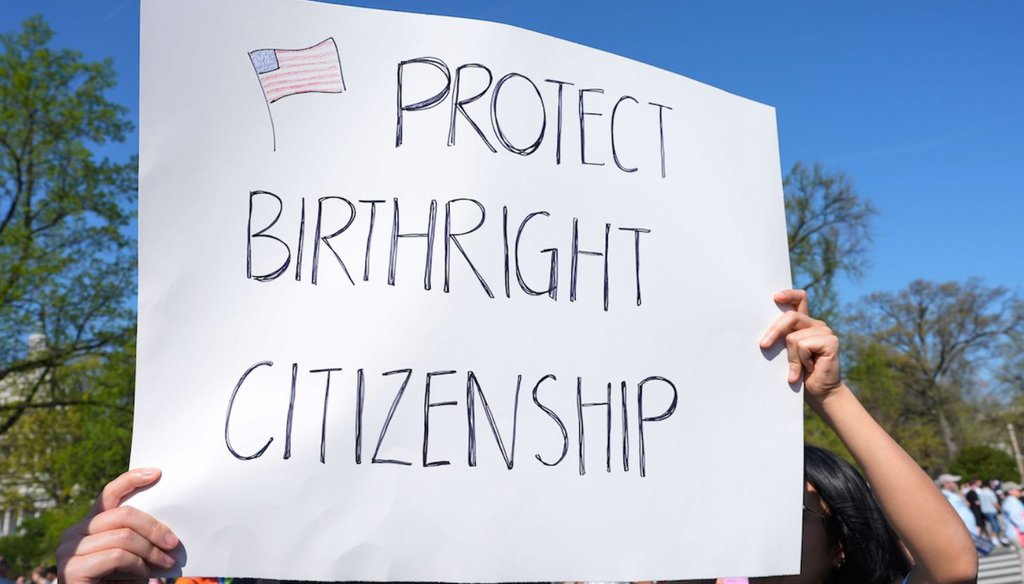
Supporters of birthright citizenship rally outside the Supreme Court on April 1, 2026. (AP)


In a landmark ruling, the U.S. Supreme Court rejected President Donald Trump's executive order seeking to eliminate birthright citizenship. The ruling reaffirms automatic citizenship for anyone born in the U.S., regardless of their parents' immigration status.
The court's decision blocked one of Trump's key 2024 campaign promises. On his first day in office, Trump issued the executive order declaring that in the future, U.S.-born children of immigrants in the country illegally would not receive automatic U.S. citizenship.
Several states and immigrant rights groups sued to block his order, arguing there was a long legal precedent to uphold birthright citizenship, including a 1898 Supreme Court case and the 14th Amendment, which says that "all persons born or naturalized in the United States, and subject to the jurisdiction thereof, are citizens of the United States and of the state wherein they reside."
In its June 30 decision in Trump v. Barbara, the court overturned Trump's order.
Chief Justice John Roberts wrote the majority opinion, joined by four other justices: Amy Coney Barrett, Ketanji Brown Jackson, Elena Kagan and Sonia Sotomayor. A sixth justice, Brett Kavanaugh, joined the majority in part; Kavanaugh wrote that existing law, but not the 14th Amendment, upholds birthright citizenship.
Multiple legal experts told PolitiFact they were surprised that only a 5-4 majority of justices agreed with the longstanding interpretation of the 14th Amendment. But the experts unanimously described Roberts' ruling as a forceful defense of birthright citizenship.
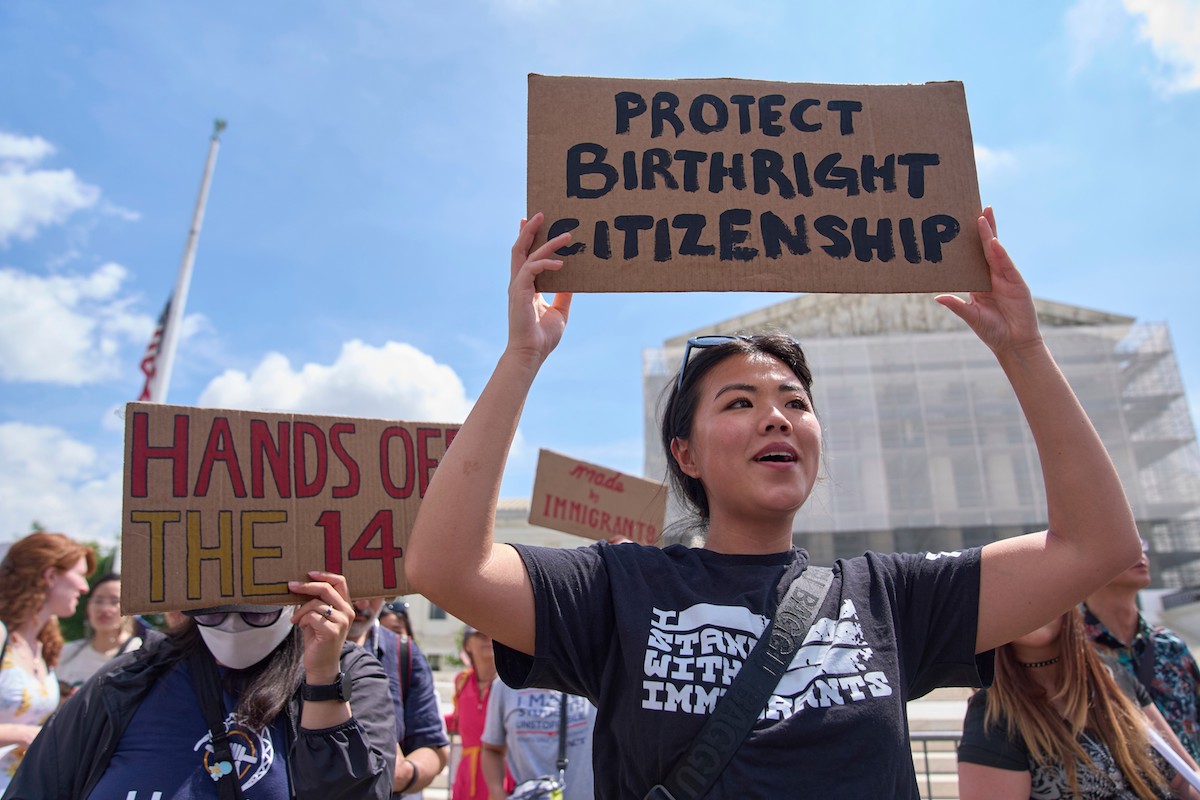
Hannah Liu, 26, of Washington, holds up a sign in support of birthright citizenship, May 15, 2025, outside of the Supreme Court in Washington. (AP)
"Citizenship, then and now, was the right to have rights — to freely participate in our political community," the majority wrote. "The Framers of the Fourteenth Amendment extended that promise to 'every free-born person in this land.' … We keep that promise today."
In a Truth Social post, Trump called the decision "too bad for our Country" and said, "Congress should start TODAY to work on ending expensive and unfair to our Country, Birthright Citizenship."
Roberts' majority opinion traced birthright citizenship back to a concept in English common law known as "jus soli," or "right of the soil," which "crossed the Atlantic and prevailed in 'each and all of the states' after American independence," he wrote.
The majority opinion sought to extend this thread through the 14th Amendment and the 1898 case, United States v. Wong Kim Ark, which upheld a broad definition of birthright citizenship, with narrow limits for the U.S.-born children of diplomats.
Roberts wrote that if Congress had intended to limit American citizenship as Trump had ordered, "nothing in the succinct language of the (14th Amendment) conveyed that design."
Trump's order ending birthright citizenship, if implemented, could have affected about 255,000 babies born each year over decades, according to a friend of the court brief filed by 141 academics opposed to Trump's order. Revoking access to citizenship would have harmed their ability to attend college and contribute to the U.S. economy, the brief said.
Kavanaugh's partial dissent could give fuel to Trump's push to pass a law outlawing birthright citizenship. Kavanaugh wrote that Trump's order did not violate the 14th Amendment but did contravene a federal statute. Congress, he wrote, could amend or enact new legislation "establishing exceptions to birthright citizenship for children born to foreign citizens unlawfully or temporarily in the country."
Such legislation does not yet have broad appeal in Congress. A bill Trump promoted on social media has drawn 87 House cosponsors and 8 Senate cosponsors since it was filed in January 2025.
Even if such a bill were to pass, "it would be struck down by the lower courts on the basis of today's ruling," and the current Supreme Court or one with similar ideological leanings would probably agree, said Temple University law professor Peter J. Spiro.
However, the dissents by justices Samuel Alito, Neil Gorsuch and Clarence Thomas mean that this issue will likely "keep getting thrown back at the court over and over so long the current SCOTUS membership remains unchanged," said Frank O. Bowman III, a University of Missouri law professor.
The Supreme Court has blocked Trump's effort to curtail birthright citizenship. We rate this Promise Broken.
Staff writer Maria Briceño contributed to this report.
RELATED: MAGA-Meter: Tracking Trump's progress on his immigration promises
Our Sources
U.S. Supreme Court, Trump v. Barbara (Birthright Citizenship), 2026
National Archives, 14th Amendment to the U.S. Constitution: Civil Rights (1868), accessed Dec. 9, 2024
Donald Trump, Truth Social post, June 30, 2026
Donald Trump, Truth Social post, June 30, 2026
Stephen Miller, X post, June 30, 2026
Congress.gov, H.R.569 - Birthright Citizenship Act of 2025, Jan. 21, 2025
Pew Research Center, About 9% of U.S. births in 2023 were to unauthorized or temporary legal immigrant mothers, March 31, 2026
PolitiFact, Fact-check: Trump misleads about birthright citizenship, birth tourism before SCOTUS hearing, March 31, 2026
PolitiFact, Donald Trump's False claim that the US is the 'only' country with birthright citizenship, Jan. 21, 2025
PolitiFact, Donald Trump is reiterating his promise to overturn birthright citizenship. Can he do it? Dec. 10, 2024
PolitiFact, Donald Trump's 2024 campaign promises: Here's his vision for a second term, Sept. 30, 2024
PolitiFact, Birthright citizenship: Could Ron DeSantis end it? And if so, how? June 29, 2024
PolitiFact, Donald Trump falls short on promise to end birthright citizenship, July 15, 2020
PolitiFact, Do rich foreign women give birth in Miami then not pay the bill, as Rubio said? Feb. 12, 2016
PolitiFact, Rand Paul says legality of birthright citizenship not fully adjudicated due to facts of 1898 case, Sept. 18, 2015
PolitiFact, "Fact-checking the claims about 'anchor babies' and whether illegal immigrants 'drop and leave,'" Aug. 6, 2010
Email interview with Kevin R. Johnson, law professor at the University of California-Davis, June 30, 2026
Email interview with Michael Gerhardt, University of North Carolina law professor, June 30, 2026
Email interview with Gabriel (Jack) Chin, law professor at the University of California-Davis, June 30, 2026
Email interview with Denise Gilman, co-director of the University of Texas law school immigration clinic, June 30, 2026
Email interview with Peter J. Spiro, Temple University law professor, June 30, 2026
Email interview with Frank O. Bowman III, University of Missouri law professor, June 30, 2026