Stand up for the facts!
Our only agenda is to publish the truth so you can be an informed participant in democracy.
We need your help.
I would like to contribute
Supreme Court puts Trump promise to revoke Haitians’ Temporary Protected Status back on track

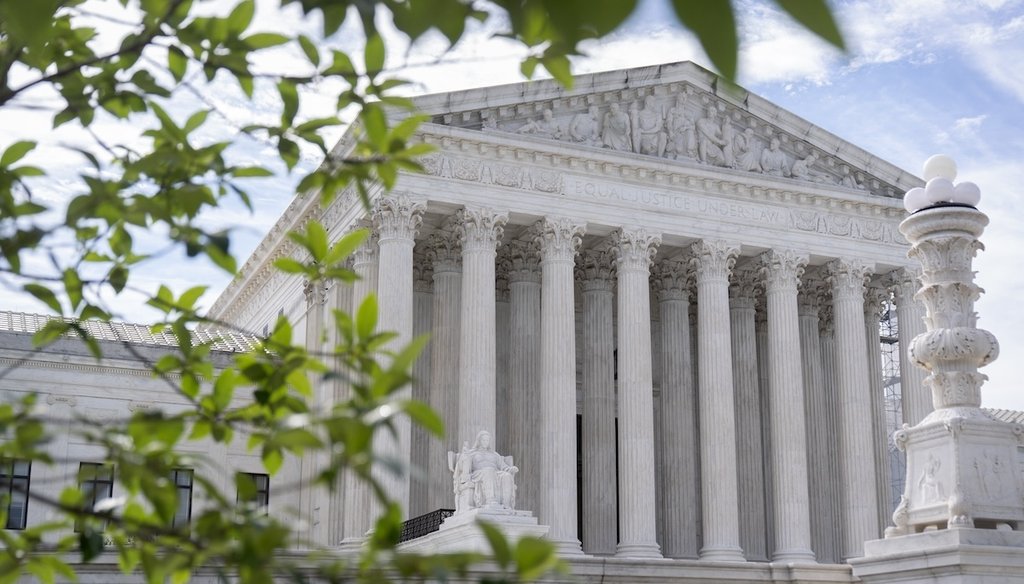
The Supreme Court building is seen June 27, 2024, in Washington. (AP)
President Donald Trump won a critical legal victory June 25 in his effort to revoke the Temporary Protected Status of Haitians.
In a 6-3 vote, the Supreme Court reversed a lower court ruling that barred the Trump administration from revoking Haiti's TPS designation.
TPS is a program that allows foreign nationals from countries experiencing crises such as natural disasters or armed conflict to live in the U.S. for up to 18 months. The federal government consistently renewed the designations, making them effectively permanent before Trump took office.
In the majority opinion, Justice Samuel Alito wrote that federal law prevented courts from reviewing TPS determinations, including claims that proper procedures had not been followed.
The Supreme Court also rejected the argument that the change to Haiti's protected status designation was racially motivated.
The legal case started after the Department of Homeland Security terminated the designation in November 2025 and five Haitian nationals sued, arguing the decision violated statutory procedures and anti-discrimination measures.
In February, U.S. District Court Judge Ana C. Reyes temporarily stopped the change from taking effect, writing that it "seems substantially likely" the decision was made "because of hostility to nonwhite immigrants." She also said legal claims against the government for violating standard procedures could be subject to court rulings.
A federal appeals court declined to reverse Reyes' ruling, saying the government had failed to demonstrate irreparable harm from the decision. Contrary to Reyes' ruling that courts could consider legal claims against the government over alleged procedure violations, the Supreme Court said that the process of designating a temporary protected status is not subject to judicial review.
The court's decision also applies to Syrians in the U.S. with protected status. The Supreme Court combined the Haitian nationals' case with one brought by Syrian nationals after Homeland Security ended Syria's TPS designation in September 2025.
Both cases will now return to their respective district courts for further proceedings.
Justice Elena Kagan, joined by Justices Sonia Sotomayor and Ketanji Brown Jackson, dissented from the majority, writing that the TPS statute does not prevent courts from reviewing whether the Department of Homeland Security followed the required procedures. She also argued that the agency's actions were racially motivated, pointing to Trump and Vice President JD Vance's false claims that Haitian immigrants in Springfield, Ohio, were stealing and eating people's pets.
The Trump administration, meanwhile, argued that the conditions that initially led to Haitians' protected status, including a 2010 earthquake that killed hundreds of thousands of Haitians, were no longer relevant.
More than 300,000 Haitians reside in the U.S. on TPS, with the largest Haitian immigrant communities living in Florida, New York and Massachusetts.
While Reyes' ruling stalled Trump's progress on this campaign promise, the Supreme Court's decision empowers the administration to revoke those Haitians' protected status.
This promise is now In the Works.
RELATED: Judge delays Trump admin timeline for ending TPS for Haitians, but they still face deportation
RELATED: 'They're eating the pets:' Trump, Vance earn PolitiFact's Lie of the Year for claims about Haitians
Our Sources
The New York Times, "How the Supreme Court Decision Upends Life for Thousands of Migrants," June 25, 2026
Supreme Court of the United States, Mullin v. Doe, June 25, 2026
United States District Court for the District of Columbia, Fritz Emmanuel Lesly Miot v. Donald Trump, February 2, 2026
United States Court of Appeals for the District of Columbia Circuit, Fritz Emmanuel Lesly Miot v. Donald Trump, March 6, 2026
American Immigration Council, "What Does the Future Hold for Haitians with TPS? The Trump Administration May Terminate It," April 24, 2017
Migration Policy Institute, "U.S. Immigrant Population by State and County," accessed June 25, 2026
SCOTUSblog, "Court allows Trump administration to end removal protections for Syrian and Haitian nationals," June 25, 2026
PolitiFact, "Trump repeats baseless claims that Haitian immigrants in Springfield, Ohio, are eating pets," September 11, 2024
PolitiFact, "Trump's promise to revoke TPS for Haitians stalls in court," February 16, 2026