Stand up for the facts!
Our only agenda is to publish the truth so you can be an informed participant in democracy.
We need your help.
I would like to contribute
Supreme Court deals setback to across-the-board tariffs

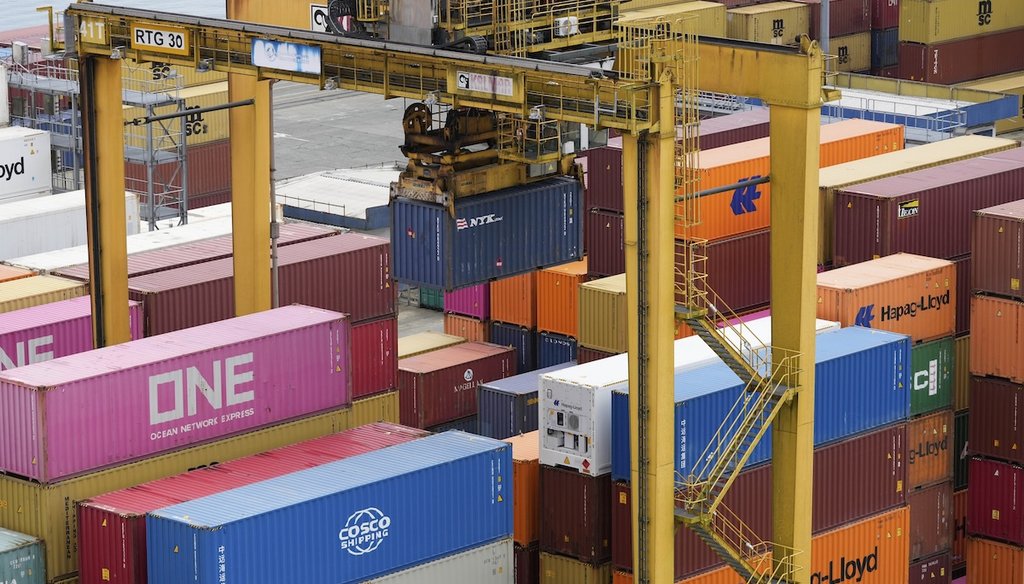
Cranes unload containers from a cargo ship at the seaport in Buenaventura on Colombia's Pacific coast on April 9, 2025. (AP)

For the better part of a year, President Donald Trump imposed 10% across-the-board tariffs, with some countries hit with levies higher than that, fulfilling a 2024 campaign promise.
Then, on Feb. 20, the U.S. Supreme Court overturned the tariffs.
In a landmark 6-3 decision, the justices ruled that Trump cannot use the International Emergency Economic Powers Act to levy tariffs. Trump had justified his most far-reaching assertions of tariff power by citing IEEPA, a 1977 law that allows tariffs on all imports during an "unusual and extraordinary threat" to the U.S. economy, national security or foreign policy.
The court ruled, "When Congress grants the power to impose tariffs, it does so clearly and with careful constraints. It did neither in IEEPA."
In remarks after the decision, Trump promised to forge ahead with alternate strategies for imposing tariffs, using other laws that are more likely to withstand judicial scrutiny.
Trump wrote on Truth Social that he would soon sign an executive order for a 10% "global tariff" using Section 122 of the 1974 Trade Act, which allows the president to address "large and serious" balance-of-payments deficits through import surcharges, quotas or a combination of the two.
The libertarian Cato Institute, which generally opposes tariffs, wrote in a blog post after the court's decision that the administration "could replicate most of the IEEPA tariff structure through Section 122 in short order" without lengthy investigations that other trade statutes require.
Investigations usually target specific classes of products, "typically take three months or more, but they probably could be completed in much less time and still be judgment-proof" in the courts, said David A. Gantz, an emeritus law professor at the University of Arizona. These could be used to impose many tariffs against China as well as those on "steel, aluminum, copper, autos and auto parts, kitchen cabinets, furniture and pharmaceuticals," he said.
The downside of Section 122 tariffs for Trump is that they expire after 150 days unless Congress extends them, which could prove complicated in an election year. The provision also hasn't been used this way before, so it is subject to legal challenge, said Boise State University political scientist Ross Burkhart. It's also unclear whether "balance of payments" would be legally equivalent to trade.
In his Truth Social post, Trump said he would use another law not affected by the Supreme Court decision: Section 301 of the 1974 Trade Act, which allows tariffs when the president determines that a foreign country "is unjustifiable and burdens or restricts United States commerce" through trade agreement violations. This requires that executive branch officials investigate and find a violation.
Julian Arato, a University of Michigan law professor, told PolitiFact that although Trump still has paths he can pursue to impose tariffs, "It doesn't mean it will be easy. The other statutory authorities require various degrees of process, and my sense is that the court's tariff opinion should also serve as notice that too much bending of these procedural constraints may not be tolerated by the courts."
The Supreme Court decision is a significant setback for the 10% baseline tariff, but Trump has already said he would seek to use other legal tools to make it happen. Success is far from assured, but there's a path. So we rate this promise In the Works.
Our Sources
Supreme Court, Learning Resources Inc. v. Trump, Feb. 20, 2026
Section 338 of the Tariff Act of 1930
Section 232 of the Trade Expansion Act of 1962
Section 122 of the Trade Act of 1974
Section 301 of the Trade Act of 1974
Section 203 of the International Emergency Economic Powers Act
Donald Trump, Truth Social post, Feb. 20, 2026
Cato Institute, "The Supreme Court Got It Right on IEEPA—But Don't Pop the Champagne Yet," Feb. 20, 2026
Reed Smith, "Trump 2.0 tariff tracker," accessed Feb. 20, 2026
New York Times, live blog coverage of Supreme Court decision, Feb. 20, 2026
PolitiFact, "Can President-elect Donald Trump enact tariffs without Congress? And can anyone stop him?" Dec. 2, 2024
PolitiFact, "The now-paused tariffs Trump touted as reciprocal actually weren't," April 14, 2025
PolitiFact, "Supreme Court strikes down use of primary law Donald Trump used to impose tariffs," Feb. 20, 2026
Interview with Ross Burkhart, Boise State University political scientist, Feb. 20, 2026
Email interview with Meredith Kolsky Lewis, University at Buffalo law professor, Feb. 20, 2026
Email interview with David A. Gantz, emeritus law professor at the University of Arizona, Feb. 20, 2026
Email interview with Julian Arato, University of Michigan law professor, Feb. 20, 2026