Get PolitiFact in your inbox.
Supreme Court restricts president’s ability to unilaterally set high Chinese tariffs

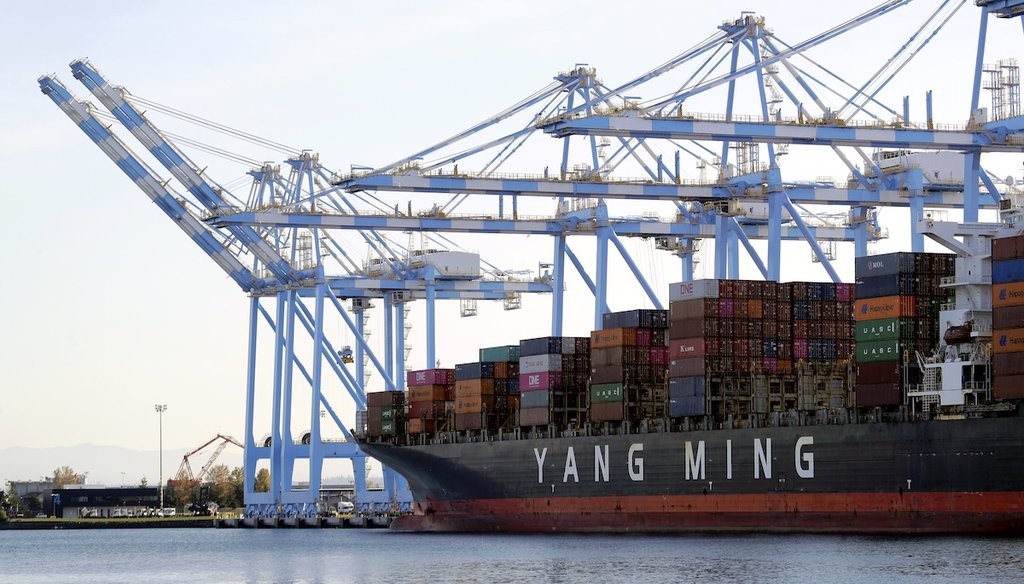
Cargo cranes remove containers from a Yang Ming Marine Transport Corp. boat at the Port of Tacoma in Tacoma, Wash. in 2019. (AP)

A 6-3 Supreme Court decision on Feb. 20 hampered major aspects of President Donald Trump's tariff policy, but its impact on Chinese tariffs was more modest.
The ruling barred Trump from using the International Emergency Economic Powers Act to levy tariffs. Trump had justified his most far-reaching assertions of tariff power by citing IEEPA, a 1977 law that allows tariffs on all imports during an "unusual and extraordinary threat ... to the national security, foreign policy or economy of the United States."
The court ruled that "when Congress grants the power to impose tariffs, it does so clearly and with careful constraints. It did neither in IEEPA."
This amounted to a major setback for several key Trump tariff efforts, including reciprocal tariffs and a 10% baseline tariff rate for U.S. trading partners.
It also curbed Trump's tariff efforts on China — but not entirely.
China, like most U.S. trading partners, is subject to a 10% across-the-board tariff; that seems to be invalidated by the Feb. 20 ruling, though Trump has said he would seek to revive the 10% baseline tariff using a different law.
Trump also enacted a 10% tariff to punish China over its production of fentanyl. This could also be at risk from the justices' ruling.
But because the justices did not touch other tariff laws, Trump could impose tariffs on certain products or sectors once an investigation is completed — and these could be important tools in the U.S. trade fight with China.
Trump has imposed a tariff on Chinese semiconductors, though it won't come into effect until June 2027 and the percentage hasn't been set. This remains on track because it was based on Section 301 of the 1974 Trade Act, which allows tariffs when the president determines that a foreign country "is unjustifiable and burdens or restricts United States commerce" through violations of trade agreements. This requires a finding by executive branch officials after an investigation.
Other tariffs on a wide range of Chinese products are also in effect, often based on either Section 301 or Section 232 of the 1962 Trade Expansion Act, which lets the president impose tariffs if national security is threatened. Both Trump and President Joe Biden used Section 232 as the basis for steel and aluminum tariffs imposed since 2018.
The administration could investigate a range of Chinese products and use these laws to impose tariffs, trade experts said.
Investigations under these provisions "typically take three months or more, but they probably could be completed in much less time and still be judgment-proof" in the courts, said David A. Gantz, an emeritus law professor at the University of Arizona. These could be used to impose many tariffs against China as well as those on "steel, aluminum, copper, autos and auto parts, kitchen cabinets, furniture and pharmaceuticals," he said.
The range of Chinese goods Trump might be able to tariff this way remains to be seen. So is the question of whether the rate could reach 60%. But Trump has some tools to work with, so we rate this In the Works.
Our Sources
Supreme Court, Learning Resources Inc. v. Trump, Feb. 20, 2026
Section 338 of the Tariff Act of 1930
Section 232 of the Trade Expansion Act of 1962
Section 122 of the Trade Act of 1974
Section 301 of the Trade Act of 1974
Section 203 of the International Emergency Economic Powers Act
Donald Trump, Truth Social post, Feb. 20, 2026
Cato Institute, "The Supreme Court Got It Right on IEEPA—But Don't Pop the Champagne Yet," Feb. 20, 2026
Reed Smith, "Trump 2.0 tariff tracker," accessed Feb. 20, 2026
New York Times, live blog coverage of Supreme Court decision, Feb. 20, 2026
PolitiFact, "Can President-elect Donald Trump enact tariffs without Congress? And can anyone stop him?" Dec. 2, 2024
PolitiFact, "The now-paused tariffs Trump touted as reciprocal actually weren't," April 14, 2025
PolitiFact, "Supreme Court strikes down use of primary law Donald Trump used to impose tariffs," Feb. 20, 2026
Interview with Ross Burkhart, Boise State University political scientist, Feb. 20, 2026
Email interview with Meredith Kolsky Lewis, University at Buffalo law professor, Feb. 20, 2026
Email interview with David A. Gantz, emeritus law professor at the University of Arizona, Feb. 20, 2026
Email interview with Julian Arato, University of Michigan law professor, Feb. 20, 2026