Get PolitiFact in your inbox.
Trump’s tax bill includes $1,000 bonus for U.S. citizen newborns through 2028

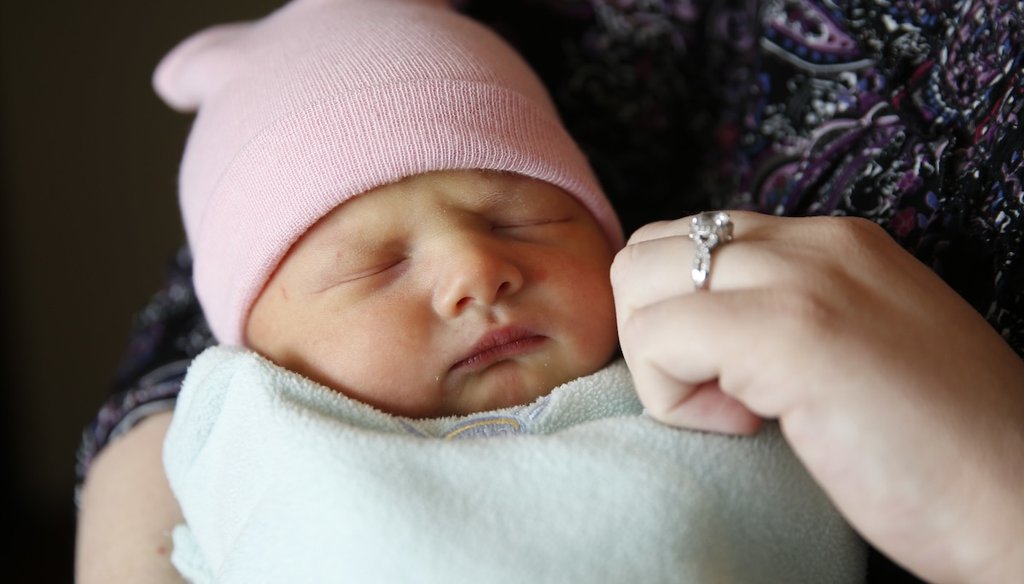
A mother holds her newborn child after her blood was collected at Community Hospital North in Indianapolis on May 12, 2016. (AP)

President Donald Trump's signature tax and spending legislation passed Congress without any Democratic support in either chamber, with critics arguing that it extended tax cuts for the wealthy while reducing safety net programs such as Medicaid and food stamps.
But one provision enacted as part of the bill, which Trump signed July 4, was based on a policy idea that Democrats have previously supported: a "baby bonus."
Under this concept, the federal government provides seed money for every newborn; this money grows in tax-favored accounts until the child is an adult.
During Joe Biden's presidency, Democrats such as Sen. Cory Booker, D-N.J., and Rep. Ayanna Pressley, D-Mass., proposed giving $1,000 to every newborn, with subsequent federal payments of as much as $2,000 annually through age 18.
In announcing details of his less expansive — and, for the government, less expensive — plan in June 2025, Trump called it "a pilot program which will make it possible for countless American children to have a strong start in life at no cost to the American taxpayer."
In Trump's enacted version, the federal government will pay the initial $1,000 per newborn, but additional funds to bolster the account would come not from the government but from the child's parents (up to $5,000 a year) or from the parents' employers (up to $2,500 a year, counted separately from the parental deposits).
Contributions to the account aren't tax-deductible on the parents' filings, but the funds in the account would grow without taxation until the money is withdrawn.
All withdrawals have to be made by the beneficiary and start when they're 18. Any withdrawals made after 18 for certain permitted purposes — such as higher education or disaster recovery, or home purchases up to $10,000 — would come without penalties to the account holder but would incur a tax liability. A withdrawal for any other purpose made from age 18 to 59 and a half would incur a 10% penalty and tax liability. The penalties disappear after 59 and a half, but taxes would still be owed.
Consistent with his promise for mass deportation of people illegally in the United States, the bonus is only available to babies who are U.S. citizens. The program will run for four years — covering babies born in 2025, 2026, 2027 and 2028 — and then expire unless it's extended by the next president.
Although the accounts were initially called Money Account for Growth and Advancement accounts — MAGA — they were later changed to "Trump accounts."
Trump promised to create a federal "baby bonus" payment, and his big tax bill did so. We rate this a Promise Kept.
Our Sources
Washington Examiner, "What are Trump accounts? Government launches $1,000 baby bonus," July 8, 2025
Forbes, "$1,000 Baby Bonus Explained: Who Qualifies And How To Get It," July 7, 2025
MSNBC, "The 'Trump Accounts' have a silly name. But they're a good idea anyway," May 27, 2025
Roll Call, "Baby bonus a new twist in Democrats' child tax credit push" June 20, 2023
Vox.com, "Baby bonds could shrink the Black-white wealth gap," Feb. 17, 2021
Email interview with Kyle Pomerleau, senior fellow at the American Enterprise Institute, July 9, 2025