Stand up for the facts!
Our only agenda is to publish the truth so you can be an informed participant in democracy.
We need your help.
I would like to contribute
VA expands legal guardianship for homeless veterans in the courts

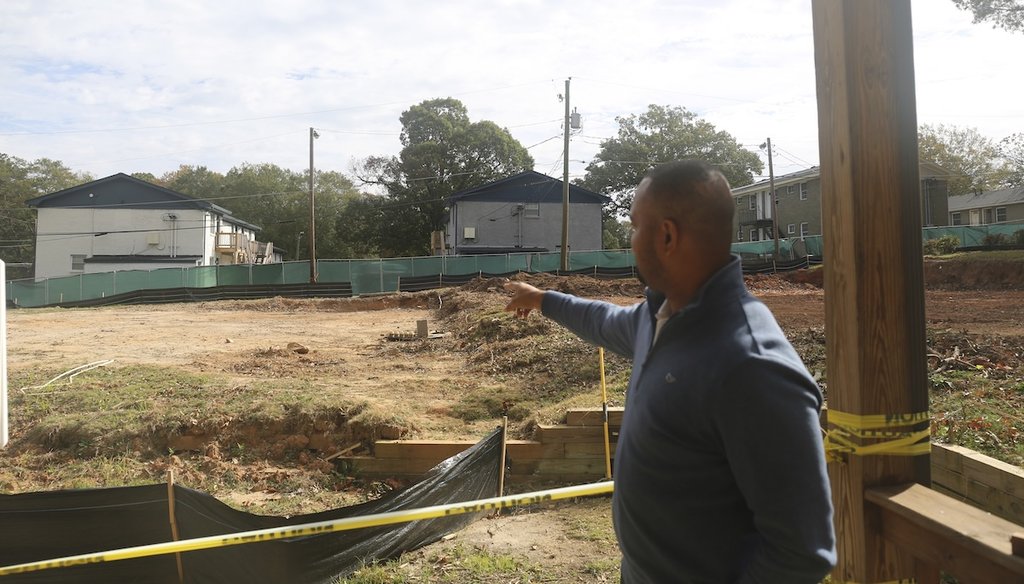
Veterans Empowerment Organization CEO Tony Kimbrough looks over the site on which a two-story building will be built to house 20 formerly homeless veterans in Atlanta, on Oct. 31, 2023. (AP)

The Trump administration is trying to help veterans who can't make their own health decisions navigate the courts.
An internal memo said it could affect "some veterans who are either homeless or at risk of homelessness," which would advance President Donald Trump's promise to end veteran homelessness. But in public, the administration has downplayed the policy change, saying it is not meant to address homelessness.
On March 11, the Department of Veterans Affairs and the Justice Department signed a memorandum to widen the VA's authority to represent veterans in the courts who are "unable to make their own health care decisions."
Under the memorandum, the Justice Department can appoint VA attorneys as "special assistant U.S. attorneys" to pursue legal guardianships in state courts in cases where veterans can't make decisions regarding their health or have no family or legal experts representing them. The guardian assigned to a veteran would be chosen from outside the VA's ranks.
The New York Times obtained an internal memo for a pilot project meant to expand veterans' guardianships, titled Project Safe Harbor. The project chose five VA hubs to test guardianships that would refer veterans into suitable places to live.
On March 18, Thomas O'Toole, the VA's acting assistant undersecretary for health for clinical services, told the House Veterans Affairs Committee that the new policy would help shift approximately 700 veterans without family or legal representation from acute-care VA facilities — but that its effect on homeless veterans would be limited.
"The population that we are targeting with this effort are those veterans who are hospitalized and who are boarding in an acute care bed in a VA facility," O'Toole said. "It is not intended for outreach. It is not intended as a homeless initiative."
Other initiatives by the VA are under way.
Trump signed the Disabled Veterans Housing Support Act in January to give veterans better access to housing programs.
Another VA initiative, Getting Veterans off the Street, instructs the VA's health care facilities to offer homeless veterans benefits, behavioral health services, housing and health care. So far, the VA said this initiative has helped place about 26,000 veterans in transitional or permanent housing.
The VA also issued $42 million in grants to eligible organizations that work on veterans' homelessness.
There are signs of progress, though some predate the Trump administration.
The most recent report by the U.S. Housing and Urban Development Department says veterans saw an 8% decline in homelessness between 2023 and 2024 — one of the only demographics to see a drop. In 2024, about 30,000 veterans experienced homelessness, according to an annual point-in-time count.
The veteran unemployment rate was 3.8% in February, down from 4.1% in January, the Labor Department said. The civilian unemployment rate in February was 4.4%, which is lower than 4.3% in January.
In November, the VA announced it housed more than 51,000 veterans in fiscal year 2025, an approximate increase of 4,000 from the previous fiscal year.
At the same time, the VA shrank by thousands of medical personnel in March after professionals retired or resigned last year, The New York Times reported. VA Secretary Doug Collins said the VA reduced its staff by 30,000 people from 2024 to 2025.
The administration says the new guardianship initiative could ease veterans' homelessness, to a limited degree. We continue to rate this promise In the Works.
Our Sources
The Department of Veterans Affairs, "VA, DOJ sign agreement to improve care for nation's most vulnerable veterans," March 11, 2026
House Committee On Veterans' Affairs, "Full Committee Legislative Hearing," March 18, 2026
The New York Times, "V.A. Begins Drive to Put Some Homeless Veterans Into Guardianship," March 11, 2026
The U.S. Department of Housing and Urban Development, "The 2024 Annual Homelessness Assessment Report (AHAR) to Congress," December 2024
The Department of Labor, "Veteran Unemployment Rate was 3.9% in February," March 6, 2026
The Department of Veterans Affairs, "VA houses largest number of homeless Veterans in seven years," Nov. 18, 2025
Office of Inspector General, "VHA Facilities' Collection and Oversight of Specialty Care Call Data," Feb. 19, 2026
The New York Times, "Despite Promises, Veterans Affairs Department Cut THousands of Roles for Doctors and Nurses," March 3, 2026
PolitiFact, "President Trump hasn't ended veteran homelessness, but he signed legislation aimed at doing so," Feb. 20, 2026
The White House, "Congressional Bill H.R. 224, H.R. 1823, H.R. 4446 Signed into Law," Jan. 30, 2026
GOV Info, HOUSING AND COMMUNITY DEVELOPMENT ACT OF 1974: Title I; sections 210 and 213; title VI; and sections 802, 809, 817, and 819, accessed Feb. 18, 2026
The Department of Veterans Affairs, "Getting Veterans off the street: A new step toward ending Veteran homelessness," July 13, 2025
The Department of Veterans Affairs, "VA announces $42M in grants to fight Veteran homelessness," June 11, 2025
Doug Collins, "Message from VA's Secretary," Jan. 16, 2026