Get PolitiFact in your inbox.
Trump’s executive order doesn’t change death penalty precedent

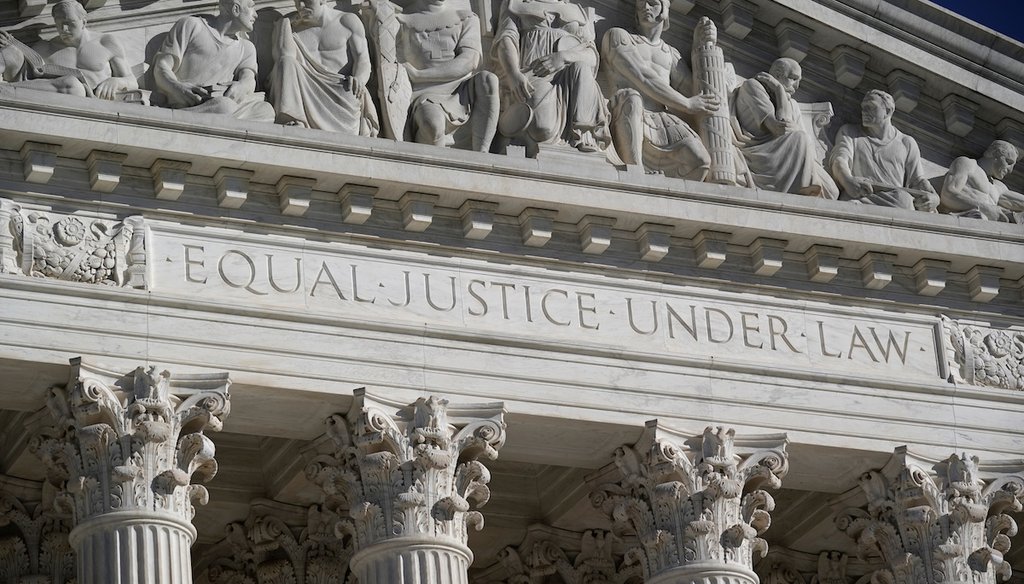
The Supreme Court facade is seen in Washington, Nov. 4, 2020. (AP)

During his 2024 presidential campaign, Donald Trump promised to seek the death penalty for child rapists and child traffickers.
After taking office in 2025, Trump issued an executive order to resume federal executions. The attorney general lifted a moratorium implemented by the Biden administration.
It remains to be seen whether the executive order can be legally applied to child rapists and child traffickers. Legal precedent prohibits the death penalty for crimes that did not result in death.
The executive order:
-
Did not mention rape or child trafficking. It directed the attorney general to "pursue the death penalty for all crimes of a severity demanding its use," and it specified pursuing the death penalty for federal capital crimes involving the killing of a law enforcement officer and committed by people in the country illegally.
-
Directed a review of the imprisonment conditions of 37 people convicted of murder whose sentences former President Joe Biden commuted. Biden's actions had taken them off of death row and reclassified their sentences to life without possibility of parole. The order said these people included rapists and child molesters. One person had a record of sexually assaulting children, but he was sentenced to death for a different crime: the murder of an adult woman.
When contacted for comment, a Justice Department spokesperson referred PolitiFact to its lifting of the federal death penalty moratorium, and said the agency continues to seek ways to implement Trump's executive order.
Experts told PolitiFact the executive order contradicts legal precedent, including Kennedy v. Louisiana, a 2008 decision in which the Supreme Court ruled imposing the death penalty for the rape of a child when no one died violates the U.S. Constitution's Eighth Amendment prohibiting "cruel and unusual punishment."
"A death would have to result for an offense like the rape or trafficking of a child to constitute a death-eligible offense," said Alexandra Klein, Washington & Lee University School of Law associate professor.
Although the executive order directed efforts to overrule Supreme Court precedents, Klein said, precedent can't be overturned without a case before the Supreme Court.
"There would have to be a criminal trial and conviction and a capital sentence for that offense (which the Eighth Amendment forbids under current law), followed by appeals that raised that specific constitutional issue," she wrote in an email.
There have been some state efforts to overturn Kennedy v. Louisiana, but no case has made it to the Supreme Court, based on a search of news reports.
In 2025, Arkansas, Florida, Idaho and Oklahoma passed legislation allowing the death penalty for sex crimes against children. The Death Penalty Information Center said the laws are contrary to Kennedy v. Louisiana.
While Trump has issued an executive order to restore the death penalty, it does not change legal precedent that bars the death penalty for crimes that did not result in death. We rate this promise Stalled.
Our Sources
The White House, Restoring the Death Penalty and Protecting Public Safety, Jan. 20, 2025
Death Penalty Information Center, The Death Penalty in 2025, accessed Feb. 19, 2026
KFOX14, Trump will charge doctors for 'sexual mutilation' of children, campaign says, Aug. 20, 2024
The Hill, Trump's death penalty push gains traction in statehouses, Oct. 13, 2025
Email interview, Alexandra Klein, Washington and Lee University School of Law associate professor of law, Feb. 18, 2026
Email interview, James Coleman, Duke University law professor, Feb. 19, 2026
Emailed statement, Department of Justice spokesperson, Feb. 19, 2026
Emailed statement from the White House, Feb. 19, 2026