Stand up for the facts!
Our only agenda is to publish the truth so you can be an informed participant in democracy.
We need your help.
I would like to contribute
Trump’s effort to change voter ID laws stalls

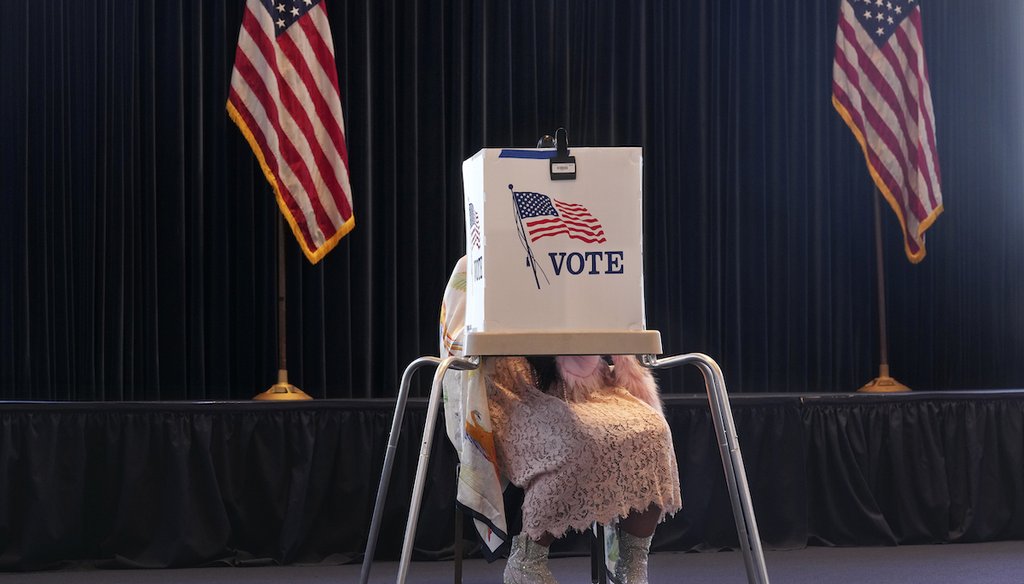
A voter works on her ballot at a polling place at the Ronald Reagan Presidential Library on Election Day, Tuesday, Nov. 5, 2024, in Simi Valley, Calif. (AP)

President Donald Trump repeatedly told voters that every state needs voter ID, but during his first year in office he didn't change state ID rules — something that isn't in his purview as president.
"Voter I.D. Must Be Part of Every Single Vote. NO EXCEPTIONS! I Will Be Doing An Executive Order To That End!!!," Trump said in an August Truth Social post. "Also, No Mail-In Voting, Except For Those That Are Very Ill, And The Far Away Military. USE PAPER BALLOTS ONLY!!!"
No such executive order followed. States set laws on voter ID — not the federal government.
Trump's promise to require voter ID at the polls is one of about 75 promises we are tracking on our MAGA-Meter. Trump's related voting promise to require proof of citizenship at the polls is rated Stalled, as is his promise to count all votes on election night.
We asked the White House what steps Trump had taken to require voter ID. A spokesperson sent a list of examples of many Republican-led states taking steps to remove dead people or potential noncitizens from the voter rolls.
But that's not akin to changing voter ID rules, and state searches for noncitizens voting have turned up small numbers among millions of voters. Louisiana, for example, found 79 noncitizens have voted since the 1980s.
White House spokesperson Abigail Jackson told PolitiFact that the administration has been working with states to protect election integrity.
"The Trump Administration remains committed to securing our elections and ensuring only American citizens vote in American elections," Jackson said.
The Constitution, specifically the Elections Clause, Art. I, Sec. 4, makes clear that only state legislatures, or Congress, have the power to regulate elections, said David J. Becker, executive director of The Center for Election Innovation & Research, an organization that aims to restore trust in the American election system.
"The President has attempted to pressure states to change election laws, but he has no power to do so," Becker said.
Jonathan Diaz, a lawyer at the Campaign Legal Center, said Congress could pass laws related to elections but it has not legislated on voter ID, or another Trump promise to require only paper ballots.
According to the National Conference of State Legislatures, 36 states request or require voters to show some form of ID at the polls, with variation as to whether a photo ID or another form of identification is accepted. The remaining 14 states and Washington, D.C., require no form of identification to vote at the polls but use other methods to verify voters' identities, such as matching voters' signatures or asking voters for personal information. Federal law requires first-time voters to show ID when requesting mail ballots, while some states have additional ID requirements for voters mailing in ballots.
Trump's quest to overhaul election laws is built on the falsehood that Democrats stole the 2020 election. Some other complaints about the election system also don't hold up to scrutiny.
Voter impersonation at the polls is rare. We found in 2016 that people were more likely to be struck by lightning than to impersonate someone else at the polls.
Trump has time before the midterms to take action related to voter ID, but any effort to control state laws would result in lawsuits.
We rate this promise Stalled.
RELATED: Trump's actions could affect the 2026 midterm elections. What will it mean for voters?
Our Sources
President Donald Trump, Truth Social post, Aug. 30, 2025
Missouri Secretary of State Denny Hoskins, Secretary Hoskins Highlights Ongoing Election Integrity Efforts, July 30, 2025
Louisiana Illuminator, Louisiana election investigation finds 79 noncitizens have voted since 1980s, Sept. 4, 2025
Votebeat, New federal ruling is latest defeat to Trump administration's election agenda, Jan. 13, 2026
Votebeat, Hundreds of Texas voters flagged as potential noncitizens may have already proven their citizenship, Dec. 2, 2025
NPR, A federal judge dismisses the DOJ's effort to get voter data from California, Jan. 15, 2026
Brennan Center for Justice at NYU school of law, Tracker of Justice Department Requests for Voter Information, Updated Jan. 16, 2026
President Donald Trump, Preserving and Protecting the Integrity of American elections executive order, March 25, 2025
PolitiFact, Fact-check: Trump relies on falsehoods when pushing voting changes in speech to governors, Feb. 16, 2025
Email interview, White House spokesperson Abigail Jackson, Jan. 16, 2026
Email interview, David Becker, executive director and founder, The Center for Election Innovation & Research, Jan. 16, 2026
Email interview, Jonathan Diaz, Campaign Legal Center, director, voting advocacy and partnerships, Jan. 16, 2026