Get PolitiFact in your inbox.
Trump’s promise to count all votes on election night stalls as related case heads to Supreme Court

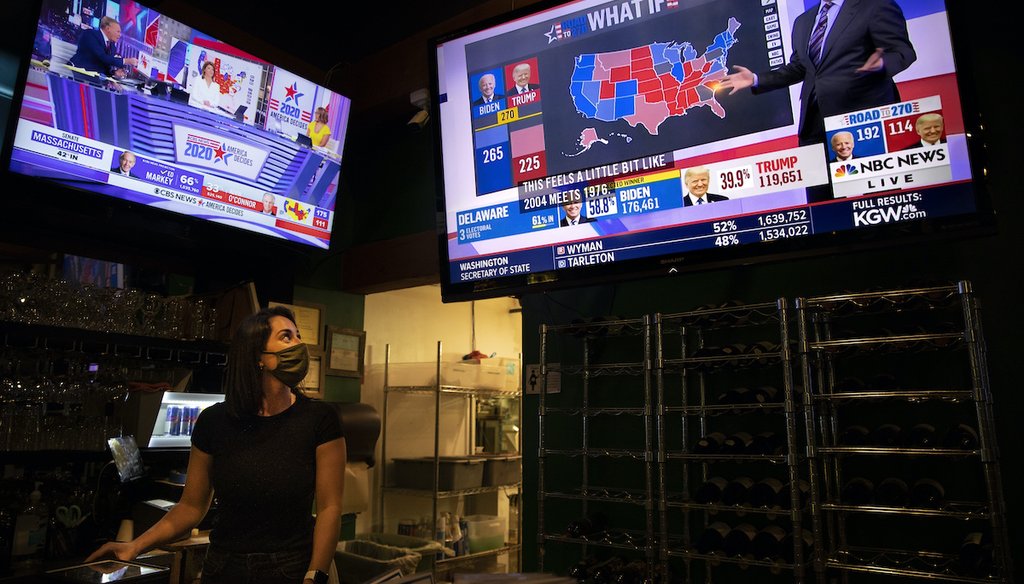
Bartender Sam Schilke watches election results on television at a bar and grill, Nov. 3, 2020, in Portland, Ore. (AP)

Courts have disagreed with President Donald Trump's efforts to mandate that states change their mail ballot deadlines, but a related case is headed to the U.S. Supreme Court before the midterms.
Trump said during the campaign that "we want all votes counted on election night."
In March, Trump issued an executive order that said only mail ballots received by Election Day can be counted and threatened to withhold funding from states that don't comply.
Most states require mail ballots be received by Election Day. But about 14 states allow ballots to be counted if received after Election Day, as long as they were postmarked by Election Day. (The 14 are Alaska, California, Illinois, Maryland, Massachusetts, Mississippi, Nevada, New Jersey, New York, Oregon, Texas, Virginia, Washington and West Virginia.) The rationale is to provide a grace period in case of postal service delays.
Federal courts have blocked Trump's order, including in a case filed by Oregon and Washington and a separate case filed by California and 18 other states.
Conservative groups including the Republican National Committee filed a lawsuit against Mississippi challenging its law, which says election officials must count mail ballots received up to five business days after Election Day if postmarked by Election Day. Their argument is that ballots received after that day should not be counted because federal law sets the Tuesday after the first Monday in November in certain years as Election Day for federal offices.
The Supreme Court will hold oral arguments on March 23 and is expected to rule before the midterms. Voting rights advocates challenging the lawsuit predict that changing the rules will create voter confusion.
Even if the court rules in favor of the plaintiff and bans election officials from counting mail ballots received after Election Day, that would not mean official election results would be available on election night. State laws set deadlines that give officials weeks to finish the process of counting all eligible ballots. When the margins are far enough apart, media outlets can project winners based on partial results.
We will revisit this promise after the Supreme Court rules, but for now we rated it Stalled.
Our Sources
Fox News, Election integrity groups press Supreme Court to require ballots by Election Day
AP, Judge blocks Trump's elections order in lawsuit by vote-by-mail states Oregon and Washington, Jan. 9, 2026
U.S. Supreme Court, Watson v RNC, 2025
Brennan Center for Justice at NYU Law, Watson v. Republican National Committee, Jan. 21, 2026
President Donald Trump, Executive order, March 25, 2025
White House, Fact sheet, March 25, 2025
National Conference of State Legislatures, Table 11: Receipt and Postmark Deadlines for Absentee/Mail Ballots, Aug. 1, 2025
U.S. District Court of Massachusetts, State of California v. Trump, 2025
State of California v. Trump, Preliminary injunction, June 13, 2025
U.S. District Court of Massachusetts, Memorandum and order, June 2025
California Attorney General Rob Bonta, Attorney General Bonta Co-Leads Multistate Lawsuit Against Trump Administration Over Unlawful Executive Order Seeking to Impose Sweeping Voting Restrictions, April 3, 2025
California Attorney General Rob Bonta, Attorney General Bonta Defeats Trump Administration's Effort to Dismiss States' Lawsuit over Unlawful Elections Executive Order, Sept. 17, 2025
3 U.S. Code § 1 - Time of appointing electors
3 U.S. Code § 21 - Definitions
California Attorney General's office, Statement to PolitiFact, Feb. 18, 2026
Email interview, Mike Faulk, spokesperson, Washington State Attorney General's Office, Feb. 16, 2026
Email interview, Jason Snead, executive director, Honest Elections Project, Feb. 18, 2026