Stand up for the facts!
Our only agenda is to publish the truth so you can be an informed participant in democracy.
We need your help.
I would like to contribute
In rebuke of Trump, Supreme Court says states can count postmarked, late-arriving ballots

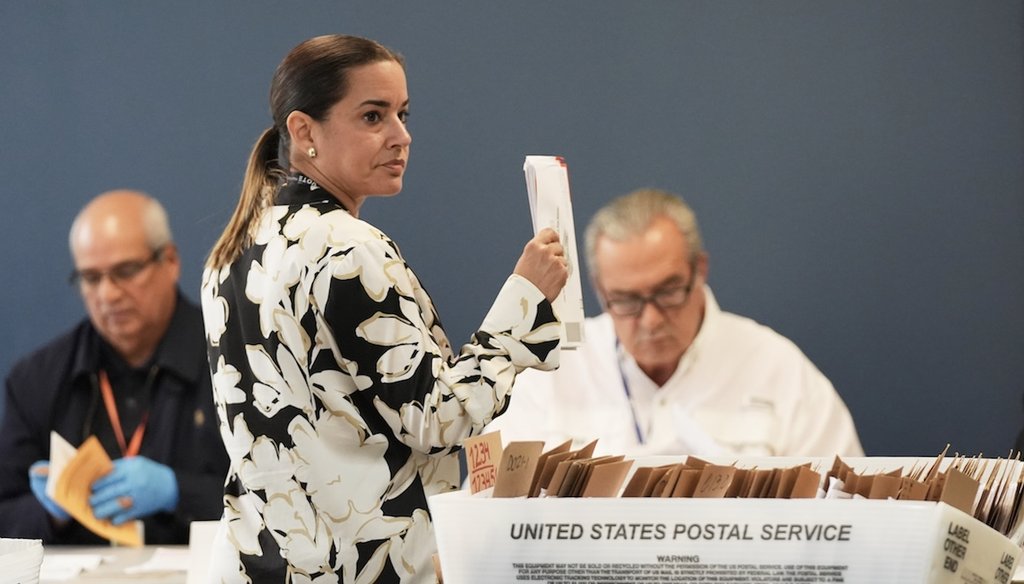
Employees sort vote-by-mail ballots for municipal elections on Election Day at the Miami-Dade County Supervisor of Elections Office on Nov. 4, 2025, in Doral, Fla. (AP)

In a decision that thwarted a priority of President Donald Trump, the U.S. Supreme Court said in a 5-4 ruling that states are allowed to count mail ballots postmarked by Election Day but received later.
The ruling effectively blocks Trump's campaign promise to count all votes by election night.
Conservative groups and the Republican National Committee had challenged a Mississippi law that says officials must count mail ballots received up to five business days after the election, as long as they are postmarked by Election Day.
"Nothing in the federal election-day statutes requires ballots to be received by election day," said the majority opinion, written by Justice Amy Coney Barrett and joined by Chief Justice John Roberts and the three liberal justices, Ketanji Brown Jackson, Elena Kagan and Sonia Sotomayor.
The decision in Watson v. Republican National Committee "keeps the status quo intact," said Jonathan Diaz, director of voting advocacy and partnerships with the Campaign Legal Center, a voting advocacy group. "There are no changes to state ballot receipt deadlines, for either military and overseas voters or regular absentee or mail voters."
Most states require that mail ballots be received by Election Day. But 14 states — Alaska, California, Illinois, Maryland, Massachusetts, Mississippi, Nevada, New Jersey, New York, Oregon, Texas, Virginia, Washington and West Virginia — allow ballots to be counted if received after Election Day, as long as they were postmarked by Election Day. The rationale is to provide a grace period in case of postal service delays.
Another 16 states allow flexibility for a more limited group of voters, such as those casting ballots overseas.
The majority made clear that states and Congress, and not the courts, determine how postmarked, late-arriving ballots are counted, said Sean Morales-Doyle, director of the Brennan Center for Justice's voting rights and elections program.
Legal analysts characterized the decision as a clear loss for the Trump administration.
"The Supreme Court fully rejected the administration's position in Watson, closing the door to court challenges on this particular issue," said Aaron D. Blacksberg, federal policy counsel with the Institute for Responsive Government, a group that works to improve election administration.
Blacksberg said challenges by the Trump administration and its allies are likely to continue on other aspects of election administration. But he and others agreed that the Supreme Court decision marked the end of the road for any effort to block states from counting postmarked, late-arriving mail ballots — at least until Congress acts, which is unlikely given the chambers' current political lineups.
One Trump-driven challenge on mail voting that will be unaffected by the Watson ruling is the effort to require states to provide the Department of Homeland Security and the U.S. Postal Service with lists of eligible mail voters. That provision is blocked by an order from the U.S. District Court for the District of Massachusetts, with further legal skirmishing expected in the coming months.
Another battle over voting rules is the SAVE America Act, which would require people registering to vote or changing their registration to produce documentary proof of citizenship, such as a passport or birth certificate. Trump has prioritized this legislation, but Senate Republicans said they lack the votes to pass it.
In his response to the Supreme Court decision, Trump cited the SAVE America Act.
"In light of the tremendous loss in the Supreme Court today concerning Voter's Rights, and the fact that 'people's' votes are allowed to be counted LONG AFTER an Election is over, it is more important than ever to pass THE SAVE AMERICA ACT," Trump wrote June 29 on Truth Social.
Hours later, Trump called the ruling "very detrimental to honest elections." hours later.
Even if states stopped counting ballots that arrived after Election Day, they would not complete an official final count that night. It takes weeks to process and verify ballots, and state procedures and deadlines vary.
Trump said he wanted all votes counted on election night, but the Supreme Court ruling allows states to continue counting postmarked, late-arriving ballots that arrive within a legal time. We rate this Promise Broken.
RELATED: MAGA-Meter: Tracking Trump's second term promises
RELATED: From booze-filled parties to mail ballots: how did American voting actually evolve
Our Sources
U.S. Supreme Court, decision in Watson v. Republican National Committee, June 29, 2026
Donald Trump, Truth Social post, June 29, 2026
White House, X post, June 29, 2026
Congress.gov, H.R. 7296 - SAVE America Act
National Conference of State Legislatures, "Table 11: Receipt and Postmark Deadlines for Absentee/Mail Ballots," accessed June 29, 2026
Washington Post, "Federal court blocks Trump's executive order limiting mail ballots," June 25, 2026
Email interview with Jonathan Diaz, director of voting advocacy and partnerships with the Campaign Legal Center, June 29, 2026
Email interview with Aaron D. Blacksberg, federal policy counsel with the Institute for Responsive Government, June 29, 2026
Interview with Sean Morales-Doyle, director of the voting rights and elections program at New York University's Brennan Center for Justice, June 29, 2026