Stand up for the facts!
Our only agenda is to publish the truth so you can be an informed participant in democracy.
We need your help.
I would like to contribute
Supreme Court ruled states can ban trans athletes, but it’s not required

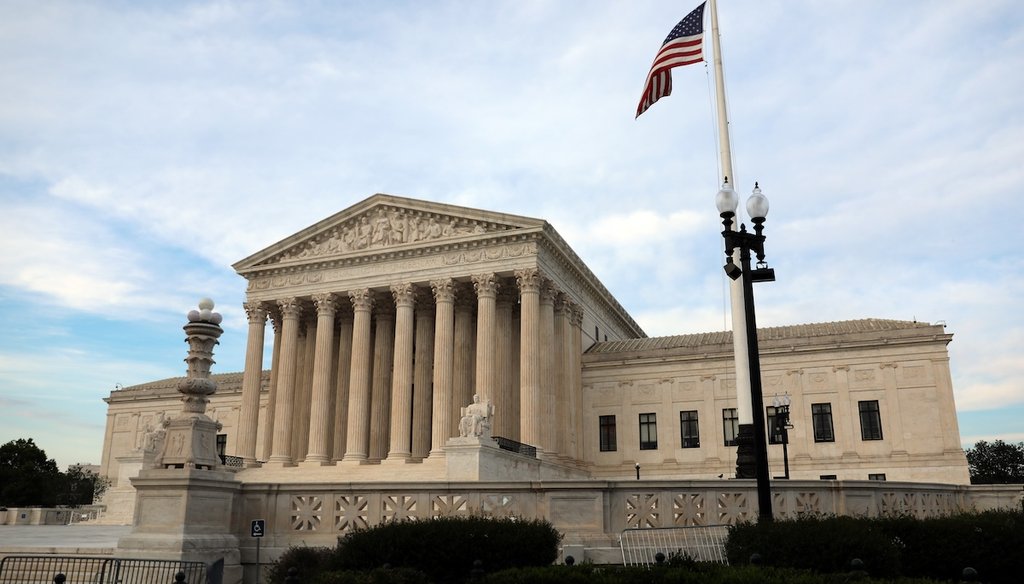
The U.S. Supreme Court is photographed, on Thursday, June 25, 2026, in Washington. (AP)

The U.S. Supreme Court ruled June 30 that states can ban transgender girls and women from competing in girls' and women's sports, but the court didn't require states to adopt that policy, sidestepping a national ban. The ruling is a partial victory for the Trump administration, which has sought a nationwide ban.
The ruling upheld West Virginia and Idaho laws that prohibited transgender women — people whose birth-assigned sex is male but who identify as women — from participating in girls' and women's sports in publicly funded schools and colleges.
In addition to West Virginia and Idaho, 27 additional states have similar laws or policies limiting the participation of transgender athletes.
The court's ruling combined two cases, both brought by transgender athletes who argued their states' laws violated Title IX and the Constitution's equal protection clause by not letting them participate in the sports team that aligned with their gender identity.
Title IX is a 1972 federal law that prohibits sex-based discrimination in federally funded schools. The law is best known for requiring equal athletics participation opportunities for women and men.
The Biden and Trump administrations held opposing views on whether Title IX protects or prohibits transgender athletes, and legal cases wrestling with this question have been progressing through the courts for years.
Ultimately, all nine justices agreed that the West Virginia and Idaho state laws don't violate Title IX. But the justices were split on whether it violated the equal protection clause.
Justice Sonia Sotomayor, joined by Justices Elena Kagan and Ketanji Brown Jackson, argued that the majority's decision to dismiss the equal protection claim was premature. Sotomayor wrote that "unresolved factual questions" prevented the court from assessing the merits of the equal protection claim, and so the court should have returned the case to the lower district court for review.
Although the ruling aligns with Trump's position, it does not fulfill his campaign pledge yet.
The court's majority opinion said Title IX and the equal protection clause lets sports teams determine eligibility based on biological sex — meaning states that want to exclude transgender athletes can.
But the opinion does not require states to implement a ban. The court did not address whether trans-inclusive policies were permissible, and ruled only on whether trans-exclusive policies were allowed.
As lawyer Elana Redfield put it in an email to PolitiFact, "Today's decision makes clear that states MAY enforce Title IX to exclude transgender people, but does not mandate that they MUST." Redfield is the federal policy director at UCLA's Williams Institute, an LGBTQ+ public policy research institute.
This is relevant because 21 states either have no policies on transgender athlete participation or like California, have laws or policies that actively protect transgender athlete participation.
Because the Trump administration takes the position that Title IX prohibits the participation of transgender athletes, over the past two years the Education and Justice departments have both launched numerous investigations into several state education departments, statewide athletic associations and school districts, alleging Title IX violations because of their transgender athlete policies.
So far, the Justice Department has sued state school systems in Maine, California and Minnesota. The lawsuits are ongoing and no federal funding has been revoked.
"The Trump Administration takes the position that sex based eligibility requirements for girls' and women's sports should be mandatory," said Doriane Lambelet Coleman, a Duke University law professor. "The Court today only decided that such standards are permissible, and so the decision doesn't have a direct effect on the Administration's ongoing investigations."
The federal government may attempt to leverage this decision or cite it in their legal cases or enforcement actions against states and schools with trans-inclusive policies. But this ruling alone does not institute a nationwide ban.
This promise remains In the Works.
PolitiFact Staff Writers Caleb McCullough and Gracey Abernethy contributed to this report.
Our Sources
Email interview with Doriane Lambelet Coleman, a law professor at Duke University, June 30, 2026
Email interview with Elana Redfield, federal policy director at the Williams Institute, June 30, 2026
Supreme Court of the United States, West Virginia V. B. P. J., June 30, 2026
West Virginia Legislature, Save Women's Sports Act, March 4, 2021
Idaho Legislature, House Bill 500, February 13, 2020
Movement Advancement Project, LGBTQ Youth: Bans on Transgender Youth Participation in Sports, January 1, 2026
Sports Illustrated, "50 Years of Title IX: How One Law Changed Women's Sports Forever," May 19, 2022
PolitiFact, "Here's how new Title IX regulations could affect LGBTQ+ students," April 26, 2024
PolitiFact, "Executive order threatens Title IX funding, but formal regulations have yet to come," February 28, 2025
PolitiFact, "This Supreme Court case is reshaping LGBTQ+ rights. You probably haven't heard about it," May 20, 2024
State of California Department of Justice, LGBTQ+: Know Your Rights
U.S. Department of Education, OCR Launches Investigations into Illinois DOE, the CHicago Public School District 299, and Deerfield Public Schools District 109 Over Reported Title IX Violations, March 20, 2025
U.S. Department of Education, U.S. Department of Education to Investigate Title IX Violations in Athletics, February 6, 2025
U.S. Department of Education, U.S. Department of Education's Office for Civil Rights Launches Title IX Investigation into Saratoga Springs City School District, May 6, 2025
Court Listener, United States v. Maine Department of Education, accessed June 30, 2026
Court Listener, United States v. California Interscholastic Federation, accessed June 30 2026
U.S. Department of Justice, Justice Department Sues Minnesota to Protect Girls' Sports and Intimate Spaces, March 30, 2026
SCOTUSblog, Court rules that states can exclude transgender athletes from girls' and women's sports teams, June, 30 2026