Stand up for the facts!
Our only agenda is to publish the truth so you can be an informed participant in democracy.
We need your help.
I would like to contribute
Trump cancels $1 billion in federal funding for public broadcasting

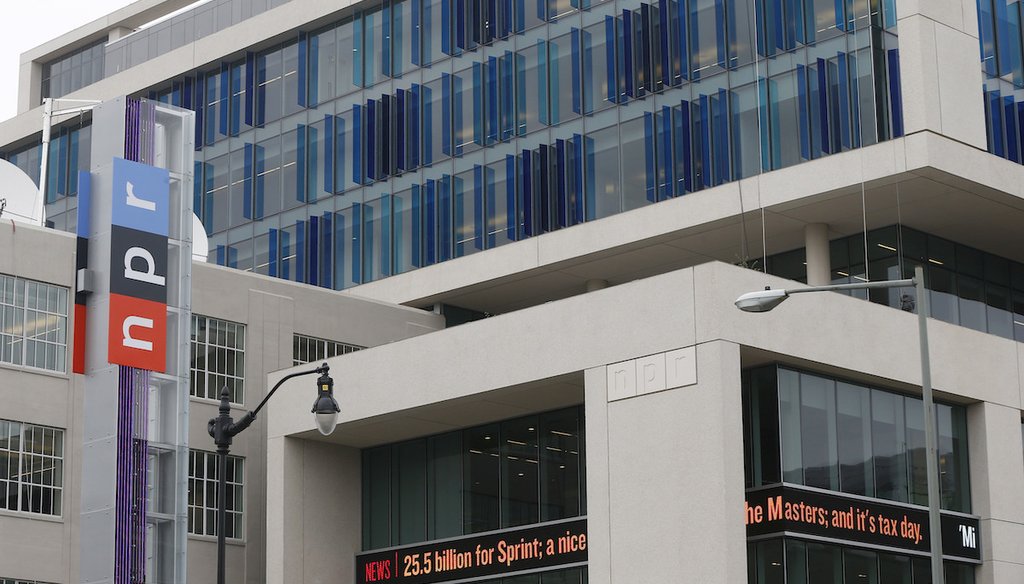
An April 15, 2013, file photo shows National Public Radio headquarters in Washington, D.C. (AP)

President Donald Trump promised to cut federal funding for NPR. On July 18, a Republican-led Congress helped him keep his promise.
The House approved a White House proposal, known formally as a rescissions package, canceling approximately $9 billion in previously approved federal funding. The package arrived to the House after advancing through the Senate in a 51-48 vote early July 17, sending the bill to Trump's desk.
Most of the rollbacks targeted foreign aid spending. The rest — $1.07 billion — rescinded funding for the Corporation for Public Broadcasting, or CPB, a private nonprofit.
CPB distributes the money it receives to NPR, PBS and more than 1,500 local radio and television stations through grants.
"HOUSE APPROVES NINE BILLION DOLLAR CUTS PACKAGE, INCLUDING ATROCIOUS NPR AND PUBLIC BROADCASTING… THIS IS BIG!!!" Trump posted on Truth Social minutes after Congress passed his request early July 18.
The last rescissions package to be enacted was under President Bill Clinton in 1999.
A relatively small portion of NPR's annual operating revenue comes from federal grants. Trump's actions pose the most impact on small news outlets.
The White House request came as part of the Department of Government Efficiency's work under the Trump administration to slash billions of dollars of government programs.
Trump initially proposed a $9.4 billion rescissions package. This was partially amended in the Senate to keep funding for HIV/AIDS prevention research in Africa.
Leading up to Senate debates, Trump implored fellow Republicans to stick to ideological cleavages and said those who didn't support him would not have his endorsement.
The recissions package claws back CPB funding already appropriated for fiscal years 2026 and 2027. Meaning, CPB will not receive the $535 million at the start of fiscal year 2026 in early October.
Since 1975, CPB funding has been appropriated two years in advance. The corporation, as an independent nonprofit, aims to provide stability in public media planning. The advance gives producers and stations more time to secure funding, said CPB spokesperson Tracey Briggs.
NPR President and CEO Katherine Maher said in a July 18 statement that, "Public funding has enabled the flourishing of a uniquely American system of unparalleled cultural, informational, and educational programming, and ensured access to vital emergency alerting and reporting in times of crisis — all for about $1.60 per American, every year."
How federal funding flows to national, local stations
Approximately 80 public radio stations depend on CPB funding for 30% or more of their revenue, NPR spokesperson Heather Walls told PolitiFact via email.
Broadcasters in rural areas often rely disproportionately on federal grants for their operations because a funding formula factors that they have fewer donors and programming sponsors.
Larger market stations typically receive a smaller percentage of CPB funding. Meaning, NPR and PBS aren't as dependent on federal funding to operate.
According to a breakdown of NPR's revenue from fiscal years 2020 to 2024, CPB and federal grants account for approximately 1% of NPR's annual operating budget. For PBS, it's about 15%, The New York Times reported
But for local stations in rural areas, the federal funding cuts deliver the harshest blow.
"It would be very difficult for them to make up the difference of that loss," said Walls.
Many Republicans have attacked NPR and PBS as having a liberal bias. They also argue against the need for public media since most Americans have cell phone and internet access.
Supporters say that rural areas depend on local broadcast stations, especially during emergencies and natural disasters.
Sen. Susan Collins of Maine was one of two Republicans who voted against the rescissions package.
"I share the frustration with the biased reporting by NPR, and I would support defunding it," Collins said in a statement. But local TV and radio stations provide important coverage, she said. "In Maine, this funding supports the emergency alert network, coverage of high school basketball championships, a locally produced high school quiz show, and classical music stations."
Rescissions package, explained
A rescission package is a request to impound, or cancel, funds Congress already approved.
Trump's ability to propose a rescission package comes from the Congressional Budget and Impoundment Control Act of 1974, or ICA.
The act arose under the Nixon administration when the former president was unwilling to spend certain appropriated funds.
"Simply, the impoundment part of the law works this way: If the president wishes to rescind appropriated funds s/he must send a rescission proposal to Congress, which has 45 session days to approve the request. If Congress doesn't approve the request, the President is required to release the funds," Massachusetts Institute of Technology political science professor Charles Stewart III told PolitiFact.
In theory, the ICA protects the constitutional balance of power.
"The power of the purse is Congress's under the Constitution, and on one hand, the fact that Congress must approve of rescissions bills reflects that constitutionality reality," said Molly Reynolds of the Brookings Institution, a nonpartisan think tank in Washington.
After the president sends a "special message," only Congress can authorize the rescission.
"That's Congress acting on a proposal that — yes, comes from the president — but that's not the president's actions. That is Congress acting to change the law," said Julian Davis Mortenson, a University of Michigan law professor.
However, both Reynolds and Devin O'Connor, senior fellow at the Center on Budget and Policy Priorities, told PolitiFact that partisan dynamics at play could undermine Congress's spending powers going forward.
Because of the filibuster, the congressional budget requires 60 votes to pass the Senate. Rescissions packages, on the other hand, can undo a bipartisan budget deal with a simple majority. In that regard, Republicans can use their 53-47 majority to pass it along party lines with fewer obstacles.
Reynolds said that could make reaching congressional agreement on spending deals more difficult.
"If members don't have reason to believe that the president will stick to a deal they have reached, what incentive do they have to do the hard work of reaching a deal in the first place?" she said.
Our ruling
Trump promised to cancel federal funding for NPR.
The White House asked Congress on June 3 to cut $9.4 billion in already approved spending, which included more than $1 billion for the Corporation for Public Broadcasting. CPB appropriations are distributed to NPR, PBS and more than 1,500 local radio and television stations through grants.
Congress approved Trump's request July 18.
We rate this Promise Kept.
Our Sources
President Donald Trump, Rescissions request, May 28, 2025
Donald Trump, Truth Social post, July 10, 2025
Sen. Bill Cassidy, X post, April 29, 2024
Committee on Oversight and Government Reform, DOGE Subcommittee Chairwoman Marjorie Taylor Greene Opens Hearing with NPR and PBS Executives, March 26, 2025
Government Accountability Office, Updated Rescission Statistics, Fiscal Years 1974–2020
Fox News, Trump sends $9.4 billion DOGE cuts proposal to Congress, targeting NPR, PBS, June 3, 2025
Senate vote on Passage of the Bill (H.R. 4, As Amended ) Roll Call Vote 119th Congress - 1st Session, July 17, 2025
U.S. Senate, About Filibusters and Cloture
Congressional Budget and Impoundment Control Act of 1974
2 U.S. Code § 683 - Rescission of budget authority
NPR public radio finances, FY20-FY24
The Poynter Institute, Opinion | The U.S. government is one step closer to defunding NPR, PBS, June 13, 2025
The Poynter Institute, Through widespread outages and collapsed infrastructure, North Carolina journalists hustle to cover Helene's aftermath, October 1, 2024
The New York Times, What Will Funding Cuts Do to NPR and PBS?, July 14, 2025
WABI 5, Senator Collins releases a statement on rescissions legislation, July 15, 2025
Center on Budget and Policy Priorities, Rescission Package Would Sabotage Recent Funding Deal, Cripple Future Ones, July 15, 2025
President and CEO of NPR Katherine Maher press release, Unprecedented Rescission Bill Defunds Public Media, July 18, 2025
Telephone interview, Julian Davis Mortenson, University of Michigan law professor, July 16, 2025
Email interview, Corporation for Public Broadcasting spokesperson Tracey Briggs, July 18, 2025
Email interview, PBS spokesperson Kayla Springer, July 18, 2025
Email interview, NPR spokesperson Heather Walls, July 16, 2025
Email interview, Molly Reynolds, senior fellow at Brookings Institution, July 16, 2025
Email interview, Devin O'Connor, senior fellow at Center on Budget and Policy Priorities, July 16, 2025
Email interview, Charles Stewart III, Massachusetts Institute of Technology professor, July 16, 2025