Get PolitiFact in your inbox.
Lawmakers look to reset fuel economy rules, cut incentives to end electric vehicle goals

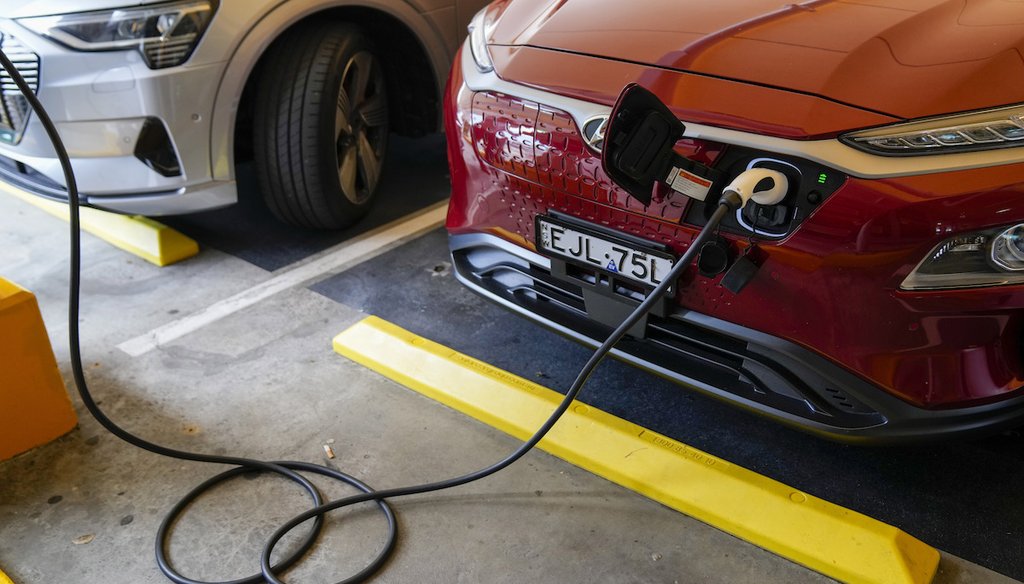
An electric car gets charged at a supermarket parking lot in Sydney, Australia. (AP)

In his second term, President Donald Trump has rolled back nearly all incentives encouraging Americans to buy electric cars.
Trump signed an executive order on his first day back in office to repeal Biden-era policies on electric vehicles, which he has inaccurately referred to as "mandates." Biden's EV goals did not require the replacement of gas-powered vehicles but sought to encourage more production by adding emissions rules to incentivize automakers.
As his administration has worked to undo Biden-era regulations, Republicans in Congress have pitched in to reverse EV-friendly changes in U.S. law, ending consumer benefits and loosening fuel economy standard enforcement.
The efforts roll up to this: a nearly complete repeal of Biden's EV framework.
Legislative measures
The One Big Beautiful Bill Act, which Trump signed into law in July 2025, resulted in significant changes for the auto industry's electric vehicle incentives.
The law eliminated $7,500 tax credits for buying or leasing new EVs and $4,000 for used ones.
It also dropped penalties for automakers failing to comply with Corporate Average Fuel Economy standards, which regulate the distance a vehicle must travel on one gallon of gasoline.
The law ended a tax credit for properties with alternative fuel refueling infrastructure, including electric car chargers, on June 30, 2026 — six years before its expiration date.
The BUILD America 250 Act, a sweeping transportation bill introduced in May, would further erode federal support for electric cars. Chris Celek, Electric Vehicle Association executive director, said the bill would add a $130 registration fee on EVs and $35 fee on hybrid vehicles, going beyond what 25 states already charge.
Electrification Coalition spokesperson Noah Barnes said the bill does not reauthorize the National Electric Vehicle Infrastructure program, which provides funding for states to build charging infrastructure for electric cars, and cuts 60% of another grant program for EV charging stations.
Agency and executive action
In December, Trump and Transportation Secretary Sean Duffy proposed a reset of Biden's Corporate Average Fuel Economy standards for passenger cars and light trucks, saying the change would allow automakers to comply while producing gasoline and diesel vehicles.
The Transportation Department press office told PolitiFact new regulations about heavy-duty pickup trucks and vans are expected later this year.
The federal government has also stalled on approving roughly $1 billion for about 20,000 charging ports, Barnes said. The Federal Highway Administration has not approved about 145 projects.
Barnes said the Federal Highway Administration is likewise considering Buy America requirements for chargers funded by the National Electric Vehicle Infrastructure program. If rules are adopted without enough lead time or industry input, they could temporarily disqualify a large share of equipment suppliers.
Both of those actions delay the deployment of further EV infrastructure, Barnes said.
California Attorney General Rob Bonta accused the Trump administration of illegally suspending the programs by refusing to spend allocated funds for projects. He sued over the move with a state coalition.
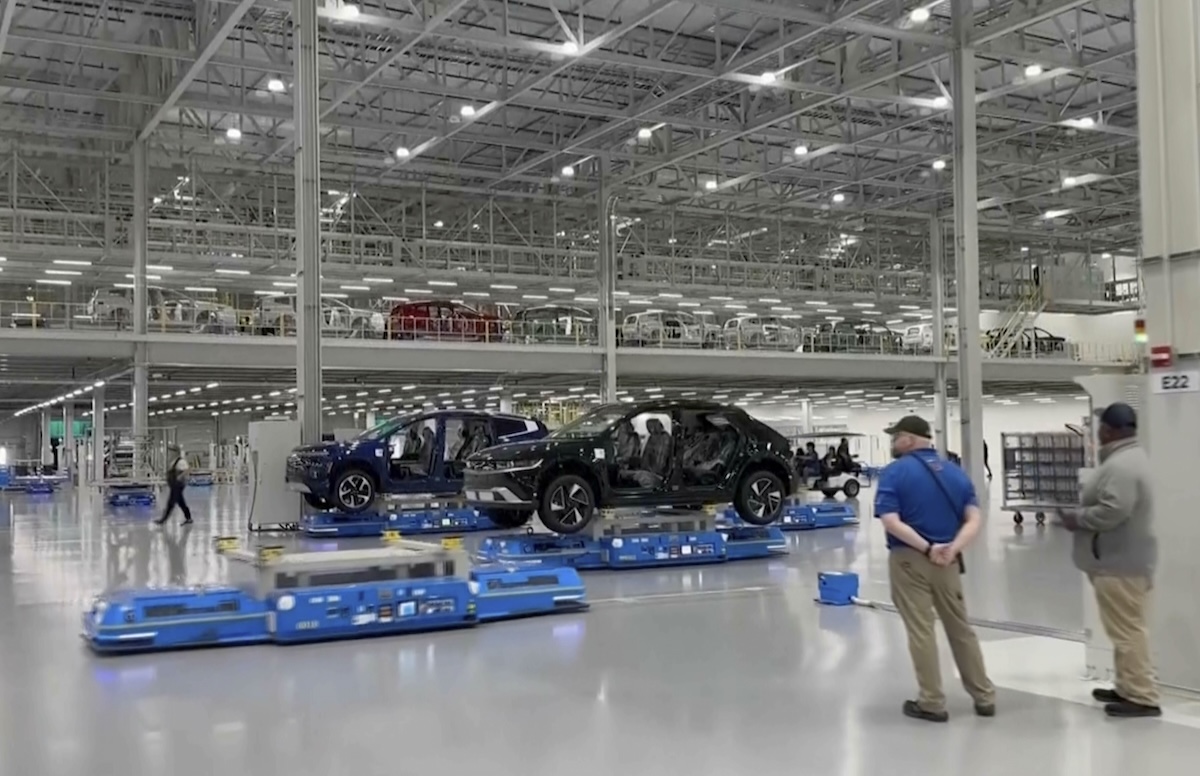
Electric cars are assembled at a Hyundai electric vehicle plant in Ellabell, Ga., on March 26, 2025. (AP)
The Trump administration has worked to undo other emission regulations.
In February, the Environmental Protection Agency repealed the 2009 Greenhouse Gas Endangerment Finding, removing the foundation of vehicles' greenhouse gas emissions standards.
Trump overturned rules in June 2025 allowing California to set its own regulations for emissions, which the president called an "attempt to impose a nationwide electric vehicle mandate." In March, the Justice Department sued the state over its EV policies.
For all of its efforts, Trump's policies discouraging electric car adoption haven't been consistent.
E&E News reported that Trump's Energy Department set fuel economy standards that could force automakers to manufacture more EVs if penalties for failing to comply with the rules eventually resume.
The Trump administration's proposal to reclassify SUVs as passenger vehicles could force even more EV production, given that SUVs' fuel economy would then drive up fuel use and require companies to produce more EVs to balance out.
Barnes said the end of incentives for electric cars produced a short-term dip in demand, though the overall trend is up. Celek also said higher gasoline prices from the Iran war were driving an increase in EV sales.
The Energy Department did not respond to our questions about the E&E News report or further EV policy.
Our ruling
Trump has dismantled many regulations that encourage EV adoption in the U.S., but more work remains on resetting fuel economy standards and ending Biden-era programs that funded EV infrastructure.
This promise remains In the Works.
Our Sources
White House, "Unleashing American Energy," January 20, 2025
White House, statement by the president on repealing rules for California to set its own emissions standards, June 12, 2025
Reuters, "US electric vehicle tax breaks will expire on Sept. 30," July 3, 2025
Sidley Environmental, Health, and Safety Brief, "Congress Eliminates Corporate Average Fuel Economy (CAFE) Penalties for Passenger Cars and Light Trucks," July 8, 2025
National Highway Traffic Safety Administration, "Corporate Average Fuel Economy," accessed June 18, 2026
Department of Energy, "Alternative Fuel Infrastructure Tax Credit," accessed June 26, 2026
Department of Energy, "National Electric Vehicle Infrastructure (NEVI) Formula Program," accessed June 26, 2026
Department of Energy, "Charging and Fueling Infrastructure Grants," accessed June 26, 2026
Department of Transportation, "President Trump & Transportation Secretary Sean P. Duffy Unveil New "Freedom Means Affordable Cars" Initiative to Reset Fuel Economy Standards," December 3, 2025
Akin, "Significant Cuts to IRA Clean Energy Tax Credits Included in Enacted Reconciliation Bill," July 8, 2025
Congress.gov, "H.R.8870 - BUILD America 250 Act," accessed June 26, 2026
Tax Foundation, "Electric Vehicle Taxes by State, 2025," August 19, 2025
State of California Department of Justice, "Attorney General Bonta: Trump Administration's Illegal Attempt to Stop Funding for EV Charging Infrastructure Must Hit a Dead End," December 16, 2025
Department of Transportation proposed rule on Buy America requirements for electric vehicle chargers, February 10, 2026
Department of Energy rule on the petroleum-equivalent fuel economy calculation, January 8, 2026
E&E News, "Trump may have created an accidental EV mandate," June 18, 2026
NPR, "Here's how much the Iran war cost — and how its effects will linger," June 18, 2026
Environmental Protection Agency, "Final Rule: Rescission of the Greenhouse Gas Endangerment Finding and Motor Vehicle Greenhouse Gas Emission Standards Under the Clean Air Act," accessed June 18, 2026
DLA Piper, "NHTSA proposes major reduction in fuel economy standards for vehicle model years 2022 to 2031," December 22, 2025
Department of Justice, "President Trump's Justice Department & Transportation Department Sue to Stop California's Illegal EV Mandate," March 12, 2026
Email interview with Chris Celek, Electric Vehicle Association executive director, June 25, 2026
Email interview with Noah Barnes, Electrification Coalition communications director, June 26, 2026
Email interview with Department of Transportation press office, July 1, 2026
PolitiFact, "Donald Trump's off-base claims about electric car 'mandates' and markets," October 11, 2023
PolitiFact, "Trump targets Biden's electric vehicle sales goals," January 22, 2025