Stand up for the facts!
Our only agenda is to publish the truth so you can be an informed participant in democracy.
We need your help.
I would like to contribute

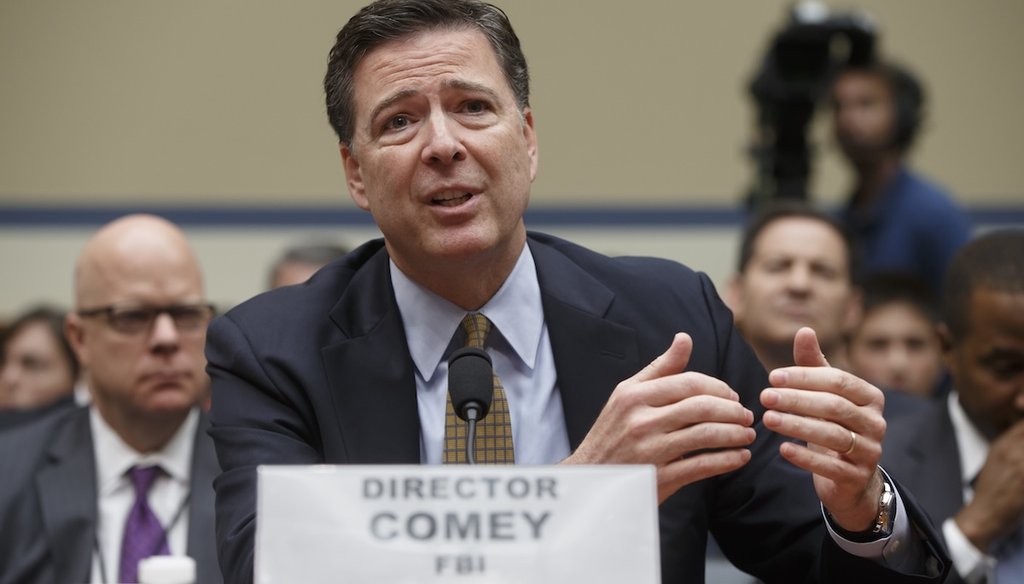
FBI Director James Comey testifies before the House Oversight Committee on July 7, 2016. (AP)

Could James Comey — the former FBI director indicted in September for false testimony to Congress — find a powerful criminal defense tool in President Donald Trump’s repeated public attacks against him?
Such a defense, known as "selective" or "vindictive" prosecution, is a tactic that defense attorneys often pursue but rarely win. If they use this legal strategy, Comey’s lawyers would argue that the prosecution is improper because it either violates Comey’s constitutional rights or is retaliatory in nature.
For Comey, the maneuver has a better-than-usual chance of succeeding, experts said.
"I believe the Comey case to be the strongest case for selective prosecution I’ve seen in my 50 years as a defense lawyer," said Stanley Brand, a distinguished fellow in law and government at Penn State Dickinson Law.
Experts said Comey’s argument could carry weight because of Trump’s unusually voluminous criticism directed at him in speeches and on social media, and Trump’s public calls for Comey’s prosecution.
Comey’s legal team has not shared its legal strategy. In an Instagram post after the indictment was announced, Comey said, "My heart is broken for the Department of Justice. I have great confidence in the federal judicial system and I am innocent, so let's have a trial, and keep the faith."
The Comey case, and the Trump criticism that preceded it
Conflict between Trump and Comey has been festering for years. Trump fired Comey, who was an Obama nominee, as FBI chief in 2017, and Comey publicly criticized Trump’s leadership. Earlier this year, the FBI investigated Comey after he posted a photo of seashells spelling out "86 47," which Trump allies called an incitement of violence against Trump, the 47th U.S. president. "Eighty-six" is often used in the hospitality industry to signal something is ready to be thrown out. Former FBI agents told PolitiFact they do not recall the term being used to mean an incitement of violence.
In July 2024, Trump said of Comey and former CIA Director John Brennan, "I think they’re crooked as hell, and maybe they have to pay a price for that." Later that month, he said, "The old FBI under Comey was crooked as hell. He was one of the most crooked."
In August 2024, referring to Comey and former Director of National Intelligence James Clapper, Trump said, "They’re sick people, and they’re criminals, and they should be taken care of." The following month, when Trump was asked if he would be "comfortable" seeing Comey and Brennan "handcuffed and arrested live on TV," Trump responded, "Would not bother me at all."
In September, Erik Siebert, the top federal prosecutor in the Eastern District of Virginia, left his post under pressure from the Trump administration. Trump tapped a White House aide and former personal defense lawyer, Lindsey Halligan, to replace him.
On Sept. 20, Trump addressed a Truth Social post to U.S. Attorney General Pam Bondi about a potential Comey prosecution, as well as prosecutions of other Trump critics, including Sen. Adam Schiff, D-Calif., and New York Attorney General Letitia James. "They’re all guilty as hell," Trump wrote. "We can’t delay any longer, it’s killing our reputation and credibility. … JUSTICE MUST BE SERVED."
On Sept. 25, just days into Halligan’s tenure, a federal grand jury in Alexandria, Virginia, indicted Comey on two counts — making a false statement and obstructing a congressional proceeding, related to 2020 testimony. The grand jury declined to indict Comey on a third charge.
The following day, Trump posted on Truth Social, "James ‘Dirty Cop’ Comey was a destroyer of lives. He knew exactly what he was saying, and that it was a very serious and far reaching lie for which a very big price must be paid!"
Can Comey use these statements in his defense?
Legal experts cite three ways defendants can argue that their prosecution was improper. One, known as malicious prosecution, is less useful for a defendant such as Comey because it would involve filing a civil lawsuit after being cleared at trial.
But Comey could use one of the other two approaches to head off a trial entirely.
One is selective prosecution, which stems from constitutional principles including equal protection, due process and the First Amendment. The other option is vindictive prosecution, in which a prosecution is retaliatory in nature.
Claims of selective or vindictive prosecution can be raised in a pretrial motion that aims to dismiss the case.
"The doctrine calls for dismissal of a criminal prosecution if the defendant can show that there are similarly situated people have not been prosecuted, and that the defendant was singled out for constitutionally impermissible reasons, such as race, religion, or political affiliation," said David A. Slansky, a Stanford University law professor.
When presented before a trial, a selective prosecution claim "requires some prima facie showing of discriminatory animus or effect before a court can be convinced to entertain it," Brand said. If that standard can be met, "it can lead to discovery, which may sufficiently buttress the claim to support dismissal."
Such motions are common and "often seen in politically-charged indictments," said Bradley Moss, a lawyer with the firm Mark S. Zaid, P.C. Trump raised both selective and vindictive prosecution claims in 2023 when he was tried for actions related to the Jan. 6, 2021, storming of the U.S. Capitol. So did President Joe Biden’s son Hunter Biden, who was convicted on gun charges and pleaded guilty to tax charges before being pardoned by his father. In neither case did the argument succeed.
"To meet the high threshold, the defendant has to demonstrate with clear evidence that similarly situated persons have not been prosecuted and that the decision to prosecute was based on an arbitrary factor," Moss said.
What’s Comey’s likelihood of success?
Experts widely agreed that claims of selective or vindictive prosecution to forestall a trial are rarely successful.
"The burden is high and these motions are rarely granted," said Neama Rahmani, president of the firm West Coast Trial Lawyers.
Brand said judges usually presume good faith on the part of government lawyers, essentially giving them the benefit of the doubt. He said it’s also hard to collect sufficient evidence to meet the burden of proof.
But despite these long legal odds, legal experts said Comey has a better shot at success than most, as might other Trump adversaries who could find themselves defendants in the coming months.
Cheryl Bader, a Fordham University clinical associate law professor, said as for vindictive prosecution, "there is unusually strong evidence that Comey was singled out for prosecution because of his opposition to President Trump."
Brand agreed. "The record is rife with evidence of the president’s animus toward defendants and his direct orders to initiate prosecutions regardless of Justice Department prosecutorial standards and mores," he said.
The sudden indictment after Halligan’s arrival after the office had declined to pursue a prosecution could also strengthen Comey’s case, Brand said.
"The decision of previous prosecutors who declined charges based on their belief that insufficient evidence existed … amounts to a strong case even before discovery of what documents may exist internally," Brand said.
Given the "incredibly difficult" standards for dismissal of the charges, Moss said Comey’s legal team might instead focus their efforts on dismissing the charges on the substance of the indictment, arguing that the facts "are not sufficient as a matter of law."
James Robenalt, a partner with the law firm Thompson Hine, said this would be an appealing approach for Comey’s legal team because the charges he faces involve "an exacting crime that depends exactly on words used."
Our Sources
Federal Rules of Criminal Procedure, Rule 12. Pleadings and Pretrial Motions
Donald Trump, Truth Social post, Sept. 20, 2025
Donald Trump, Truth Social post, Sept. 26, 2025
YouTube, "President Trump Participates in a Multilateral Lunch with African Leaders," July 9, 2025
YouTube, "President Trump Participates in a Bilateral Meeting with the President of the Philippines," July 22, 2025
YouTube, "President Trump Delivers Remarks," Aug. 14, 2025
Daily Caller, "EXCLUSIVE: Full Transcript: Daily Caller Interviews President Donald Trump," Sept. 1, 2025
CBS News, "Acting U.S. attorney resigns amid concern he could be fired for failing to bring case against Letitia James," Sept. 19, 2025
CBS News, "Lindsey Halligan, Trump's former defense lawyer, sworn in as interim U.S. attorney in key Virginia office," Sept. 22, 2025
New York Times, "Trump and Comey: An Escalating Conflict With No Off-Ramp," Sept. 25, 2025
New York Times, "Grand Jury Indicts Longtime Trump Target, Former F.B.I. Director James Comey," Sept. 25, 2025
New York Times, "Were Hunter Biden’s Prosecutions a Result of Political Pressure? A Look at the Facts," Dec. 2, 2024
ABC News, "What Donald Trump has said about James Comey over the past year," June 7, 2017
ABC News, "Timeline: Hunter Biden granted pardon after legal, political scrutiny," April 11, 2025
NBC News, "Here's a Timeline of Trump's Statements on Comey," May 10, 2017
The Bulwark, "Trump’s Own Words Have Discredited the Case Against Comey," Sept. 30, 2025
The Guardian, "Trump pressure tactics in Comey case ‘chilling’ – but they could backfire, experts say," Sept. 30, 2025
PolitiFact, "James Comey posted the number ‘86’ in reference to Donald Trump. What’s the history of the term?" May 16, 2025
Email interview with Shirin Sinnar, law professor at Stanford University, Sept. 30, 2025
Email interview with Jerry H. Goldfeder, senior counsel with Cozen O'Connor, Sept. 30, 2025
Email interview with Robert L. Deitz, lawyer and professor at George Mason University’s Schar School of Policy and Government, Sept. 30, 2025
Email interview with Jeffrey B. Welty, professor of public law and government at the University of North Carolina, Sept. 30, 2025
Email interview with David A. Slansky, Stanford University law professor, Sept. 30, 202
Email interview with Neama Rahmani, president of the firm West Coast Trial Lawyers, Sept. 30, 2025
Email interview with James Robenalt, partner with the law firm Thompson Hine, Sept. 30, 2025
Email interview with Stanley Brand, distinguished fellow in law and government at Penn State Dickinson Law, Sept. 30, 2025
Email interview with Bradley Moss, lawyer with the firm Mark S. Zaid, P.C., Sept. 30, 2025
Email interview with Cheryl Bader, Fordham University clinical associate law professor, Oct. 1, 2025
Interview with David Achtenberg, emeritus law professor at the University of Missouri-Kansas City, Sept. 30, 2025
Browse the Truth-O-Meter
More by Louis Jacobson