Stand up for the facts!
Our only agenda is to publish the truth so you can be an informed participant in democracy.
We need your help.
I would like to contribute

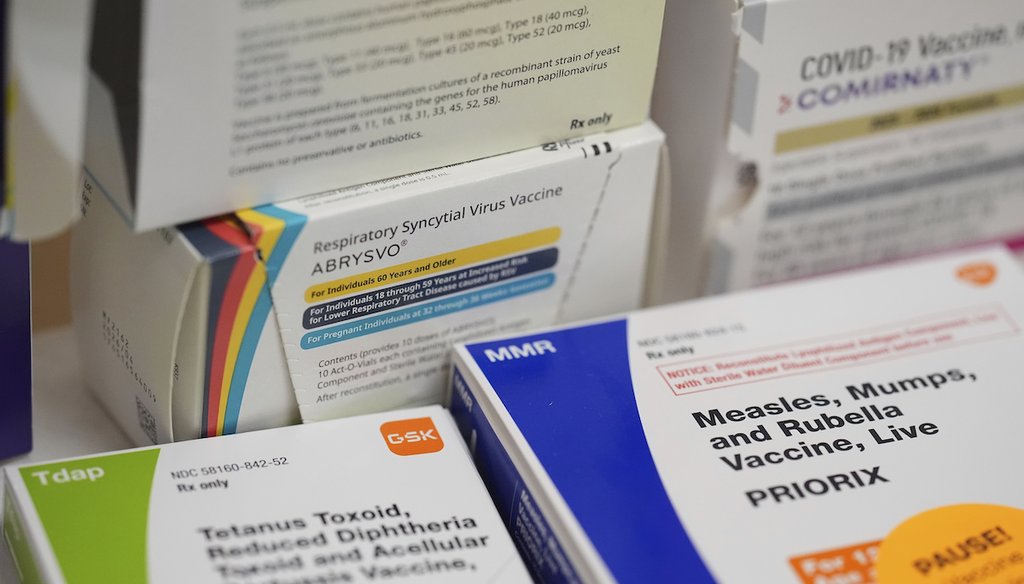
Boxes of various vaccines are seen inside a CVS pharmacy, Sept. 9, 2025, in Miami. (AP)

Days after announcing a push to end Florida’s school vaccine mandates, state Surgeon General Dr. Joseph Ladapo questioned the whooping cough vaccine’s effectiveness.
In a Sept. 7 interview on CNN’s "State of the Union," Ladapo told host Jake Tapper that his department didn’t study how ending the vaccine requirements could affect children’s health or future outbreaks.
"Absolutely not," Ladapo responded, before referring to whooping cough vaccines. "That's an example of a vaccine that is ineffective. The data show that it's ineffective at preventing transmission."
Pertussis, or whooping cough, is a highly contagious bacterial infection that can cause uncontrollable coughing fits. Its common name comes from the sound of infected infants and children make when they try to catch their breath in between coughs.
Like many vaccines, the DTaP vaccine — which stands for diphtheria, tetanus and acellular pertussis — is not a perfect barrier, but it significantly lowers the risk of severe disease.
The DTaP vaccine is 98% effective in children within a year of their last dose, and about 71% effective five years after the last dose, according to guidance from the U.S. Centers for Disease Control and Prevention.
"The core misunderstanding here is making perfect the enemy of the good," said Dr. Christoph Diasio, a pediatrician at Sandhills Pediatrics in North Carolina. "We would love a 100% perfect magic shield against pertussis — the vaccine protection does wane, it's not perfect — but that doesn't mean that it is useless. It is much much better to get protection from the vaccine rather than to be totally vulnerable to a disease so terrible you can break ribs."
The acellular pertussis vaccine used in the U.S. since the 1990s is less effective at preventing transmission than its whole-cell predecessor, studies have shown. But widespread vaccination — which school vaccine mandates are based on — reduces overall transmission by lowering the number of susceptible people.
"The whole-cell pertussis vaccine, while more effective, also caused more side effects because it had more antigens in it," Dr. Jason Terk, a pediatrician at Cook Children’s Health Care System in Texas, said. "The 5 cents of truth in his statement relates to it being comparatively less effective than what we used to use."
Emily Oster, a health economist and founder of ParentData, said Ladapo’s statement about the vaccine’s effectiveness regarding transmission is "broadly" true, but noted that the rationale for school vaccination rules is that viruses have trouble getting a foothold when more people are vaccinated.
"The vaccine is very protective against infection in individuals," Oster wrote by email. "Yes, it is true that if someone DID get infected they might pass it along, but if the virus is constantly running into people with vaccination, it will die."
PolitiFact reached out to Florida’s health department about Ladapo’s comment but did not hear back by publication.
How the vaccine works
Whooping cough can be extremely serious in babies and young children, causing vomiting, pneumonia, convulsions, apnea, brain damage or death. Infants can turn blue during coughing spells because of lack of oxygen. In teens and adults, the disease can cause weight loss, bladder control loss and passing out. Severe coughing can cause rib fractures.
Doctors typically administer the combination DTaP vaccine in five doses to patients from infancy through early childhood to help build up immunity and ensure protection doesn’t fade. Different vaccines against the diseases are available for older children, adolescents and adults.
Before pertussis vaccines became available in the 1940s, the condition was one of the more common childhood diseases in the U.S. Each year, as many as 200,000 children got sick and around 9,000 died, according to the National Foundation for Infectious Diseases.
Once the vaccine came to market, case numbers decreased through the 1980s by more than 90% compared with the pre-vaccine era.
A vaccine shift over safety
In the 1990s, the U.S. switched to an acellular vaccine, which contains fragments of a pathogen, because it had fewer side effects and still provided coverage. (Whole-cell versions contain the entire pathogen.)
After pertussis cases began to increase gradually in the early 2000s, researchers looked into the cause and found that the acellular vaccine is not as protective as the previous whole-cell version, with some evidence that the immune response wanes more quickly. (As a result, an additional dose is now recommended around 11 and 12 years old.)
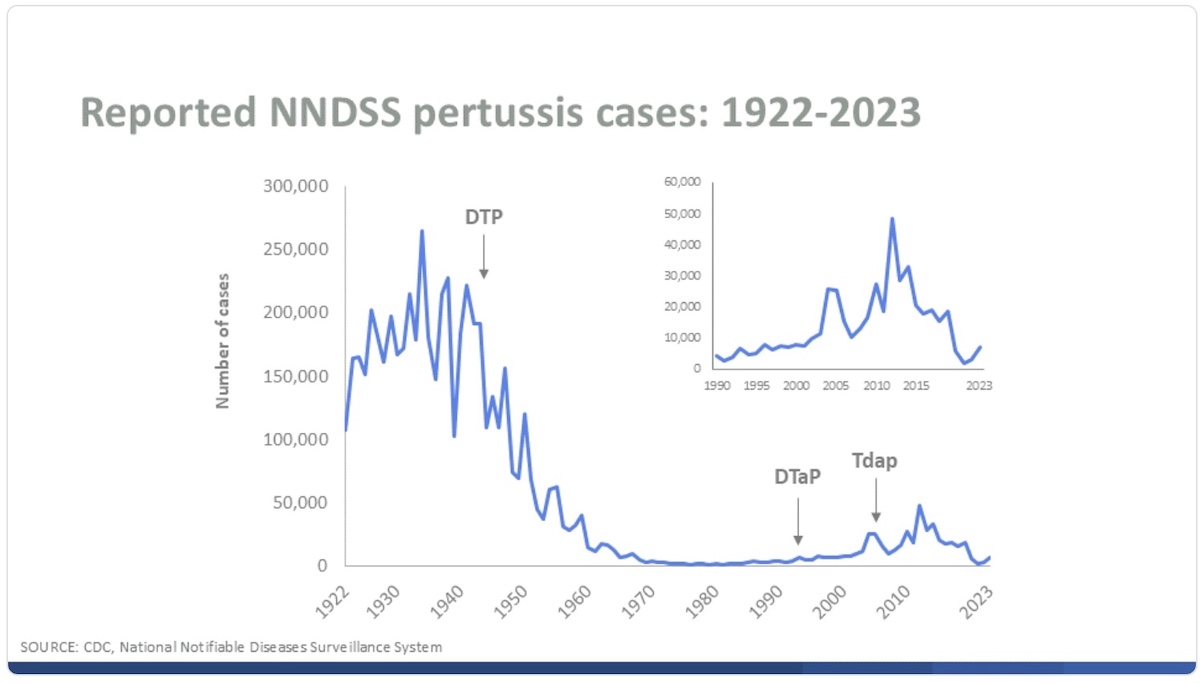
There could be other factors that explain the uptick: The disease is more quickly detected and recognized, patients have greater access to laboratory diagnostics, and surveillance and health department reporting is stronger.
Some studies have also shown families increasingly using school vaccination exemptions or declining routine vaccines.
"The easier it is to get non-medical exemptions, the greater the number of unvaccinated children will be, increasing the likelihood of pertussis outbreaks in schools and communities," Richard Gilligan, the former director of the Clinical Microbiology-Immunology Laboratories at the University of North Carolina Hospitals, wrote in a 2022 analysis. "School age students can bring this highly contagious organism home and infect non-boosted parents and unvaccinated siblings, especially infants."
Oster also referred to research that found states that offer personal belief exemptions, and more easily granted exemptions, were associated with increased whooping cough cases. In Florida, parents can exempt their children from vaccine mandates on medical or religious grounds.
In his report, Gilligan also pointed to the emergence of new pertussis strains, which can result in vaccinated people becoming infected but remaining asymptomatic and able to transmit the disease.
One 2022 paper that looked at different pertussis immunization practices around the world said that selecting which vaccine to use should be weighed against effectiveness, likelihood of adverse events, cost and pertussis surveillance in the community.
"The vaccine lessens transmission, it doesn't eliminate it, just like influenza, RSV, rotavirus vaccines — they lessen transmission," said Dr. Paul Offit, director of the Vaccine Education Center at the Children’s Hospital of Philadelphia. "With SARS-CoV-2, (the virus that causes COVID-19), which is similar, if you lived in a highly vaccinated area, you were much less likely to get the disease even if you weren’t vaccinated."
Ultimately, health officials decided that the safety benefits of the acellular pertussis vaccine outweighed the more effective, more reactive whole-cell version. It still offered protection, they said, particularly in shared spaces like schools, when most children were vaccinated.
"There have been no serious safety signals in the 30 years since the DTaP vaccination has been on the market," Terk, the Texas pediatrician, said.
In Florida, the school requirement for the DTaP vaccine will stay put for now. The state health department told The Associated Press it submitted a rule change Sept. 3 to remove vaccine requirements for chickenpox, hepatitis B, Haemophilus influenza type b (Hib), and pneumococcal diseases for schoolchildren. That’s expected to go into effect around December 2025.
Other vaccines, such as those for measles, polio and whooping cough will require legislative action to be removed. Florida lawmakers aren’t scheduled to meet again until January 2026.
RELATED: Every school vaccine mandate "drips" with "slavery."
RELATED: Do pediatricians recommend vaccines to make a profit? There’s not much money there.
Our Sources
CNN, Florida Surgeon General admits he didn't study impact before calling to lift vaccine mandate, Sept. 7, 2025
CNN, State of the Union transcript, Sept. 7, 2025
NBC News, Florida surgeon general says state will eliminate all vaccine mandates, Sept. 3, 2025
Tampa Bay Times, Florida’s vaccine overhaul is a big deal. Here’s what you need to know., Sept. 7, 2025
The Associated Press, Florida’s plan to drop school vaccine rule won’t start for 90 days, won’t cover all diseases, Sept. 7, 2025
American Academy of Pediatrics, What doctors wish patients knew about pertussis, March 14, 2025
American Academy of Pediatrics, Fact Checked: DTaP Vaccine Stops Spread of Whooping Cough, April 22, 2025
HealthyChildren.org, Whooping Cough (Pertussis): Symptoms, Treatment & Prevention, Updated June 10, 2025
HealthyChildren.org, DTaP (Diphtheria, Tetanus, Pertussis) Vaccine: What You Need to Know, Updated Jan. 27, 2021
Nemours Kids Health, Your Child's Vaccines: Diphtheria, Tetanus & Pertussis Vaccine (DTaP, Tdap), Reviewed December 2024
The U.S. Centers for Disease Control and Prevention,About Diphtheria, Tetanus, and Pertussis Vaccines, Reviewed Sept. 2022
The U.S. Centers for Disease Control and Prevention, Information for Parents and Caregivers, Whooping Cough (Pertussis) and the Importance of Childhood Vaccination, Accessed Sept. 8, 2025
The U.S. Centers for Disease Control and Prevention, Pertussis Surveillance and Trends, June 11, 2025
The U.S. Centers for Disease Control and Prevention,, Pertussis Cases by Year (1922-2023), April 24, 2025
The U.S. Centers for Disease Control and Prevention,, Vaccination Coverage and Exemptions among Kindergartners, July 31, 2025
PubMed, Acellular pertussis vaccines protect against disease but fail to prevent infection and transmission in a nonhuman primate model, Nov. 25, 2013
PubMed, Effectiveness of pertussis vaccination and duration of immunity Sept. 26, 2016
PubMed, Whole-Cell and Acellular Pertussis Vaccine: Reflections on Efficacy, June 13, 2022
American Society for Microbiology, Evaluating Efficacy of Pertussis Vaccines in Children, Oct. 21, 2022
The U.S. Centers for Disease Control and Prevention, Pertactin-Deficient Bordetella pertussis, Vaccine-Driven Evolution, and Reemergence of Pertussis, Volume 27, Number 6 — June 2021
JAMA Network, Association Between Vaccine Refusal and Vaccine-Preventable Diseases in the United States, March 15, 2016
FloridaHealth.gov, Exemption from Required Immunizations, Updated Aug. 28, 2025
Johns Hopkins Bloomberg School of Public Health, International Vaccine Access Center, Across the U.S., Childhood Vaccination Rates Continue to Decline, Aug. 20, 2025
ProPublica, "Not Just Measles": Whooping Cough Cases Are Soaring as Vaccine Rates Decline, April 11, 2025
The New York Times, How ‘Health Freedom’ Became a Winning Rallying Cry, Dec. 28, 2024
Email interview Dr. Christoph Diasio, pediatrician at Sandhills Pediatrics in North Carolina, Sept. 8, 2025
Email interview, Dr. Jason Terk, pediatrician at Cook Children’s Health Care System in Texas, Sept. 8, 2025
Phone interview, Dr. Paul Offit, pediatrics professor in the Children’s Hospital of Philadelphia’s infectious diseases division and director of its Vaccine Education Center, Sept. 9, 2025
Email interview, Emily Oster, economist who researches health and statistical methods and founder of ParentData, Sept. 9, 2025
Email interview, Dr. Otto Ramos, pediatric epidemiologist for Nicklaus Children's hospital in Miami, Sept. 9, 2025