Stand up for the facts!
Our only agenda is to publish the truth so you can be an informed participant in democracy.
We need your help.
I would like to contribute

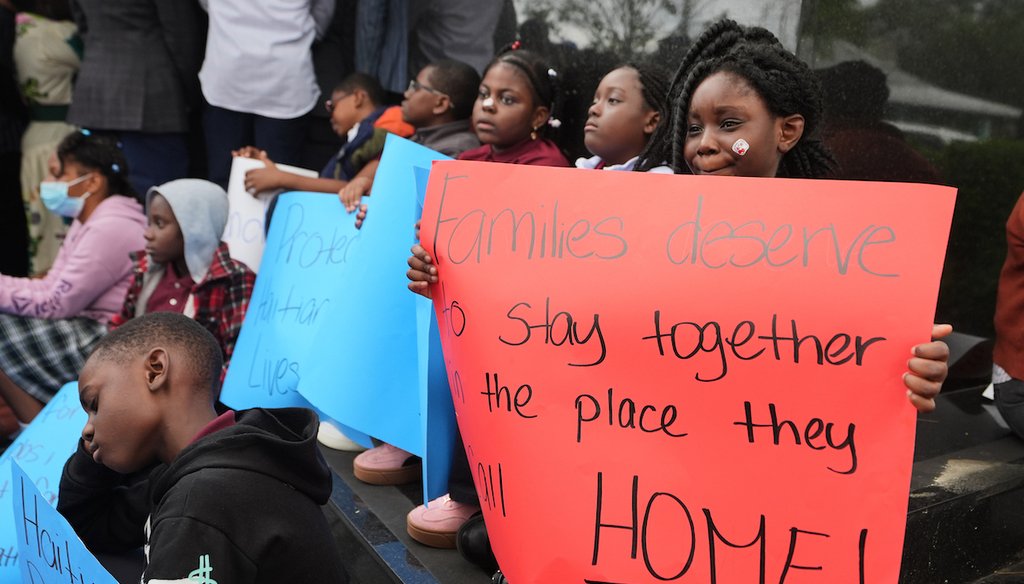
A local student named Shama holds a sign during a vigil to mark the anniversary of Haiti's 2010 earthquake, and support of Temporary Protected Status (TPS) for Haitians, Jan. 12, 2026, in the Little Haiti neighborhood of Miami. (AP)

A federal judge blocked the Trump administration from forcing hundreds of thousands of Haitians to leave the U.S., a temporary blow to President Donald Trump’s campaign promise he made while spreading a ridiculous falsehood about Haitians eating pets in Springfield, Ohio.
U.S. District Court Judge Ana C. Reyes in Washington, D.C., said in her Feb. 2 ruling it "seems substantially likely" that the administration decided to terminate Temporary Protected Status "because of hostility to nonwhite immigrants."
The ruling came a day before the federal protections for Haitians were set to expire in accordance with a Department of Homeland Security directive issued by Secretary Kristi Noem. Reyes’ ruling allows litigation to continue before the protections end.
Temporary Protected Status, which allows people to temporarily live and work in the U.S., is provided to people from certain countries experiencing war, environmental disasters and epidemics. The U.S. first gave Haitians eligibility for the program following a 2010 earthquake. During the Biden administration, Haiti’s deteriorating conditions prompted the U.S. federal government to redesignate Haiti’s status , allowing more Haitians to become eligible.
More than 300,000 Haitians who have TPS live in the U.S., with the largest group residing in Florida. Many work in health care, manufacturing or agriculture.
The judge’s ruling brought relief for Haitians and employers who rely on them.
The Jewish Telegraphic Agency reported days before the ruling that some of the senior citizens at Sinai Residences in Boca Raton, Florida, asked if they could hide Haitian staff in their apartments. About 9% of staff members are Haitians with Temporary Protected Status while 69% of the center’s staff are foreign-born.
Springfield’s Republican Mayor Rob Rue said in a statement that the ruling provides stability for families who are part of the community.
"It reflects the reality that many individuals are working, paying taxes, raising families and contributing every day to the life of our City," he said.
The Trump administration plans to appeal the ruling, which means that federal protections for Haitians remain in jeopardy.
"Supreme Court, here we come," wrote Homeland Security spokesperson Tricia McLaughlin.
The class action lawsuit challenging the Trump administration’s ending of TPS was filed on behalf of five Haitian TPS holders, including a nurse in Springfield, Ohio, a neuroscience graduate student in California, a software engineer who lives in New Jersey, a New York college student and a laboratory assistant in a toxicology department.
Q: What did the judge rule?
Reyes found that Noem’s decision to terminate TPS was "arbitrary and capricious" and ignored a requirement by Congress that she review conditions in Haiti after consulting with appropriate agencies.
The federal government said in a November notice ending TPS that "there are no extraordinary and temporary conditions in Haiti" that prevent Haitian nationals "from returning in safety."
That conclusion runs counter to the evidence, Reyes found, pointing to the State Department warnings against travel to Haiti because of crime, terrorism and civil unrest.
In an 83-page ruling, Reyes called out repeated anti-immigrant rhetoric by Noem and Trump.
Noem’s decision to terminate TPS "was motivated, at least in part, by racial animus," Reyes wrote. She noted statements by Noem calling people from certain countries "killers, leeches, and entitlement junkies," and saying, "WE DON'T WANT THEM. NOT ONE."
During a December 2025 Pennsylvania rally, Trump said the U.S. allows in people from "shithole countries." He added, "Why can't we have some people from Norway, Sweden — just a few — let us have a few from Denmark."
The judge wrote, "It is not a coincidence that Haiti’s population is ninety-five percent black while Norway’s is over ninety percent white."
Q: What does the ruling mean for Haitians with TPS?
For now, Haitians who have TPS can remain in the U.S.
If the Trump administration were allowed to end TPS, immigration authorities could arrest TPS holders, terminate asylum proceedings and send Haitians to a third country the U.S. has an agreement with, such as Uganda, Ecuador, or Honduras, University of Miami law professor Irwin Stotzky told PolitiFact before the ruling.
Q: Why does the Trump administration want to end the program?
Trump promised to end protections for Haitians while campaigning in 2024 as he spread the falsehood that Haitians in Springfield were stealing and eating people's pets.
City and county officials said repeatedly that was not happening. Rebuttals did not diminish the consequences, including dozens of bomb threats at schools, grocery stores and government buildings. PolitiFact named the statements by Trump and his running mate JD Vance the 2024 Lie of the Year.
About 10,000 Haitians with TPS now live in Springfield. Some news reports cite higher figures, but the population may have declined since Trump took office.
McLaughlin, Homeland Security’s spokesperson, said after the Feb. 2 ruling, "Haiti’s TPS was granted following an earthquake that took place over 15 years ago, it was never intended to be a de facto amnesty program, yet that’s how previous administrations have used it for decades. Temporary means temporary and the final word will not be from an activist judge legislating from the bench."
Although TPS was originally designated because of the earthquake, it was redesignated multiple times including after the 2021 assassination of President Jovenel Moïse and other national upheaval.
During Trump’s first term, the courts blocked his administration’s efforts to end TPS for Haitians.
RELATED: Immigration after one year under Trump: Where do mass deportation efforts stand?
Q: Are people who have TPS eligible for government assistance?
Business leaders and politicians — including Ohio Gov. Mike DeWine, a Republican — said Haitian TPS holders contribute positively to the economy. TPS critics said Haitians are a drain on government resources.
Sen. Bernie Moreno, R-Ohio, told 10 WBNS in late January that ending the temporary protections "doesn't necessarily mean (affected Haitians) have to go back to Haiti. They can go wherever they'd like, but we cannot continue to keep that many people that are predominantly reliant on our social safety net programs."
We contacted Moreno’s office to ask which safety net programs he referred to and received no response.
TPS holders are not eligible for federal benefits such as Temporary Assistance to Needy Families and Supplemental Nutrition Assistance Program, according to the nonpartisan Migration Policy Institute. (If someone had TPS but then obtained asylum or permanent residency, then that subsequent status determines their eligibility for federal benefits.)
For Medicaid and the federal Children’s Health Insurance Program, TPS holders are eligible if pregnant or up to 21 years old in states that elect to cover these groups..
Examining government services used by TPS holders is only part of the equation.
Reyes wrote that Noem "failed to consider the impact Haitian TPS holders have on our economy" and "did not account for the $1.3 billion they pay annually in taxes, among their many other contributions."
RELATED: Tracking Trump’s campaign promises on our MAGA-Meter
Our Sources
U.S. District Court District of Columbia, Ruling in Miot et al v Trump, Feb. 2, 2026
Homeland Security spokesperson Tricia McLaughlin, Statement, Feb. 2, 2026
FWD.us, Haitian TPS Holders Make the U.S. Stronger, January 2026
Springfield News-Sun, Springfield schools leader: Area officials preparing, but lack details of possible ICE activity, Jan. 28, 2026
10 WBNS, Haitian community in Springfield prepares for end of Temporary Protected Status, potential ICE operations, Jan. 30, 2026
WHIO TV, Judge blocks Trump admin from ending protections for Haitians; Springfield mayor releases statement, Feb. 2, 2026
Miami Herald, Haitian TPS ends on Tuesday. No economy will be hit harder than Greater Miami’s, Jan. 31, 2026
Migration Policy Institute, Immigrants’ Eligibility for U.S. Public Benefits: A Primer, January 2024
Jewish Telegraphic Agency, Jewish seniors are offering to hide their Haitian caregivers as Trump’s TPS end looms, Jan. 30, 2026
PolitiFact, Judge delays Trump admin timeline for ending TPS for Haitians, but they still face deportation, July 2, 2025
Email interview, Chris Cook, Clark County, Ohio Health Commissioner, Feb. 2, 2026
Email interview, Julia Gelatt, associate director of the U.S. Immigration Policy Program at the Migration Policy Institute, Feb. 2, 2026
Email interview, Dan Tierney, Gov. Mike DeWine spokesperson, Feb. 2, 2026
Email interview, Karen Graves, city of Springfield spokesperson, Feb. 2, 2026
Email interview, Bill Teets, Ohio Department of Job and Family Services spokesperson, Feb. 2, 2026
Email interview, Irwin Stotzky, University of Miami law professor, Feb. 2, 2026
Email interview, Ira Kurzban, immigration lawyer, Feb. 2, 2026