Get PolitiFact in your inbox.

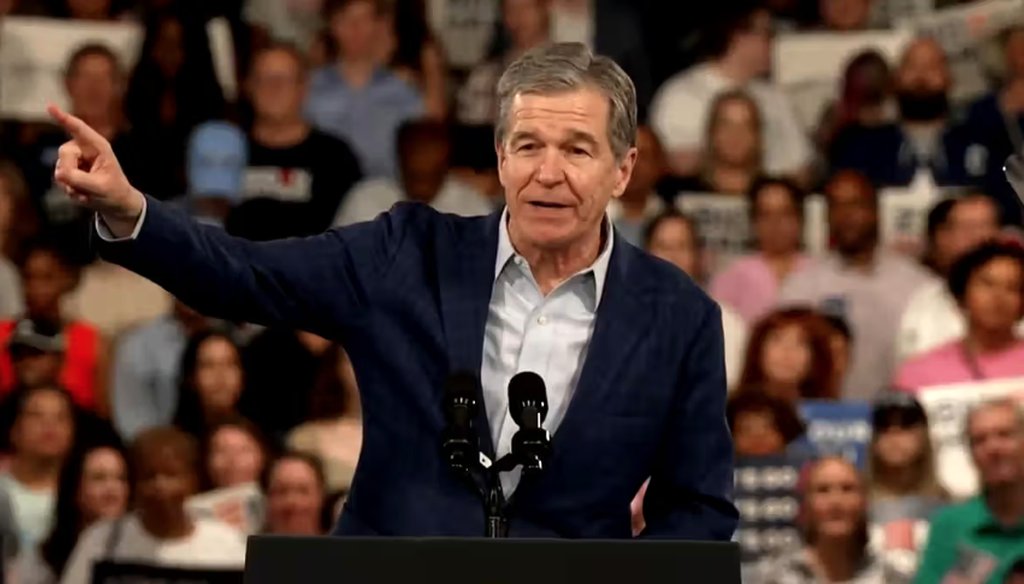
North Carolina Gov. Roy Cooper speaks at a rally for President Joe Biden in June of 2024 in Raleigh. (WRAL)

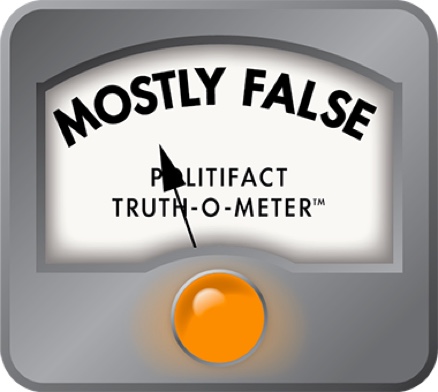
Some North Carolina Republicans say that the man accused of killing a woman on a Charlotte commuter train last year was released from prison early as part of a 2021 COVID-era settlement between civil rights groups and then-Gov. Roy Cooper, a Democrat.
With Cooper running for North Carolina’s open U.S. Senate seat, GOP political operatives are hoping the claims make a splash in the 2026 election. But Brown wasn’t behind bars when the settlement was reached and it had no bearing on whether Brown was free to roam the streets in 2025.
DeCarlos Brown Jr. faces state and federal murder charges in the killing of Iryna Zarutska, a 23-year-old Ukrainian who moved to Charlotte in 2022 after Russia invaded her home country. Zarutska’s Aug. 22 fatal stabbing, captured by surveillance video, prompted scrutiny of Brown’s criminal history and the officials who handled his cases.
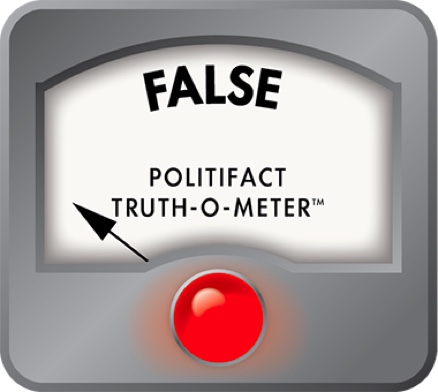
Cooper’s Republican critics have repeatedly sought to blame the former governor’s actions for Zarutska’s death. Michael Whatley — the former Republican National Committee chairman who is seeking the GOP nomination for the North Carolina U.S. Senate seat — said in a social media post in September: "Cooper bears direct responsibility for this heinous act and must answer to the public about why he prioritizes criminals over public safety." PolitiFact North Carolina previously rated that statement False.
Now, Republicans are focused on a settlement that Cooper’s administration agreed to on Feb. 25, 2021 — five months after Brown had been released from prison on Sept. 20, 2020. The details of the settlement don’t change the rating from our previous PolitiFact fact-check, but are worth explaining as Whatley and other Republicans attempt to once more implicate Cooper in Zarutska’s death.
Fox News Digital reported Feb. 4 that Brown’s prison identification number appeared in records related to a legal settlement between the NAACP and the Cooper administration in 2021 — a settlement that authorized the early release or transition of 3,500 prisoners amid the COVID-19 pandemic. Cooper agreed to the settlement after the state lost an early decision in the case. A Wake County judge ruled that state prisons were likely violating as many as 32,000 prisoners’ constitutional rights.
Cooper’s administration got around having to release the full 3,500 prisoners they agreed to let go by counting people who had been recently released just prior to the settlement — including Brown.
On Feb. 4, shortly after Fox News reported that Brown had been among the prisoners released early due to the COVID-19 settlement, the Republican National Committee said Cooper "should apologize to the Zarutska family for releasing their daughter’s killer." And the National Republican Senatorial Committee accused Cooper of "caving to the woke mob and releasing Zarutska's murderer."
Other Republicans — including U.S. House Speaker Mike Johnson and U.S. Senator Ted Budd of North Carolina — also posted about it on social media.
Here’s what state records and the Department of Adult Correction say about Brown’s case.
Why was Brown in prison prior to Zarutska’s death? Brown pleaded guilty to robbery with a dangerous weapon in 2014. Armed robbery is a Class D felony, which can carry a sentence of 13 years in prison, depending on a defendant’s criminal record. A judge sentenced him in February 2015 to a minimum of 73 months in prison, or a little more than six years. But Brown got credit for 176 days in jail while awaiting trial. He was incarcerated in North Carolina’s prison system from Feb. 21, 2015, to Sept. 20, 2020.
Did Cooper release prisoners during the pandemic? Yes. He agreed to it as part of a settlement. In April 2020, a coalition of civil rights groups sued the Cooper administration in an attempt to reduce COVID-19 infection risk in state facilities. The ACLU of North Carolina accused Cooper of failing to protect inmates from the virus and criticized him because he "refused to sign an executive order to halt jail admissions, release a meaningful number of medically vulnerable people, or allow people whose sentences are nearly up to be released."
The Cooper administration argued in court that it was sufficiently protecting inmates from the virus. In June 2020, a North Carolina Superior Court judge ruled that the groups were likely to win their case. In a settlement reached Feb. 25, 2021, the administration agreed to the early release of 3,500 people in state custody.
Did the settlement trigger Brown’s release? No. Brown was released from prison five months before the settlement. Brown "was not released early or paroled. With credit for jail time served before conviction, he served 100% of his minimum sentence," Brad Deen, a spokesman for the Department of Adult Correction told PolitiFact last year. Department spokesman Keith Acree said Feb. 5 that Brown’s release from prison was "entirely unrelated" to the February 2021 settlement.
Why is Brown mentioned in the settlement? Brown was allowed to be included on a list of prisoners released early even though the settlement had no bearing on his case, Acree said. Here’s why: While out of prison and on post-release supervision on Feb. 6, 2021, Brown was arrested for assault on a female and damage to personal property, Acree said. On Feb. 15, 2021, correctional officers held a hearing to consider revoking his post-release supervision and potentially return Brown to prison.
During the hearing, Brown denied guilt, according to records provided by the Acree. According to a parole hearing officer’s written hearing summary, Brown said that the incident involved his sister "and he immediately left after she attacked him and went straight to his mom’s house."Brown also said he turned himself in after the warrant for his arrest was issued.
On Feb. 15, 2021, the parole hearing officer decided to allow Brown to remain free while under post-release supervision. Brown reached the end of his sentence on Sept. 20, 2021.
The COVID-19 settlement reached Feb. 25, 2021 — 10 days after Brown’s parole hearing officer’s decision — allowed the department to count Brown toward the department’s quota of released prisoners even though Brown was already free, Acree said. Brown was one of many prisoners whose release came before Feb. 25, 2021, but qualified to be counted in the settlement, according to a PolitiFact review of settlement documents provided by the state.
How long could the state have held Brown after his February 2021 arrest? If the parole hearing officer had decided differently during the Feb. 15, 2021, hearing, Brown could have returned to prison for approximately seven months and been released on Sept. 20, 2021, Acree said.
Brown could have begun a new prison sentence if convicted of female or damage to personal property. Assault on a female is a Class 1A misdemeanor that carries a maximum jail sentence of 150 days. Damage to personal property is a Class 1 misdemeanor if the damages total more than $200 in value and could result in a maximum jail sentence of 120 days. Those charges were ultimately dropped in December 2022, Acree said.
Did the 2021 settlement play a role in Zarutska’s death? No. Brown was sentenced for armed robbery before Cooper became governor, and Brown was released from prison before the Cooper administration reached its settlement with civil rights groups.
The state reconsidered Brown’s post-release supervision on Feb. 15, before the settlement was reached on Feb. 25. Cooper wasn’t involved in that hearing, Acree said. And even if correctional officers had decided to keep Brown in prison, he would have been released Sept. 20, 2021 — almost four years ahead of Zarutska’s killing.
PolitiFact shared the state’s information with the Whatley campaign. Jonathan Felts, a spokesman for the Whatley campaign, said the state’s decision to allow Brown to remain free after his Feb. 6, 2021, arrest is a reflection of Cooper’s approach to public safety.
Felts said corrections officers "could have punished Brown by making him serve the rest of his sentence in prison but instead let him go free.
"That’s soft-on-crime," Felts said, "not tough-on-crime."
The Cooper campaign refuted Republican claims that the governor released Brown early.
"Decarlos Brown was not released from prison as a result of a court ordered settlement but in fact served his full sentence and was not released early," Cooper campaign spokesperson Jordan Monaghan said. "Roy Cooper is the only candidate who spent his career prosecuting violent criminals and keeping thousands of them behind bars as attorney general, and signing tough on crime laws and stricter pretrial release bail policy as governor."
PolitiFact reporter Will Doran contributed.
Our Sources
Fox News, "Charlotte rail murder suspect linked to inmate release approved under ex-Dem governor, GOP alleges," Feb. 4, 2026.
Email and telephone correspondence with Jonathan Felts, spokesman for Michael Whatley’s U.S. Senate campaign.
Email and telephone correspondence with Jordan Monaghan, spokesman for Roy Cooper’s U.S. Senate campaign.
Email and telephone correspondence with Keith Acree, spokesman for the North Carolina Department of Adult Correction.
ACLU of North Carolina, "Civil Rights Groups File Emergency Lawsuit to Demand Governor, State Officials Protect Incarcerated People From COVID-19," April 8, 2020.
ACLU of North Carolina, "A Court Ordered NC State Officials to do More to Protect Incarcerated People from COVID-19. They’re Still Fighting It," July 24, 2020.
WRAL, "NC judge rules in favor of state prisoners who claim incarceration during pandemic is unconstitutional," June 8, 2020.
WRAL, "Early release coming for 3,500 NC prisoners," Feb. 26, 2021.