Stand up for the facts!
Our only agenda is to publish the truth so you can be an informed participant in democracy.
We need your help.
I would like to contribute

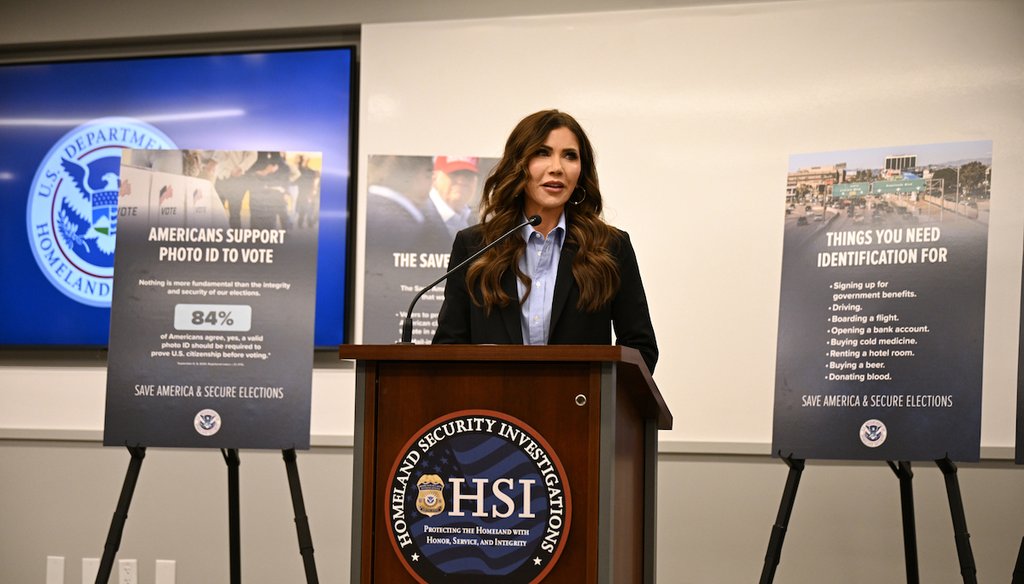
Homeland Security Secretary Kristi Noem speaks to press, Feb. 13, 2026, in Scottsdale, Ariz. (AP)

If Your Time is short
-
During his first term, President Donald Trump created the Cybersecurity and Infrastructure Security Agency within the Department of Homeland Security in part to protect election infrastructure.
-
That agency provides states, cities and counties information about how to prevent and respond to security threats.
Homeland Security Secretary Kristi Noem made comments that could lead people to misinterpret her agency’s role in elections as she lobbied for legislation that would require photo ID to vote and documentary proof of citizenship for voter registration.
"Although the Constitution gives states the primary responsibility for running their elections, Congress also gives authorities and duties to the federal government," Noem said Feb. 13 at a press conference. "Now, as the Secretary of the Department of Homeland Security, those authorities lie within my department. And the responsibility lies with me."
Her comments came two days after House Republicans passed the SAVE America Act, legislation backed by President Donald Trump.
Noem then described what she said is her role in elections:
"I have the responsibility of not just pointing out different vulnerabilities that we may see in our election systems, but also with making sure that we're putting forward mitigation measures that can be enacted at the state and local level to make sure that our elections are run correctly, that the votes are counted and tabulated and that the people that were elected were put into those positions."
A phrase she later used about making sure "we have the right people voting, electing the right leaders" drew alarm from Democrats.
After CNN’s Jake Tapper questioned her remarks about the "right people" voting, Noem responded on X: "We must build election infrastructure that makes it easy and secure for eligible American citizens to vote — while preventing noncitizens, including illegal aliens, from casting ballots. The choice of who to vote for is obviously up to the voters themselves."
States administer elections while Homeland Security plays a very limited part. We contacted Noem’s agency for evidence to support her statements and received no response.
Homeland Security agency assists in protecting elections, but doesn’t operate them
In 2018, Trump signed a law creating the Cybersecurity and Infrastructure Security Agency within the Department of Homeland Security to protect critical infrastructure including elections from physical and cyber threats. The agency says such infrastructure is considered so vital that if incapacitated or destroyed it would harm security, national public health or safety.
The agency works with state and local governments, election officials, federal partners and private sector partners to manage risks to voting sites, databases and equipment.
CISA provides these partners with quick security alerts, training, and physical and cybersecurity assessments of election facilities.
Wendy Weiser, a lawyer at the left-leaning Brennan Center for Justice at New York University School of Law, pushed back on Noem’s remarks in an X post, saying Homeland Security is not in charge of elections.
"There is no law that ‘delegates’ power over elections to DHS. None," Weiser wrote. "There are laws that give DHS duties with respect to America’s ‘critical infrastructure,’ but they do not put DHS in charge of that infrastructure, and especially not elections."
The agency offers risk assessments, advice and support, Weiser wrote, "but only on a voluntary basis."
The statute that created CISA says the agency "upon request, provide(s) analyses, expertise, and other technical assistance to critical infrastructure owners and operators" and when appropriate, shares it with other agencies.
Because of CISA security training, Rhode Island election workers knew how to respond in September 2024 when an envelope containing white powder with the return address "U.S. Traitor Elimination Army" arrived at the state’s Board of Elections. CISA had already distributed physical security and cybersecurity checklists with tips about how to address such a threat.
Which agencies oversee vote counting and tabulation?
Local governments tabulate votes.
Noem correctly acknowledged that "the Constitution gives states the primary responsibility for running their elections." The Constitution delegates to states the authority to set "the times, places and manner" of holding congressional elections, while Congress can pass election laws.
Congress has passed only a few statutes relating to state election administration, such as the National Voter Registration Act, which sets certain voter registration requirements such as compelling government offices to offer opportunities for people to register to vote.
But "none confer oversight authority over state election administration" to Homeland Security, said Rebecca Green, a William and Mary Law School professor.
CISA "has no independent authority or oversight role in how states run their elections," Green said.
Other federal agencies have limited tasks in elections. The Justice Department can file lawsuits alleging violations of federal laws while the Election Assistance Commission tests and certifies election equipment.
RELATED: Does the US have stricter ID rules for buying beer than voting?
Our Sources
Reuters, LIVE: DHS's Kristi Noem speaks on election security in Phoenix, Feb. 13, 2026
Rev.com, Noem on Elections, Feb. 13, 2026
Cybersecurity and Infrastructure Security Agency, Fact sheet, July 2025
CISA, Election security and critical infrastructure sectors, Accessed Feb. 16, 2026
Congress.gov, H.R.3359 - Cybersecurity and Infrastructure Security Agency Act of 2018, Nov. 16, 2018
42 U.S. Code § 5195c - Critical infrastructures protection, 2001
National Conference of State Legislatures, Election Certification Deadlines, Jan. 20, 2025
Cato Institute, Trump’s Claims About Noncitizens Voting Are False. We Can Prove It. Feb. 5, 2026
Federal Voting Assistance Program, About the Laws, Accessed Feb. 18, 2026
Arizona Mirror, Kristi Noem was unable to cite single election fraud case during secretive Arizona visit, Feb. 13, 2026
Vote Beat, Kristi Noem’s hastily-arranged Arizona visit stokes rumors in wake of feds’ unprecedented actions, Feb. 13, 2026
Brennan Center for Justice at NYU Law vice president for democracy, Wendy Weiser, X thread, Feb. 13, 2026
Homeland Democrats, X post, Feb. 13, 2026
Utah Lt. Gov. Deidre Henderson, Citizenship review update, Jan. 22, 2026
New York Times, Initial Review Finds No Widespread Illegal Voting by Migrants, Puncturing a Trump Claim, Jan. 14, 2026
PolitiFact, Trump's actions could affect the 2026 midterm elections. What will it mean for voters? Nov. 3, 2025
Email interview, Calli Jones, spokesperson for Arizona Secretary of State Adrian Fontes, Feb. 16, 2026
Email interview, Wendy Weiser, vice president for democracy at the Brennan Center for Justice at NYU law, Feb. 16, 2026
Email interview, Rebecca Green, William and Mary Law School professor, Feb. 17, 2026
Email interview, Jennifer Morrell, CEO of the Elections Group, Feb. 18, 2026