Stand up for the facts!
Our only agenda is to publish the truth so you can be an informed participant in democracy.
We need your help.
I would like to contribute

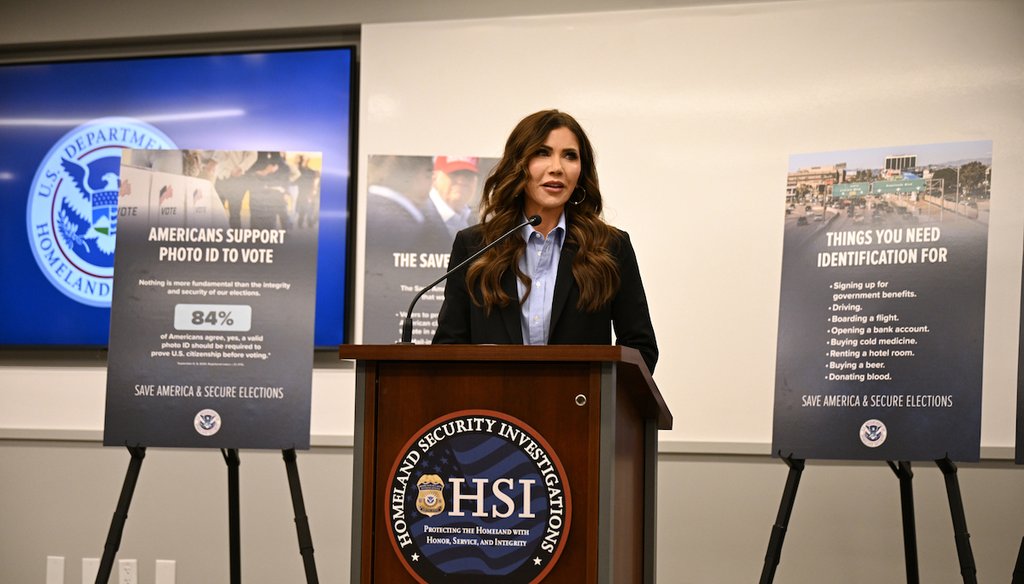
Homeland Security Secretary Kristi Noem speaks to the press on Feb. 13, 2026, in Scottsdale, Ariz. (AP)
The Trump administration revamped a tool to search citizenship status and help states find ineligible voters.
A Florida Democratic lawmaker said the U.S. Department of Homeland Security is using it to target eligible voters.
"DHS is pushing states to ban naturalized U.S. citizens from voting by falsely labeling them as illegal," U.S. Rep. Debbie Wasserman Schultz said Feb. 15 on X. "It’s an attack on democracy disguised as immigration enforcement. If the SAVE Act becomes law, DHS would use the same flawed, untested tool nationwide."
Wasserman Schultz’s post linked to a news investigation that reported the Systematic Alien Verification Act (SAVE) tool has wrongly identified foreign-born, naturalized U.S. citizens as ineligible voters. Previously, the SAVE tool was primarily used to prevent noncitizens from using federal benefits, but the Trump administration rapidly expanded it in 2025, building a national citizenship lookup tool to find noncitizens on state voter rolls.
Right now, states’ participation is voluntary. But if the SAVE America Act becomes law, they would be required to use the tool.
Federal law already bans noncitizens from voting in federal elections and cases of noncitizen voting are rare. If they vote, noncitizens risk deportation, fines, or jail time.
The U.S. House recently passed the SAVE America Act, which would require people to provide documentary proof of citizenship to register to vote and present an approved form of photo ID when voting.
The bill has President Donald Trump’s support but faces a shaky future in the Senate.
As lawmakers consider imposing the expanded SAVE tool across the country, we looked at how Florida and other states are using it and what it means for voters.
What is the SAVE tool?
U.S. Citizenship and Immigration Services runs the SAVE tool, which checks immigrants’ eligibility for public assistance programs, such as Medicaid, housing loans and unemployment.
For more than a decade, some states, including Florida, have used SAVE to check people’s citizenship status for voter registration.
What changed in 2025?
The Trump administration expanded the tool by pulling in data from across the federal government to try to help states find noncitizen voters.
The overhaul started after Trump’s March executive order directing the Social Security Administration to share data on anyone who has ever applied for a Social Security number to help states verify voter eligibility. The tool continues to merge data, recently including the State Department's U.S. passport database.
The tool now lets state election officials use the last four digits of voters' Social Security numbers, passport numbers, names and birth dates to check if voters are citizens. They also use it to verify whether voters have died.
The Justice Department, meanwhile, has told states to turn over their voter rolls to find noncitizens, and then sued about half of those states for failing to fully comply.
What have Florida and other states discovered using the tool?
Florida is among 26 states that use or plan to use the tool for voter verification, DHS said.
In a 2025 report, Florida’s Office of Election Crimes and Security said preliminary investigations into the citizenship status of more than 835 people found that 198 were "likely noncitizens" who illegally registered or voted in Florida; it referred 170 to law enforcement. The report said it used various methods in its investigation, including DMV records, documents relevant to citizenship, and the SAVE tool to cross verify people’s status.
The office didn't respond to PolitiFact’s questions about how many of Florida’s more than 13.3 million registered voters were confirmed noncitizens, voted in recent elections or faced criminal charges. The secretary of state’s office also didn’t say how many citizens have been mistakenly flagged by the SAVE tool.
Several Florida county elections officials told PolitiFact that the state primarily sends a list of potential noncitizens to their offices for their review.
Alachua County, which has about 162,600 registered voters, used information from the tool to remove nine people from its voter rolls for noncitizenship since January 2025, said Dillon Boatner, an information specialist at the county’s elections office. Three of the nine had cast votes within the past four years, he said.
Polk County, which has about 444,900 registered voters, confirmed 69 people flagged by the system were noncitizens and were removed from voter rolls over the last year, said Melony Bell, the county’s elections supervisor. When PolitiFact asked for the total number of people the tool flagged for review, and how many ended up being U.S. citizens, Bell said the office couldn’t pull a report providing those numbers.
Leah Valenti, Charlotte County’s elections supervisor, told The New York Times that 15 out of 176,000 names she uploaded to the tool came back as noncitizens. Of those, three people were mistakenly added to the rolls and two others had already sent in documentation to prove their naturalized citizenship.
Other states using the tool likewise haven’t reported large numbers of noncitizens casting ballots.
Louisiana Secretary of State Nancy Landry, a Republican, said in September that officials identified 79 "likely noncitizens" who had voted in at least one election since the 1980s after running nearly all of the state's 2.9 million voters through the tool.
Utah Lt. Gov. Deidre Henderson, also a Republican, said in January that officials spent months examining the state’s 2 million registered voters and found one confirmed noncitizen, who never voted.
Out of 49.5 million voter registrations that have been checked in SAVE across the country, The New York Times reported Jan. 14 that federal officials referred around 10,000 for further investigation of noncitizenship, or roughly .02% of the names processed.
U.S. Citizenship and Immigration Services told PolitiFact over 59 million voter verification queries have been processed in the tool since its relaunch.
Why are people concerned about the tool’s accuracy?
Lawyers and organizations who specialize in voting rights have warned that using SAVE to verify citizenship can lead to errors because the data is sometimes based on incomplete or outdated information.
A Feb. 13 ProPublica and Texas Tribune investigation found that the tool has made persistent mistakes, "particularly in assessing the status of people born outside the U.S." The tool doesn’t always reflect when people became naturalized citizens and DHS has had to correct information sent to multiple states after SAVE misidentified voters as noncitizens, the report said.
SAVE doesn’t have access to all potential data that could show whether someone is a citizen, U.S. Citizen and Immigration Services told PolitiFact in a statement.
When the tool flags people who say they are citizens, the agency said it manually checks for inconsistencies before sending results back to the state for review.
Data from the Social Security Administration can be outdated for naturalized citizens because the agency has historically relied on people to voluntarily report citizenship changes in person, creating significant lags.
"This data will be reliably stale and will target naturalized citizens for undue suspicion," Danielle
Lang, the Campaign Legal Center’s director of voting rights, previously told PolitiFact. The center was one of the groups that sued the administration over Trump’s executive order.
The Social Security Administration started noting citizenship in its data 40 years ago, so the agency doesn’t have a complete database, according to the Institute for Responsive Government, an organization that provides governments with research, including about election infrastructure.
Because U.S. Citizenship and Immigration Services merged a massive amount of data from multiple agencies, the new features require testing and validation, the institute said in May, recommending election officials process carefully when using the tool.
"Data of unknown or unverified quality must not be used to initiate voter removals without strict adherence to all safeguards in state and federal law," the institute said.
What can naturalized citizens do if they are flagged?
The voter removal process varies by state. If a voter is flagged as ineligible in Florida, state statute says local election officials must notify them by mail within seven days explaining why they were identified. The notice must include a request for a response within 30 days, after which the person will be removed from the voter registration system.
Eligible voters wrongly flagged by the system must provide documentation of their citizenship or request a formal hearing to contest the findings.
For naturalized citizens, valid proof of citizenship includes a U.S. passport, a certificate of naturalization or citizenship. U.S. citizens who were born outside the country would need to show a consular report of birth abroad, a State Department document certifying a child born abroad to U.S. citizen parents acquired citizenship at birth.
RELATED: Trump administration overhauls database for election officials to check voters’ citizenship status
PolitiFact Senior Correspondent Amy Sherman contributed to this report.
Our Sources
X, Debbie Wasserman Schultz post, Feb. 15, 2026
The Department of Homeland Security DHS, USCIS, DOGE Overhaul Systematic Alien Verification for Entitlements Database, April 22, 2025
Florida State Department, Secretary of State Cord Byrd announces landmark agreement with DHS to better secure elections, Dec. 3, 2025
U.S. Citizen and Immigration Services, Voter Registration and Voter List Maintenance Fact Sheet, Updated Aug. 27, 2025
U.S. Citizen and Immigration Services, Citizenship and Naturalization, Updated July 5, 2020
House.gov, SAVE America Act, Accessed Feb. 17, 2026
Cato Institute, Trump’s Claims About Noncitizens Voting Are False. We Can Prove It., Feb. 5, 2026
Florida State Department, Florida Department of State Office of Election Crimes and Security Annual Report to Governor and Legislature, Jan. 15, 2026
The White House, PRESERVING AND PROTECTING THE INTEGRITY OF AMERICAN ELECTIONS, March 25, 2025
PolitiFact, Trump administration overhauls database for election officials to check voters’ citizenship status, July 11, 2025
ProPublica, "Not Ready for Prime Time." A Federal Tool to Check Voter Citizenship Keeps Making Mistakes., Feb. 13, 2026
FLsenate.gov, 98.075 Registration records maintenance activities; ineligibility determinations, Accessed Feb. 16, 2026
U.S. State Department, Birth of U.S. Citizens and Non-Citizen Nationals Abroad, Accessed feb. 18, 2026
Spectrum News 13, Some Florida voters foresee changes in voter access if SAVE America Act is signed into law, Feb. 13, 2026
Mother Jones, The GOP’s "Show Us Your Papers" Bill Is the Latest Effort to Help Trump Take Over Elections, Feb. 11, 2026
The New York Times, Initial Review Finds No Widespread Illegal Voting by Migrants, Puncturing a Trump Claim, Jan 14, 2026
NOLA.com, Of Louisiana's nearly 3 million voters, 79 noncitizens illegally voted since '80s, investigation finds, Sept. 4, 2026
NPR, Trump's SAVE tool is looking for noncitizen voters. But it's flagging U.S. citizens too, Dec. 10, 2025
State of Utah, CITIZENSHIP REVIEW UPDATE, Jan. 22, 2026
The Center for Election Innovation and Research, Update: Review of Claims of Noncitizen Registrants and Voters, February 2026
Bipartisan Policy Center, Modernizing Voter List Maintenance, Sept. 9, 2025
Institute for Responsive Government, An Updated Federal Database to Verify Voter Citizenship, May 23, 2025
Email interview, Dillon Boatner, information specialist at the Alachua County supervisor of elections office, Feb. 17, 2026
Email interview, Allison Novoa, public information officer at the Palm Beach County supervisor of elections office, Feb. 17, 2026
Email interview, Gretl Plessinger, spokesperson for the Florida secretary of state office, Feb. 18, 2026
Email interview, Melony Bell, the Polk County supervisor of elections, Feb. 19, 2026
Email interview, Matthew J. Tragesser, spokesperson for U.S. Citizenship and Immigration Services, Feb 29, 2026