Get PolitiFact in your inbox.

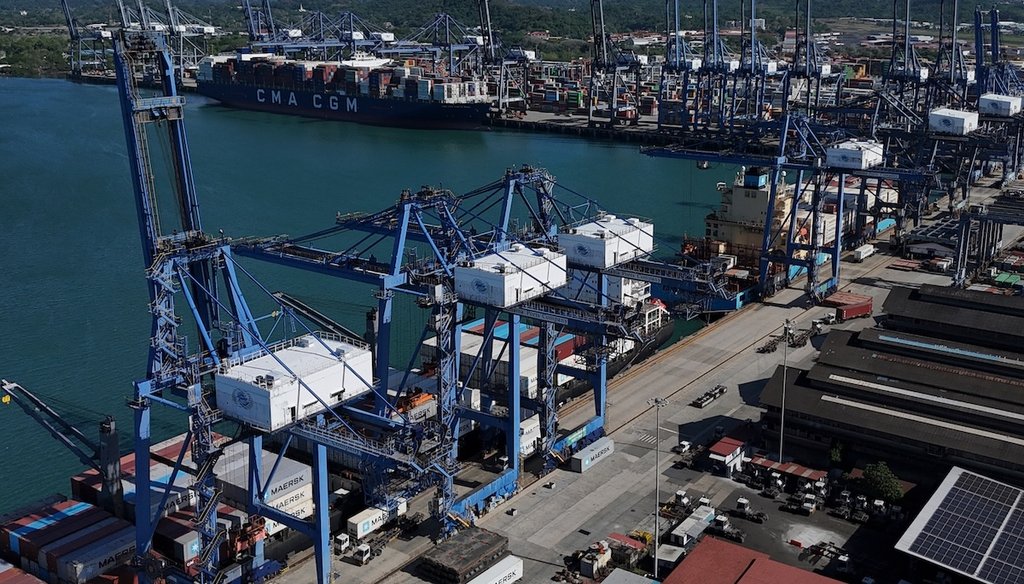
Cranes load a cargo ship at the Panama Canal's Port of Balboa on Jan. 30, 2026. (AP)

In a landmark decision, the Supreme Court ruled that President Donald Trump cannot use the International Emergency Economic Powers Act to levy tariffs on his own, blocking the primary tool he’s been using to reshape the U.S. and global economy.
In a 6-3 decision, the court ruled that "when Congress grants the power to impose tariffs, it does so clearly and with careful constraints. It did neither in IEEPA."
Trump had justified his most far-reaching assertions of tariff power by citing IEEPA, a 1977 law that allows tariffs on all imports during an "unusual and extraordinary threat ... to the national security, foreign policy or economy of the United States."
Trump will still be able to levy tariffs using other laws, but these generally require more complicated processes.
"Trump cannot raise tariffs on his own, anywhere he pleases, any longer — that’s the biggest takeaway from SCOTUS this morning," Ross Burkhart, a Boise State University political scientist who specializes in trade policy, said Feb. 20. Trump can still pursue his America First agenda, Burkhart said, but "he just has to convince more audiences of the national security threat than just himself and his advisors."
The court’s decision would seem to end: the minimum 10% tariff Trump levied on most trading partners during his April 2025 "Liberation Day" announcement; higher rates that Trump misleadingly described as "reciprocal" tariffs for certain trading partners; the tariffs linked to drug trafficking on Canada, Mexico and China; and many of the tariffs placed on China, experts said.
These tariffs have been the main drivers of Trump’s second term increases in tariff revenues. Since January 2025, the U.S. has seen an increase over the existing tariff baseline of $223.5 billion.
Still in play for the administration would be other types of tariffs, including:
-
Section 301 of the 1974 Trade Act, which allows tariffs when the president determines that a foreign country "is unjustifiable and burdens or restricts United States commerce" through violations of trade agreements;
-
Section 232 of the 1962 Trade Expansion Act, which lets the president impose tariffs if national security is threatened. Trump and President Joe Biden used Section 232 as the basis for steel and aluminum tariffs imposed since 2018;
-
Section 122 of the 1974 Trade Act, which allows the president to address "large and serious" balance-of-payments deficits through import surcharges, quotas, or a combination;
-
Section 338 of the 1930 Tariff Act, which authorizes tariffs of up to 50% if a country "discriminates" against U.S. commerce.
"Even without IEEPA, the president retains ample statutory authority to quickly recreate much of the current trade policy chaos," wrote the Cato Institute, a libertarian think tank skeptical of Trump’s tariff policy.
Trump learned of the decision during a meeting with governors at the White House, The New York Times reported. Citing two people familiar with the proceedings, the Times reported that Trump called the decision a "disgrace" and left the meeting early.
The Constitution says Congress holds the power to impose tariffs, not the president. However, over the years, Congress has passed multiple laws ceding some of that power to the president.
One of those was IEEPA, but small businesses challenged that position in court, making two key arguments. They contended that the law doesn’t explicitly let the president impose tariffs. And they argued that the tariffs didn’t rise to the level of an "unusual and extraordinary" emergency. The plaintiffs succeeded at the trial and appeals level, and now have convinced the Supreme Court as well.
Left unclear are how and when the billions in tariffs collected will be refunded; in the dissenting opinion, Justice Brett Kavanaugh, joined by justices Samuel Alito and Clarence Thomas, wrote that this process "is likely" to be a "mess."
RELATED: Year of the Lies: Farmer says some Trump tariff statements ‘as far from the truth as you can get’
Our Sources
Interview with Ross Burkhart, Boise State University political scientist, Feb. 20, 2026
Other sources linked in article.
Browse the Truth-O-Meter
More by Louis Jacobson