Get PolitiFact in your inbox.

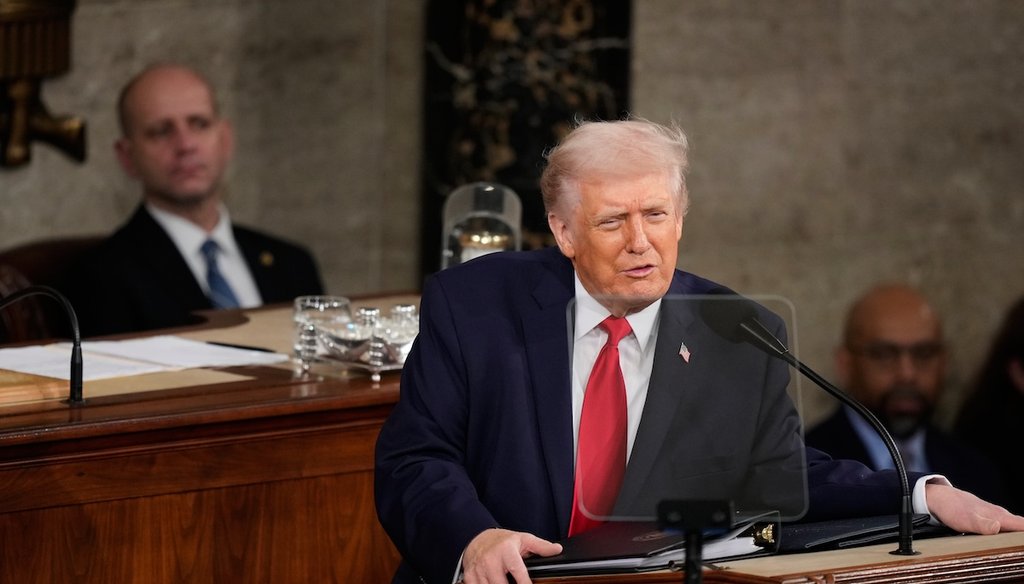
President Donald Trump delivers his State of the Union address to a joint session of Congress in the House chamber at the U.S. Capitol in Washington, Feb. 24, 2026. (AP)

During the State of the Union, President Donald Trump lauded his administration’s success in reducing the number of people trying to illegally cross the U.S. southern border as he assured that he is in favor of legal immigration.
"In the past nine months, zero illegal aliens have been admitted to the United States," Trump said Feb 24. "But we will always allow people to come in legally, people that will love our country and will work hard to maintain our country."
But Trump’s words about allowing legal immigration don’t line up with his actions.
During the first year of his second term, Trump has terminated programs that let people legally live in the U.S., limited legal ways to get here, barred people from certain countries from entering the U.S. and paused processing of certain applications for visas and immigration statuses for legal permanent residency.
Immigrants living in the U.S. legally have also been wrapped up in Trump’s mass deportation efforts. Spouses of U.S. citizens have been arrested while attending mandatory interviews to be granted permanent residency. People seeking legal status also have been detained during routine Immigration and Customs Enforcement check-ins and court appearances.
The administration’s actions "will lead to the largest restriction in legal immigration—setting aside 2020—since the 1920s," David Bier, associate director of immigration studies at the libertarian Cato Institute, wrote in December. Bier cited 2020 when the global COVID-19 pandemic restricted migration.
Here’s a sampling of how the Trump administration has restricted legal immigration.
Ended temporary programs for people legally in the U.S.
Former President Joe Biden had significantly expanded the use of humanitarian parole, a way that people can come into the U.S. legally to temporarily live and work. Trump revoked the two programs that let people receive humanitarian parole and stripped the protections from people who entered that way.
As part of this, he ended the CBP One app that let people make appointments at official ports of entry to begin requesting asylum and canceled 30,000 pending appointments. Under U.S. law, people are allowed to apply for asylum if they fear persecution in their home countries. To apply, people must be on U.S. soil.
The Department of Homeland Security has also tried to end several countries’ Temporary Protected Status, which allows people from certain countries experiencing war, environmental disasters and epidemics to temporarily live and work in the U.S. Several terminations are being challenged in court and are paused while the cases are pending.
A federal judge on Feb. 2 temporarily blocked TPS termination for Haiti saying it "seems substantially likely" that the administration decided to terminate TPS "because of hostility to nonwhite immigrants."
Ending humanitarian parole and TPS could affect about 2.5 million people currently legally in the U.S., Bier wrote.
Implemented travel bans, stopped processing applications for people from certain countries
As he did during his first term, Trump has implemented a travel ban on several countries including Haiti, Afghanistan and Somalia. The ban restricts people from 19 countries from getting temporary visas, such as for tourism and education, and restricts people from seven of the countries from staying permanently for work.
"Over the next three years, 400,000 legal immigrants and nearly 1 million tourists, business travelers, international students, foreign workers, and other temporary visitors will face this ban," according to a Cato Institute analysis.
Alongside the travel ban, the State Department on Jan. 21 paused issuing non-tourist visas for people from 75 countries. And U.S. Citizenship and Immigration Services has paused processing immigration applications from 39 countries, including for asylum, permanent residency and citizenship.
Nearly half of the world’s countries, more than 90, have some form of immigration restriction.
Dismantled U.S. refugee program
One of the limited ways people can legally migrate to the U.S. is through the refugee program.
Refugees, as defined by U.S. law, are people outside of the U.S. who fled their home countries because of persecution related to race, religion, nationality, political opinion or membership in a particular social group.
Trump has nearly entirely halted the U.S. refugee program. On his first day in office, he enacted an indefinite pause on refugee resettlement. In the weeks that followed, he canceled travel for people who had already been granted the status.
From February 2025 to October 2025, the Trump administration resettled 506 refugees, a majority of whom were white South Africans, according to the nonpartisan Migration Policy Institute. Trump has repeated the unfounded claim that white South Africans are the target of a genocide.
Trump set the fiscal year 2026 refugee resettlement cap at 7,500, a record low. In fiscal year 2024, Biden’s last year in office, the U.S. resettled 100,000 refugees.
Our Sources
The New York Times, Green Card Interviews End in Handcuffs for Spouses of U.S. Citizens, Nov. 26, 2025
Cato Institute, The Most Important Immigration Stories of 2025, Dec. 30, 2025
PolitiFact, Immigration experts say JD Vance is wrong. Haitians under temporary programs are in the US legally., Oct. 3, 2024
PolitiFact, How spin and falsehoods propelled Trump's immigration crackdown in his first 100 days, April. 28, 2025
Catholic Legal Immigration Network, Inc., Recent TPS Developments, Jan. 29, 2026
PolitiFact, Judge’s ruling on TPS for Haitians temporarily blocks Trump campaign promise, Feb. 3, 2026
The White House, Restricting And Limiting The Entry Of Foreign Nationals To Protect The Security Of The United States, Dec. 16, 2025
Cato Institute, New Ban Bars 1 in 5 Legal Immigrants, Even Citizens’ Spouses & Kids, Dec. 17, 2025
U.S. State Department, Immigrant Visa Processing Updates for Nationalities at High Risk of U.S. Public Benefits Reliance, Feb. 2, 2026
U.S. Citizenship and Immigration Services, Hold and Review of USCIS Benefit Applications Filed by Aliens from Additional High-Risk Countries, Jan. 1, 2026
CBS News, Trump administration pauses immigration cases for people from another 20 countries, Dec. 18, 2025
U.S. Code, 8 USC 1101, accessed Feb. 27, 2026
The White House, Realigning The United States Refugee Admissions Program, Jan. 20, 2025
PBS News, Trump administration cancels travel for refugees already cleared to resettle in the U.S., Jan. 22, 2025
The Migration Policy Institute, Unleashing Power in New Ways: Immigration in the First Year of Trump 2.0, Jan. 13, 2026
PolitiFact, Trump’s Afrikaner refugee policy based on unfounded claims about land, white farmer ‘genocide’, May 20, 2025