Stand up for the facts!
Our only agenda is to publish the truth so you can be an informed participant in democracy.
We need your help.
I would like to contribute

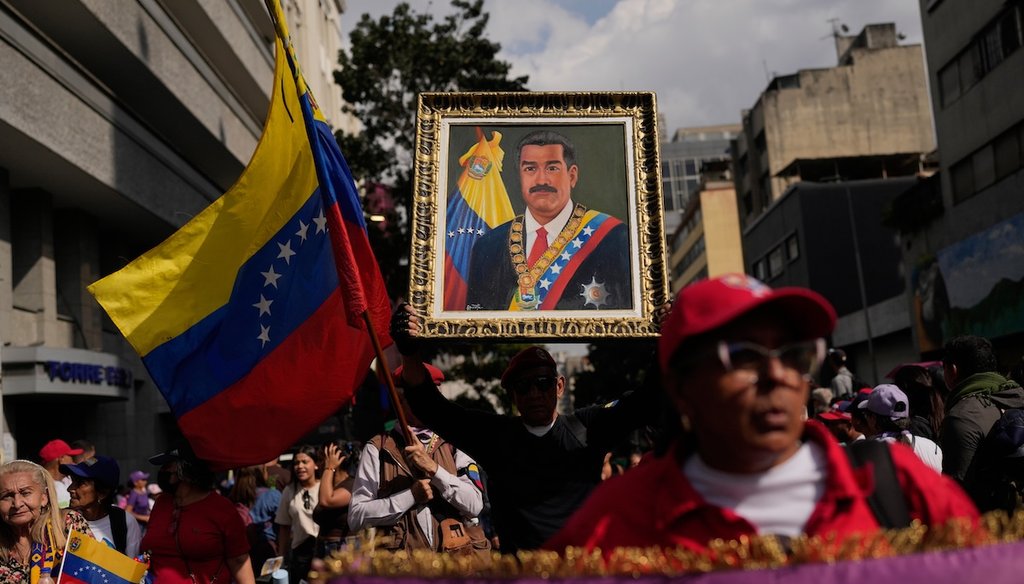
A government supporter holds an image of Nicolas Maduro during a women's march in Caracas, Venezuela, to demand his return on Jan. 6, 2026. (AP)

If Your Time is short
-
For U.S. military operations such as the one that captured Venezuelan leader Nicolás Maduro, there is a longstanding practice, supported by federal law, of informing a bipartisan group of eight top lawmakers in advance.
-
That did not happen with the Venezuela operation, and that might have violated the War Powers Resolution, which requires the president to consult with Congress before engaging in military action.
-
Courts have provided little guidance on the division of war-making authority between the president and Congress.
After the U.S. military captured Venezuelan leader Nicolás Maduro and brought him to the U.S. to face drug-related charges, congressional Democrats criticized President Donald Trump’s unilateral actions.
"The president cannot run a military operation of this size, cannot invade a foreign country, without coming to Congress first," Sen. Chris Murphy, D-Conn., said Jan. 4 on CNN’s "State of the Union."
Presidents and Congress have battled for decades over who has the institutional power to declare war, with presidents from both political parties trying to assert power and limit lawmakers’ interference.
At a Jan. 3 press conference after Maduro’s capture, Secretary of State Marco Rubio confirmed that members of Congress were not notified in advance. Trump said the administration was concerned about lawmakers potentially leaking news of the decision.
It’s unusual for an administration not to offer advance notification — at a minimum, to a select group of eight senior lawmakers who have historically been trusted with classified information. In June 2025, the administration told Republicans, but not Democrats, about the forthcoming U.S. strike on Iranian nuclear facilities.
Legal experts say the most relevant law makes it clear that the president "shall consult with Congress" before initiating military action. But there is less certainty about whether other laws might provide some flexibility for the president.
Murphy’s office did not respond to inquiries.
What do the Constitution and U.S. law say about notifying Congress?
One law that supports Murphy’s critique is the War Powers Resolution.
While most of this law’s text addresses after-action notification and deadlines for congressional approval, it also says, "The president in every possible instance shall consult with Congress before introducing United States Armed Forces into hostilities or into situations where imminent involvement in hostilities is clearly indicated by the circumstances."
The use of "shall" offers strong support for advance notification, even in the absence of a formal vote to authorize an action in advance, experts said.
Another section of U.S. law that addresses covert operations offers more leniency for the president, but it may not apply to the Venezuela operation.
The provision allows the president to notify the so-called Gang of Eight — the chair and ranking members of both the House and Senate intelligence committees, and the top-ranking members from both parties in the House and Senate — rather than Congress as a whole.
But this provision includes a loophole: If the administration doesn’t provide advance notification, "the president … shall provide a statement of the reasons for not giving prior notice" once the operation is launched.
Although the operation was planned and carried out in secret, it does not fit the definition of "covert action" under this law. The law refers to an effort where it is "intended that the role of the United States government will not be apparent or acknowledged publicly."
"The Venezuela raid simply cannot fit within the law's clear definition of a covert operation," said Michael J. Glennon, a Tufts University professor of constitutional and international law. "Obviously, there are confidential aspects to virtually every military operation, but that does not render them covert operations."
War powers have been contested for decades
Courts have not provided much guidance about who has the authority to initiate military action. The Constitution and laws giving powers to Congress have been followed inconsistently.
The U.S. Constitution assigns Congress the right to declare war. The last time Congress did that was at the beginning of World War II.
Since then, presidents have generally initiated military action using their constitutionally granted powers as commander in chief without an official declaration of war.
In August 1964, President Lyndon B. Johnson asked Congress to back his effort to widen the United States’ role in Vietnam. He received approval with enactment of the Tonkin Gulf Resolution, which passed both chambers of Congress, including the Senate, with only two dissenting votes.
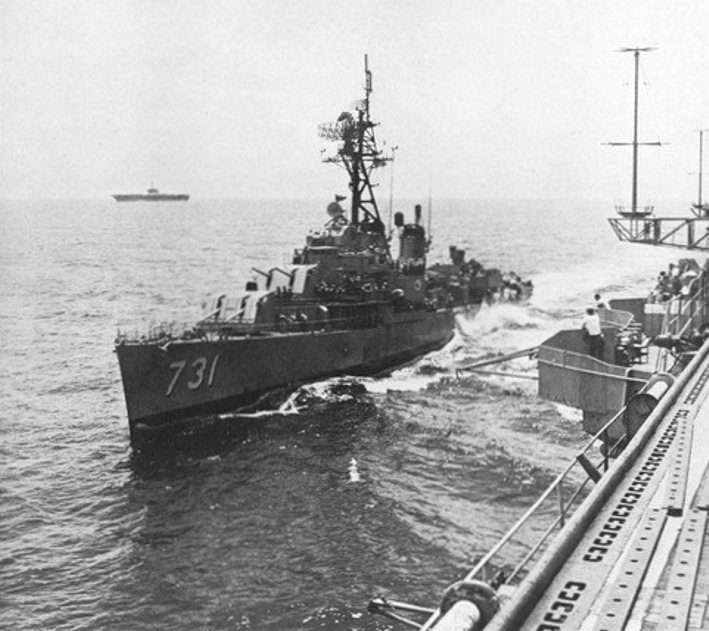
The U.S. Navy destroyer USS Maddox, one of the vessels involved in the Gulf of Tonkin incident, in the South China Sea in 1964. (U.S. Navy)
As public sentiment turned against the Vietnam War, lawmakers became increasingly frustrated about their secondary role in sending U.S. troops abroad. So in 1973, Congress passed the War Powers Resolution, which was enacted over President Richard Nixon’s veto.
The resolution required the president to report to Congress within 48 hours of introducing armed forces into hostilities and to terminate the use of U.S. armed forces within 60 days unless Congress approves. If approval is not granted and the president deems it an emergency, an additional 30 days are allowed to end operations.
Presidents have often followed the act’s requirements, usually framing any entreaties to Congress as a voluntary bid to secure "support" for military action rather than "permission."
This has sometimes taken the form of an "authorization for the use of military force" — legislation that amounts to a modern version of a declaration of war.
Presidents who have sought and received such authorizing legislation include:
-
Ronald Reagan, to oversee the handover of the Sinai Peninsula from Israel to Egypt, and separately to participate in a deployment to Lebanon. The deployment ended with a suicide attack that killed 241 American service members.
-
George H.W. Bush, to oust Iraq’s Saddam Hussein from Kuwait.
-
Bill Clinton, for military action in Somalia.
-
George W. Bush, to enter Afghanistan after the 9/11 attacks, and separately to oust Hussein from power in what became the Iraq War.
Presidents from both parties have used the broad wording of the post 9/11 authorization to support military action against a wide array of targets, using language that approves efforts "to prevent any future acts of international terrorism against the United States."
The Venezuela operation did not have any advance authorization by congressional vote.
If Congress wants a bigger role in the process, "they have to force the president’s hand," said Sarah Burns, a Rochester Institute of Technology political scientist. That means passing legislation that would "make it more consequential that the president didn’t abide by the law," she said.
Our Sources
Chris Murphy, interview with CNN’s "State of the Union, Jan. 4, 2026
Jack Reed, statement, Jan. 3, 2026
Marco Rubio, remarks at a press conference, Jan. 3, 2026
Mike Johnson, remarks to reporters, Jan. 5, 2026
Rick Crawford, interview with Fox News, Jan. 5, 2026
Legal definition of "covert operation"
Text of Tonkin Gulf Resolution
Text of War Powers Resolution
Text of 1991 authorization for the use of military force
Text of 2001 authorization for the use of military force
Text of 2002 authorization for the use of military force
Congressional Research Service, "Memorandum: Presidential References to the 2001 Authorization for Use of Military Force in Publicly Available Executive Actions and Reports to Congress," Feb. 16, 2018
PolitiFact, "Charlie Rangel says last president to seek congressional permission for war was FDR," April 5, 2011
PolitiFact, "Are U.S. actions in Libya subject to the War Powers Resolution? A review of the evidence," June 22, 2011
PolitiFact, "Does Donald Trump have sole power to decide if and when to strike Iran? Or does Congress have a say?" June 18, 2025
PolitiFact, "Did Trump violate War Powers Act by bombing Iran nuclear sites?" June 22, 2025
Email interview with Donald Wolfensberger, former staff director of the House Rules Committee, Jan. 5, 2026
Email interview with Michael O’Hanlon, director of research in the Brookings Institution’s foreign policy program, Jan. 6, 2026
Email interview with Mark F. Cancian, senior adviser at the Center for Strategic and International Studies, Jan. 6, 2026
Email interview with Sarah Burns, Rochester Institute of Technology political scientist, Jan. 7, 2026
Email interview with Michael J. Glennon, Tufts University professor of constitutional and international law, Jan. 6, 2026
Browse the Truth-O-Meter
More by Louis Jacobson