Stand up for the facts!
Our only agenda is to publish the truth so you can be an informed participant in democracy.
We need your help.
I would like to contribute

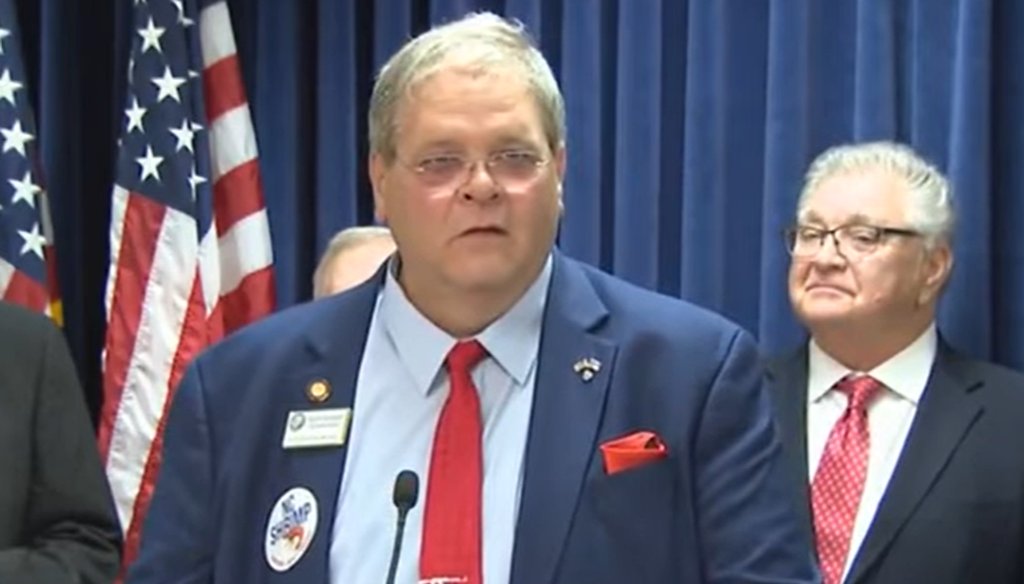
North Carolina Rep. Keith Kidwell, R-Beaufort

If Your Time is short
- A proposed constitutional amendment in North Carolina seeks to define life at fertilization and grant people the right to defend the unborn — potentially through deadly force.
- The proposal doesn’t define fertilization, nor does it mention birth control.
- House Speaker Destin Hall, who has power over which bills come up for a vote, said the bill "doesn’t have a chance of moving at all."
A North Carolina lawmaker’s effort to amend the state’s constitution to define life as beginning at fertilization generated backlash on social media and at the Legislature.
Jen Hamilton, a North Carolina labor and delivery nurse who has nearly 5 million TikTok followers and nearly 2 million Instagram followers and who recently published a best-selling book, "Birth Vibes," posted a video about House Bill 1232, warning her followers that the legislation could be used to "murder women for using birth control." Sen. Sophia Chitlik, a Durham Democrat, used similar language Tuesday when calling on Republican legislative leaders to codify North Carolinians’ rights to contraception and in vitro fertilization.
"This session, we've seen legislation in the General Assembly that would allow people to murder women if they prevent fertilization," Chitlik said. "Contraception is safe, it is effective, it is essential. Access to it is our right, and we will not stop fighting for that right."
Sponsored by Rep. Keith Kidwell, a Beaufort County Republican who has filed similar bills in previous years to no avail, the legislation says anyone seeking to cut short a person’s life "at any stage" shall be held accountable for attempted murder or for first degree murder. It also says North Carolinians have a right to defend life using "deadly force if necessary."
Although Hamilton accurately described parts of the legislation, her comments left out some important context — including that the bill is unlikely to advance — and could leave followers with a misleading impression about its applicability to birth control.
Here are some things to know about House Bill 1232.
‘Not a serious bill’
Because the bill aims to amend the North Carolina Constitution, it requires a higher level of legislative support than other bills — as well as approval from voters. It requires the approval of three-fifths of state lawmakers, rather than a simple majority.
Even if the bill were to be approved by lawmakers, it could only become law if a majority of voters supported the idea in a statewide referendum. Polls show North Carolinians are divided over reproductive rights.
But beyond that, the proposed amendment is highly unlikely to receive a House vote, let alone make the ballot. There’s just not enough support.
Kidwell is the bill’s sole sponsor. A former cosponsor removed his name from the bill, citing "misinterpretations" of its intent. The bill hasn’t been taken up in any committee in the Republican-controlled House. And House Speaker Destin Hall — a Caldwell County Republican with power over which bills come up for a vote — said Kidwell’s proposal "doesn’t have a chance of moving at all."
"It’s not a serious bill," Hall told reporters on June 2. Other than Kidwell, Hall said, "I don't think there's literally any member of our caucus who wants it to move."
What the bill says
A large portion of Hamilton’s video featured language directly from the bill.
Defining personhood. If enacted into law, the bill says it would offer legal protection to human life starting "at the moment of fertilization" — when a sperm cell fuses with an egg to create a new organism. Although the bill doesn’t mention the word "abortion," it would likely usher-in drastic changes to North Carolina’s abortion laws. The state currently limits the procedure after the 12th week of pregnancy. It could also threaten North Carolina’s use of in vitro fertilization, a process some women use to get pregnant that can result in unused embryos.
Legal protections. The bill says anyone who "willfully seeks to destroy the life of another person, by any means, at any stage of life … shall be held accountable for attempted murder or for first degree murder." This would also be a significant departure from the state’s current punishments for people involved in unlawful abortions, which mainly target abortion providers — not women who undergo abortions.
Vigilante justice. The bill also says that North Carolinians have the right to "defend his or her own life or the life of another person, even by the use of deadly force if necessary." The bill doesn’t explicitly state that violence could be used to protect fertilized eggs, but it adds that the state government "has an interest and a duty to defend innocent persons from willful destruction of their lives and to punish those who take the lives of persons, born or unborn."
Vague language
Hamilton said in her video that the bill would allow people to "murder women for using birth control." Tracy Weitz, professor at American University and senior fellow with the Women's Initiative at American Progress, referred to that claim as "extreme" and "hyperbolic."
The bill doesn’t specifically mention "birth control," which is an umbrella term that can refer to several forms of contraception. Hamilton said she uses an intrauterine device, known as an IUD, that allows fertilization of an egg but prevents it from attaching to the uterine lining to start human formation. However, most contraceptives are designed to prevent pregnancy by blocking fertilization altogether.
Hormonal IUDs — the most popular types of IUDs in the United States — are designed to prevent eggs from fertilizing. Many birth control pills prevent fertilization by reducing or stopping ovulation, or the release of an egg from an ovary. Birth control patches work similarly.
In other words: Under a conventional understanding of the fertilization process and how contraceptives most often work, the North Carolina bill could allow many forms of birth control.
Whether lawmakers would adopt a scientifically-supported definition of fertilization remains uncertain. The bill doesn’t define fertilization, leaving lawmakers the flexibility to come up with their own language after voters approve the amendment.
"There’s a lot of ambiguity, and that’s what’s dangerous," said Mary Ziegler, a University of California-Davis Law School professor who studies the politics of reproductive health care.
Weitz agreed that the bill leaves legislators wiggle room to adopt a definition of fertilization that strays from the scientific consensus.
"Yes, contraception works to prevent pregnancy as currently defined," Weitz said. "However, some extreme religious perspectives define contraception as abortion using a religious not medical definition." Still, the allegation that the bill would allow people to murder someone for using birth control is "very farfetched," she said.
"As a scientist, I try to avoid these kind of extreme hyperbolic statements," Weitz said.
Hamilton didn’t respond to requests for comment. In an email, Kidwell’s office told PolitiFact that Hamilton’s claim was "not accurate or the intent of the bill." Kidwell won’t return to the Legislature next year; he lost to a GOP primary challenger in March.
State Rep. Ben Moss, the Richmond County Republican who removed himself as a sponsor of the bill, said legislation was not intended to authorize violence against women.
"The purpose behind this legislation was to affirm the value and dignity of unborn life — not to suggest that women should face capital punishment or to create uncertainty surrounding difficult medical decisions," Moss said in a statement posted to social media. "Unfortunately, portions of the bill’s current language have led to significant understandings and differing misinterpretations that distract from the core pro-life message and intent."
Our Sources
Instagram video posted May 25, 2026.
North Carolina House Bill 1232.
X post by North Carolina state Rep. Ben Moss on May 26, 2026.
Email correspondence with Rebekah Jones, spokeswoman for state Rep. Keith Kidwell.
Interview with House Speaker Destin Hall, R-Caldwell, on June 2, 2026.
Telephone interview with Mary Ziegler, a University of California-Davis Law School professor who studies the politics of reproductive health care.
Email interview with Tracy Weitz, professor at American University and senior fellow with the Women's Initiative at American Progress.
Study, "Trends in Oral Contraceptive and Intrauterine Device Use among Reproductive-aged Women in the US from 1999 to 2017," published by the National Library of Medicine June 1, 2022.
Study, "Historical record-setting trends in IUD use in the United States," published by Science Direct in December 2018.
Cleveland Clinic explanations of intrauterine devices, birth control pills and birth control patches.
WRAL, "Fewer NC adults opposed to additional abortion restrictions, WRAL News Poll finds," Sept. 9, 2024.
Meredith Poll on "abortion law, political candidates, and current issues," published Sept. 25, 2023.
Carolina Partnership for Reform, "What our polling says on abortion," published in March 2023.