Get PolitiFact in your inbox.

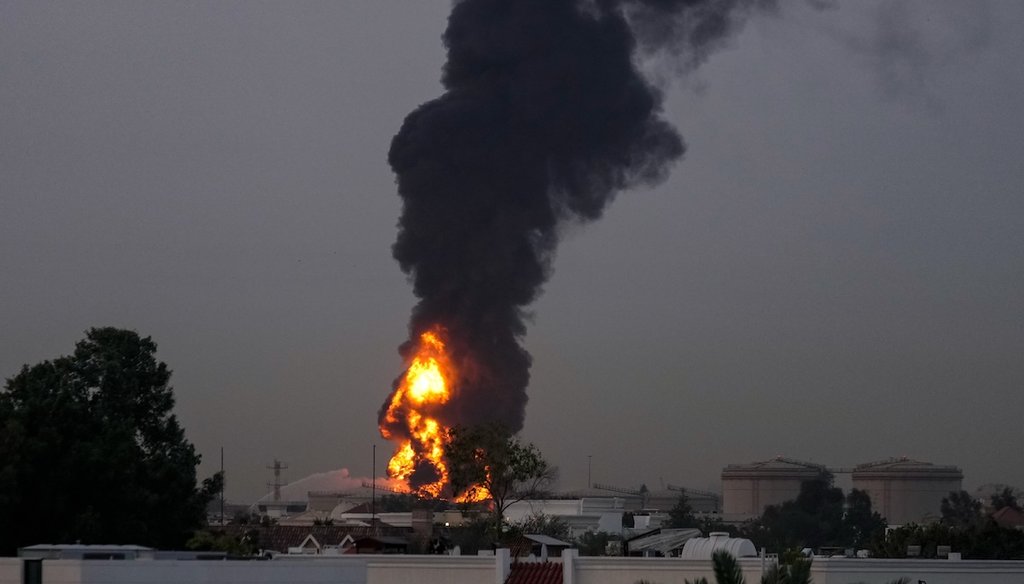
Smoke rises after s drone struck a fuel tank near Dubai International Airport in the United Arab Emirates, forcing the temporary suspension of flights, on March 16, 2026. (AP)

If Your Time is short
-
The United States has weakened Iran’s military capabilities. However, Iran continues to fire missiles and drones at its neighbors and U.S. military sites, which shows the country has maintained its ability to strike militarily.
-
U.S. dominance over Iran’s military does not necessarily translate into victory, especially if a low level of military attacks allows Iran to squeeze the U.S. and world economies.
More than two weeks into the Iran war, U.S. officials decribe widespread damage to Iran’s military. In recent days, President Donald Trump on at least seven occasions discussed the damage the U.S. military has inflicted on Iran’s war-making capabilities.
He said in a March 13 Truth Social post that Iran was "totally defeated" and said in a post the following day, "We have already destroyed 100% of Iran’s military capability." He’s offered similar assessments daily since then:
-
In a March 14 Truth Social post: "The United States of America has beaten and completely decimated Iran, both militarily, economically, and in every other way."
-
In a March 15 interview with Kristin Welker of NBC News: Iran has been "defeated militarily."
-
During a March 15 gaggle with reporters: "Militarily, we've, as far as I'm concerned, we've essentially defeated Iran. Uh, I guess they can have a little bit of fight back, but not much."
-
During a March 16 Kennedy Center board meeting: Iran’s military has been "literally obliterated. The air force is gone. The navy is gone."
-
In March 16 remarks from the Oval Office: "In two weeks we have decimated them."
Sometimes, Trump has offered greater nuance. For example, he posted March 14 on Truth Social, "It’s easy for them to send a drone or two, drop a mine, or deliver a close range missile somewhere along, or in, this waterway, no matter how badly defeated they are."
How accurate is it to say Iran has been militarily defeated?
When we contacted the White House, a spokesperson said in a statement that since the war’s start Iranian ballistic missile attacks have decreased 90%; Iranian drone attacks are down 95%; Iranian missile and air defense systems are "heavily degraded;" and U.S. strikes are dismantling Iran’s defense industrial base, aiming to hamper Iran’s efforts to rearm in the future.
Experts said it’s difficult to independently verify the White House’s figures, although the United States and Israel have achieved some military victories to date and Iran has slowed its pace of attacks.
However, Iran continues to fire drones and missiles at U.S. allies and U.S. forces in the region.
"It is not complicated: Iran has been seriously hurt in some ways but is hardly defeated," said Michael O'Hanlon, director of research in the Brookings Institution’s foreign policy program.
Continuing Iranian strikes undercut notion of 100% defeat
Experts agreed the widespread U.S. and Israeli attacks have succeeded in damaging or destroying key Iranian targets.
The U.S. military said it has sunk dozens of Iranian ships, and independent monitoring by Armed Conflict Location and Event Data counts about 1,400 distinct strikes — including missile, drone and manned — in Iran. Israeli officials have said Iran’s ballistic-missile capabilities are significantly weakened, with 160 to 190 launchers destroyed, about 200 more disabled, and 150 still active.
On March 17, the Institute for the Study of War, a U.S. think tank, released data showing that Iranian drone attacks averaged a little over 100 per day between March 2 and March 8, then fell to between six and 39 daily from March 9 to March 16. Ballistic missile attacks have not exceeded 17 since the second day of the war, March 1, the group found.
"Iran is suffering a significant military defeat," said Boaz Atzili, an American University political scientist. "The number of Iranian military casualties is probably in the thousands, compared to U.S. military casualties, which are very few. Another measure is the U.S. aerial control and the fact that no U.S. or Israeli airplane has been downed."
Lopsided metrics like these don’t mean Iran’s military capabilities have been eliminated.
"There are missiles and drones fired every day towards Israel, U.S. forces in the region, and the Gulf states," Atzili said. "Obviously they are not 100% defeated if they are able to strike back."
Even limited Iranian strikes can accomplish Iran’s goals if they continue to successfully target the crucial Strait of Hormuz, a key shipping channel, said Barbara Slavin, a fellow at the Henry L. Stimson Center, a foreign policy think tank.
As long as Iran is able to fire missiles and drones, it has what Slavin called a "potent" weapon: "leverage over oil prices and the health of the global economy."
Tactical battlefield victories do not always translate into actual victory in a war, said John Pike, director of Globalsecurity.org, a think tank.
"I imagine Iran can sustain the minimal rate of fire needed to convince civilians, insurance companies, missile defense battery operators, and the news media, that they have not surrendered," Pike said.
Kelly A. Grieco, a senior fellow with the Stimson Center, recently wrote that large declines in Iran’s missile and drone attacks might not stem from U.S. attacks: Iran could be more selective about what to target or could be stockpiling missiles and drones for larger, coordinated attacks later.
Iran, she wrote, "may have simply concluded that a lower, sustained launch rate is sufficient to maintain coercive pressure on Gulf states while conserving inventory for a conflict that could last months. A strategy of attrition does not require maximum effort every day."
Ultimately, a U.S. victory would at least require fighting to end, if not an outright surrender, experts said.
What’s important in this conflict "is a political and diplomatic victory, and the U.S. and Israel are far from that," Atzili said. Iran is fighting what is known as an asymmetric war, in which the two sides have different tolerances for disruption and different methods to use. For Iran, he said, "They only need to survive and cause damage to the other side to be considered a winner of the war."
Mark F. Cancian, a senior adviser to the Center for Strategic and International Studies, a national security-focused think tank, pointed to guidance from the U.S. Joint Chiefs of Staff, the senior group of military advisers. The closest thing the U.S. military has to a definition of a victory, the Joint Chiefs says, is that "the general goal" of a military operation is to "conclude hostilities, and establish conditions favorable to the host nation … and the United States and its multinational partners."
Given the failure so far to oust the Iranian regime, to secure an agreement from Iran’s government to end nuclear and missile programs, and to enable free passage through the Strait of Hormuz, neither of the Joint Chiefs’ conditions are met, Cancian said.
Our Sources
Donald Trump, remarks on March 13, March 14, March 14, March 15, March 15, March 16 and March 16, 2026
Joint Chiefs of Staff, "Joint Publication 3-0," accessed March 16, 2026
ACLED, "Iran Crisis Live," accessed March 16, 2026
Institute for the Study of War, X post, March 17, 2026
Kelly A. Grieco, "Don’t Count Launches: Misreading Iran’s Drone Capacity," March 16, 2026
The Atlantic, "Glimpsing Victory in Iran," March 16, 2026
Al Jazeera, "Map shows how 16 days of attacks have evolved in US-Israel war on Iran," March 16, 2026
CNBC, "U.S. forces sink 16 Iranian minelayers as reports say Tehran is mining the Strait of Hormuz," March 10, 2026
Reuters, "US military says it has sunk over 30 Iranian ships so far," March 5, 2026
Email interview with John Pike, director of Globalsecurity.org, March 16, 2026
Email interview with Barbara Slavin, a fellow at the Henry L. Stimson Center, March 16, 2026
Email interview with Mark F. Cancian, senior adviser to the Center for Strategic and International Studies, March 16, 2026
Email interview with Michael O'Hanlon, director of research in the Brookings Institution’s foreign policy program, March 16, 2026
Email interview with Boaz Atzili, American University political scientist, March 16, 2026
White House, statement to PolitiFact, March 16, 2026
Browse the Truth-O-Meter
More by Louis Jacobson