Stand up for the facts!
Our only agenda is to publish the truth so you can be an informed participant in democracy.
We need your help.
I would like to contribute

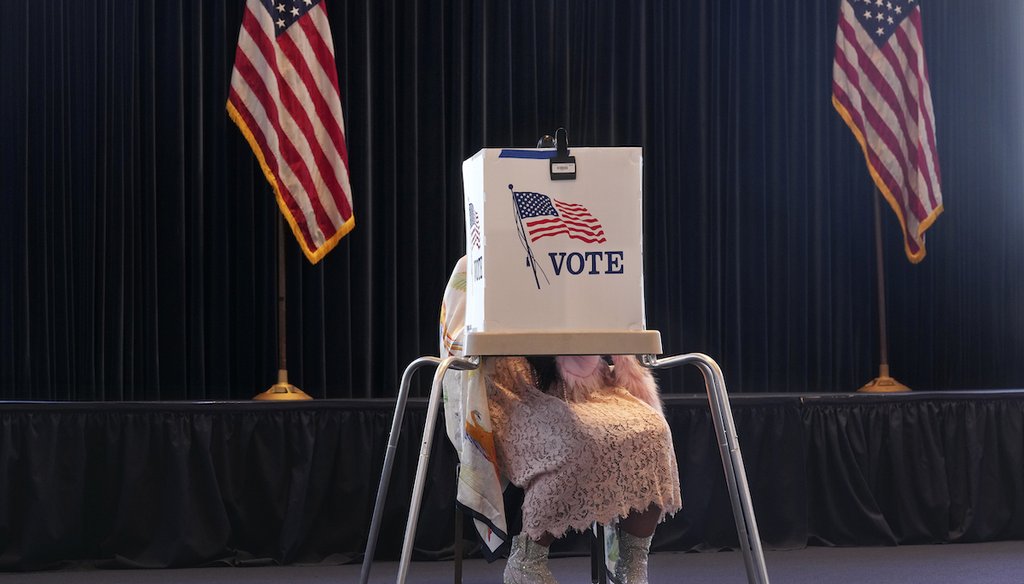
A voter works on her ballot at a polling place at the Ronald Reagan Presidential Library on Election Day, Tuesday, Nov. 5, 2024, in Simi Valley, Calif. (AP)

If Your Time is short
-
The House-passed SAVE America Act would require documentary proof of citizenship to register to vote and government-issued photo ID to cast a ballot.
-
Millions of married women have changed their names, which means that their current names are different from the ones on their birth certificates. These women would be required to provide documentation about their name change or sign an affidavit to be able to vote.
-
The legislation calls for states to set up processes to handle name discrepancies. It is unlikely to pass the Senate.
As the Senate considers the Safeguard American Voter Eligibility Act, a key point of debate is what it would do to the voting rights of millions of married women who changed their last names.
The House-passed legislation, also called the SAVE America Act, sets national standards for proving U.S. citizenship to register to vote.
The House approved the measure Feb. 11 by a vote of 218-213. Some Democratic lawmakers criticized the bill, saying that millions of women will no longer be able to vote or will have to jump through extra hoops.
Rep. Lauren Underwood, D-Ill., called it a "voter suppression bill."
"Nearly 69 million women in America have a birth certificate that does not match their current name and therefore 69 million American women would no longer be eligible to vote," Underwood said.
Rep. Katherine Clark of Massachusetts, the second-ranking House Democrat, said Republicans "decided to make it harder for women to vote" and require them to sort through a "minefield of red tape."
When Senate debate on the bill began March 17, Sen. Amy Klobuchar, D-Minn., said that the bill creates "bureaucratic hurdles" for Americans to register to vote or change their registration, "particularly for the 69 million women who have chosen to change their name when they get married. Why should they be penalized?"
The legislation's Republican supporters said that Democrats are spreading a myth.
"There is zero validity to these claims," White House press secretary Karoline Leavitt said March 10.
"The SAVE America Act does not prohibit anyone from voting, with the exception of illegal aliens," Leavitt said, later acknowledging that some people will have to go through an extra step to vote legally.
Noncitizens are already banned from voting in federal elections, and they rarely do. A few cities allow noncitizens to vote in local elections such as for school boards.
"For the small fraction of individuals who have changed their name or their address, they can still register to vote, of course," Leavitt said. "They just have to go through their state processes to update that documentation."
A 2023 Pew research survey found 79% of married women in opposite-sex marriages took their spouse’s last name. About 5% of men changed their last names after marriage. For same-sex marriages, Pew said the sample was too small to measure.
Using data from Pew and the Census, the liberal Center for American Progress found that 69 million women have taken their spouse's name and don't have a birth certificate matching their legal name
SAVE America Act requires states to develop document discrepancy processes
The Constitution tasks states, not Congress, with running elections. About two-thirds of states have laws that request or require an ID to vote; some states mandate that the ID include a photo. Other states use different verification measures.
The SAVE America Act requires citizens to provide a government-issued photo ID to vote and strict documentary proof of citizenship, such as a passport or birth certificate, to register. Under the bill, election officials could accept a Real ID driver's license that includes citizenship, though only a handful of states offer such a license. Student IDs would no longer be accepted as voter ID, even though some states currently allow that option.
President Donald Trump, who has repeatedly called on the Senate to pass the legislation, wants lawmakers to also add a ban on most voting by mail, but that’s unlikely.
The legislation doesn’t specifically mention the scenario of women changing their name through marriage, but it has a provision addressing what to do when a person’s name on their birth certificate doesn’t match their current name. It says that in cases of such name discrepancies, states shall establish processes to provide "additional documentation as necessary to establish that the name on the documentation is a previous name of the applicant" or require the voter registration applicant to sign an affidavit attesting that the name on the documentation is the applicant’s previous name.
Sen. Mike Lee, R-Utah, one of the legislation’s authors, has pointed to the affidavit portion of the legislation in response to critics.
"We’ve made special accommodation for those who don’t have documentation, for those who can’t find their birth certificate — maybe their house burned down, maybe their dog ate it, whatever it is," Lee said.
Passage in the Senate, which has 53 Republicans, appears unlikely because it needs 60 votes to pass under current rules and has faced widespread opposition by Democrats.
Election law experts say that the legislation does not remove the right to vote for women who change their names, but it does add procedural hurdles.
Derek Muller, a University of Notre Dame law professor, wrote in the Election Law Blog that "literally nothing more than an affidavit would suffice in these circumstances. This should dramatically alleviate — if not wholly eliminate — the concerns about name changes."
Muller pushed back against criticisms that 69 million women could not use their birth certificate to prove citizenship status.
He said the SAVE America Act’s option to allow registrants to provide signed affidavits offers a "less onerous" solution.
The federal legislation is more generous than an Arizona law requiring voter registrants to provide legal documentation such as a marriage certificate if their name on the birth certificate doesn’t match their current name, Muller said. Florida’s recently-passed statute mimics Arizona’s law.
But how easy or difficult it would be for women to update their registration depends on what processes their states adopt. We don’t know what guidance the federal Election Assistance Commission will provide. It’s possible some states could make it more cumbersome than others.
Aaron Blacksberg, a federal policy counsel with the Institute for Responsive Government, a group that works with election officials, said women who change their names will not be prevented from voting "but it would add significant barriers. The main issue is it's not clear what those barriers are."
The legislation is vague on details, Blacksberg said. For example, it says that states shall establish a process of requiring "additional documentation as necessary" to show name changes, but doesn’t list the type of documentation. For women who want to sign an affidavit about their name change, it doesn’t state information about the affidavit such as whether it must be signed by a notary. And the legislation says that the state processes "shall be subject to any relevant guidance adopted by the Election Assistance Commission" but the guidance that commission provides is generally voluntary for states to follow.
Another challenge is that the legislation would take effect immediately during an election year when primaries are already under way. That doesn’t leave much time for election officials to implement changes, conduct voter outreach or for women to update their registrations.
Voting rights advocates further worry it will hurt voter turnout.
"Any additional strip of red tape you put in front of voters is going to discourage some eligible voters from registering and continuing to jump through the bureaucratic hurdles," said Eliza Sweren-Becker, a deputy director at the Brennan Center for Justice at NYU School of Law.
The legislation includes criminal penalties for election officials who register a person to vote who failed to present documentary proof of citizenship even if that person is a U.S. citizen. States already have processes for handling name changes, but should SAVE America Act pass, federal law would supersede state laws.
New Hampshire’s proof of citizenship law has created obstacles for some women
Opponents of the SAVE America Act point to the impact of a New Hampshire documentary proof of citizenship law. For people who lack documentary proof, local election officials may be able to help prove a voter’s qualifications by searching state records. But that won’t help if the documents a voter needs are from another state.
New Hampshire’s law went into effect after the 2024 election, so it has only been enforced during low-turnout municipal elections, said Jake van Leer, an attorney for the ACLU, which challenged the law in an ongoing lawsuit.
During a recent trial, election officials confirmed that several voters were turned away for missing name change documentation, van Leer said.
A Bethlehem, New Hampshire, election official testified that during the span of about a year, the office processed about a dozen registration applications, but officials had to reject 25% of them because the applicants were women who used birth certificates with their maiden names but did not provide additional name change proof.
The New Hampshire Campaign for Voting Rights, a coalition of voting rights groups, held a poll observing program at some voting sites. It tracked nearly 250 voters turned away during the 2025 elections, the majority for insufficient documentary proof of citizenship, including name change documentation, van Leer said.
A Concord, New Hampshire, election official testified that she had to turn away a recently-divorced woman who had changed back to her maiden name but didn’t have proof of the name change. She noted that the woman’s ex-husband was still able to vote.
RELATED: President Trump wants to slash voting by mail. About 1 in 4 Republicans voted that way in 2024
Our Sources
Rep. Lauren Underwood, X post, Feb. 11, 2026
Rep. Becca Balint, X post, Feb. 10, 2026
Rep. Katherine Clark, press release, Feb. 10, 2026
Former Secretary of State Hillary Clinton, X post, Feb. 11, 2026
Rep. Chrissy Houlahan, Email, March 2026
Sen. Markwayne Mullin, X post, Feb. 11, 2026
Sen. Mike Lee, X post, Feb. 13, 2026
Congress.gov, S.1383 - Veterans Accessibility Advisory Committee Act of 2025, 2026
USA Today, White House responds to 'SAVE America Act' claim married women won't be allowed to vote in elections, March 10, 2026
Professor Derek Muller, Some musings on the SAVE America Act, March 15, 2026
Pew Research Center, About 8 in 10 women in opposite-sex marriages say they took their husband’s last name, Sept. 7, 2023
Bipartisan Policy Center, Do Documentary Proof of Citizenship Requirements Disadvantage One Party More Than the Other? March 16, 2026
Bipartisan Policy Center, Five Things to Know About the SAVE America Act, Feb. 2, 2026
Center for American Progress, The SAVE Act Would Disenfranchise Millions of Citizens, Jan. 31, 2026
Associated Press, New Hampshire town elections offer a preview of citizenship voting rules being considered nationwide, March 23, 2025
Snopes, How the SAVE America Act could impact voting process for everyone, including married women, March 6, 2026
The 19th, House passes elections overhaul bill that could make it harder for married women to vote, Feb. 26, 2026
Fox News, Trump voter ID push faces Senate test as GOP rebels threaten to sink bill, March 17, 2026
New Hampshire Public Radio, Trial begins over fate of NH’s proof-of-citizenship voter law, Feb. 9, 2026
PolitFact, SAVE Act would make it harder, not impossible, for married people to register to vote, Feb. 17, 2025
Email interview, Gerri Kramer, Hillsborough County supervisor of elections spokesperson, March 12, 2026
Email interview, Alison Novoa, Palm Beach County supervisor of elections spokesperson, March 17, 2026
Email interview, Cassondra Knudson, Minnesota Secretary of State Steve Simon spokesperson, March 17, 2026
Telephone interview, Aaron Blacksberg, federal policy counsel with the Institute for Responsive Government, March 17, 2026
Email interview, Justin Levitt, Loyola Marymount law professor, March 17, 2026
Telephone interview, Eliza Sweren-Becker, deputy director at the Brennan Center for Justice at NYU School of Law, March 17, 2026
Email interview, Jacob van Leer, staff attorney, ACLU Voting Rights Project, March 18, 2026
Email interview, Anna Sventek, spokesperson for the New Hampshire Secretary of State, March 18, 2026