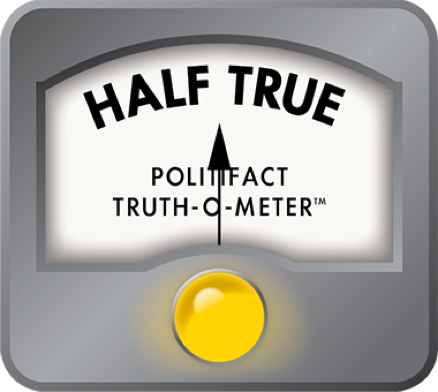

Said she has led the House effort to build a large Micron semiconductor facility near Syracuse.

Our only agenda is to publish the truth so you can be an informed participant in democracy.
We need your help.

Land in Clay, N.Y., that is slated to be developed by Micron Technology into semiconductor factories on Oct. 15, 2024. (AP)

In 2022, Rep. Claudia Tenney, R-N.Y., voted against the CHIPS and Science Act, which eventually provided billions of dollars in federal support for a large Micron plant north of Syracuse.
In 2025, she cosponsored a bill signed by President Donald Trump that expanded and extended a key provision of the CHIPS and Science Act and that could benefit the Micron plant.
Republican Rep. Claudia Tenney, whose congressional district stretches across much of Central New York, recently took credit for helping push forward a major semiconductor factory in Clay, N.Y., north of Syracuse.
"It was exciting to break ground with @MicronTech on its historic investment in New York State," Tenney posted on X Jan. 16. "This project will create 50,000 jobs and strengthen domestic semiconductor manufacturing across NY. I was honored to lead this effort in the House as Congress reaffirmed America’s commitment to long-term innovation & competitiveness."
Tenney touted her role in advancing the Micron plant, but her connection to the project is more complicated than her post acknowledged.
Tenney’s office did not respond to inquiries for this article.
Micron, one of the United States’ largest producers of computer memory and data storage, is building a $100 billion "megafab" facility that will produce semiconductors, a key component of consumer and industrial electronics.
Upon completion, it is poised to become the country’s largest such plant. According to Micron, the Clay facility will include 2.4 million square feet of clean room space, or the size of about 40 American football fields. The $100 billion in expenditures will be spread over at least 20 years.
Micron and public officials have projected that the plant will create upwards of 50,000 jobs, potentially providing a major boost to central New York’s faltering economy.
Recently, Tenney has been a supporter of the plant. She was one of several high-ranking officials at the groundbreaking. Other attendees included Commerce Secretary Howard Lutnick, Rep. Nick Langworthy, R-N.Y., and New York Democratic Sen. Chuck Schumer and Gov. Kathy Hochul.
In 2022, Tenney opposed a key piece of legislation that made the Micron plant possible: the CHIPS and Science Act, which was signed by then-President Joe Biden. The bill was designed to promote U.S. high-tech manufacturing through federal funding and incentives.
On the eve of the bill’s signing, Micron wrote in a news release that it was announcing $40 billion in manufacturing investment because the CHIPS and Science Act made it possible for the company to "move toward this significant, long-term investment plan with confidence."
When the CHIPS and Science Act was being debated in the House — and before Micron had chosen Clay as the location — Tenney explained her opposition by saying the bill "lacks critical guardrails and includes loopholes that in the long run could benefit China." She said that "much of the supported research under this bill will be executed in partnership with universities, which we know are notoriously vulnerable to Chinese espionage."
In December 2024, the U.S. Commerce Department finalized more than $6 billion in federal funds for Micron to assist in its New York and Idaho plants.
Since the bill was signed into law and Micron announced the plant would be in New York, Tenney has become more supportive.
In May 2025, Tenney and 20 bipartisan colleagues introduced the Building Advanced Semiconductor Investment Credit, or BASIC, Act, which builds on provisions of the CHIPS and Science Act. The legislation would increase the advanced manufacturing investment credit from 25% to 35% and extend its availability through Dec. 31, 2030.
This bill was enacted as part of Trump’s signature tax and spending law in 2025, the One Big Beautiful Bill Act.
Tenney’s shifting positions on the value of the CHIPS and Science Act led to a community note on her X post, which cited her vote against the bill.
Tenney said she has led the House effort to build a large Micron semiconductor facility near Syracuse.
Her role has been more complicated than that. In 2022, Tenney voted against the CHIPS and Science Act, which eventually provided billions of dollars in federal support for the Micron plant.
However, in 2025, she offered a bill that was enacted and signed by Trump that expanded and extended a key provision of the CHIPS and Science Act.
The statement is partially accurate but leaves out important details, so we rate it Half True.
Claudia Tenney, X Post, Jan. 16, 2026
New York state governor’s office, "From Promise to Progress: Governor Hochul Celebrates Groundbreaking of Micron’s Semiconductor Manufacturing Facility in Central New York," Jan. 16, 2026
U.S. Commerce Department, "Biden-Harris Administration Announces Preliminary Terms with Micron to Onshore Leading-Edge Memory Chip Production in U.S. for First Time in Decades," Apr. 25, 2024
Claudia Tenney, "Congresswoman Tenney Introduces Legislation to Stimulate Investments into American Manufacturing," May 1, 2025
Claudia Tenney, "Congresswoman Tenney’s Statement on Passage of the CHIPS and Science Act," Jul. 28, 2022
Claudia Tenney, "Congresswoman Tenney Secures Massive Win for Central New York in the One Big Beautiful Bill," Jul. 9, 2025
House of Representatives, "Roll Call 239 | Bill Number: H. R. 4346," Jul. 28, 2021
CNY Central, "Rep. Tenney introduces bill that would increase CHIPS Act tax credit," May 2, 2025
Reuters, "US finalizes $6.1 bln Micron chip-making subsidy," Dec. 10, 2024








In a world of wild talk and fake news, help us stand up for the facts.