
Florida school districts are the “biggest” drivers of increased property taxes.


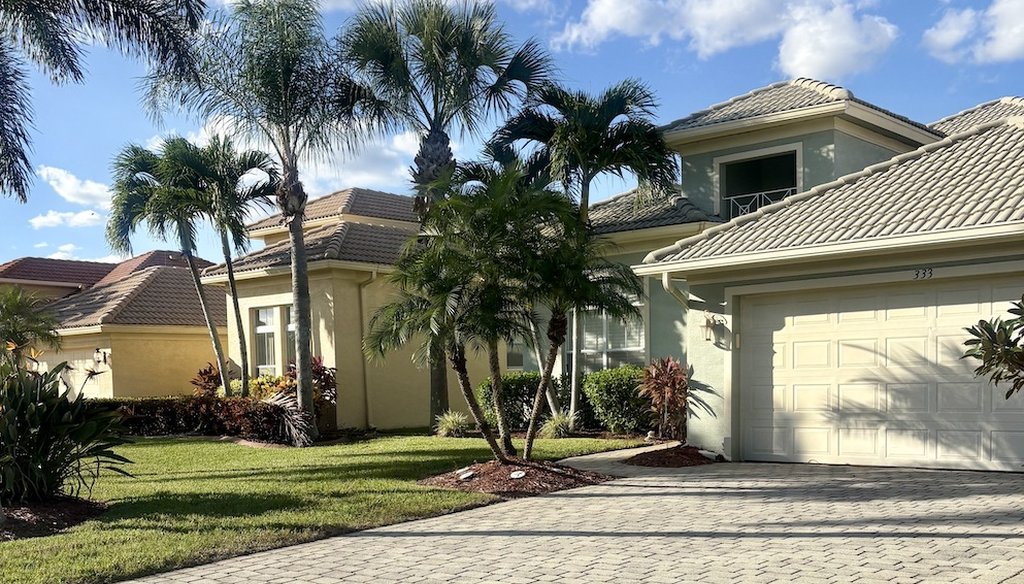
Houses seen in a neighborhood in Port Saint Lucie, Florida, on Oct. 30, 2025. (Samantha Putterman)

Florida’s public schools received $21.6 billion in property taxes in 2024, around 40% of the state’s property tax revenue. Higher property taxes, however, are largely driven by increased property values.
Florida school districts have control over some of the local tax money they receive and have the ability to decrease tax rates, but all taxes that school districts levy have some level of state control.
School districts can ask taxpayers for more money to finance specific projects. Voters must approve these increases.
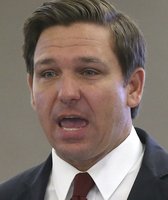
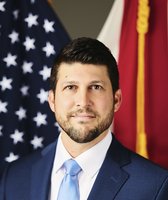
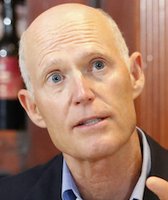
Rep. Byron Donalds, Florida’s leading Republican gubernatorial candidate, supports eliminating all property taxes on primary residences, which would cut public school funding — a stance that sets him apart from other Republicans championing a state property tax overhaul.
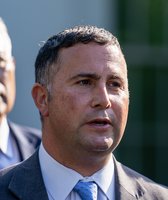
"The biggest people who've actually increased property taxes on the hardworking men and women of our state are school districts," Donalds said in a March 8 CBS News Miami interview. He pointed to Miami Dade, Broward, Hillsborough and Collier school districts and said they have decreasing enrollment but are collecting "far more property taxes than they ever have."
Florida public schools received around 40% of the state’s property tax revenue in recent years and typically make up the largest share of local taxes in homeowners’ bills. But they aren’t the main driver of property tax increases — that distinction goes to skyrocketing property values.
School districts control some of the local tax money they receive and can choose to lower certain rates. Any increases, though, are subject to caps or voter approval. A large portion of school property tax revenue also comes via a mandatory rate the Florida Legislature sets that districts must levy to receive state funding.
"The primary driver of rising property taxes are rising property values," said Abigail Hall, a University of Tampa associate economics professor. "Most of what is happening in terms of school funding is outside of the school districts’ control."
When reached for comment, a Donalds campaign spokesperson told PolitiFact that many Florida school districts have increased property taxes or are "actively considering" it. The spokesperson sent articles about Alachua County, Leon County and several others.
The articles, however, don’t prove that school districts are the "biggest" drivers of higher property taxes. In Alachua County, for example, a school board budget that led to a 6% increase in property tax revenue was largely because home values in the county increased.
The district kept its operating and infrastructure rates capped. Its overall budget decreased by about $8 million.
Florida House Republicans passed their version of a property tax overhaul in February that would eliminate some property taxes on primary residences with voter approval, exempting schools. The Senate, however, didn’t take up the measure, raising the possibility of a special session.
School districts are funded with federal, state and local money, with local funds almost exclusively coming from property taxes. State funding largely comes from sales taxes.
Local governments, including school boards, set millage rates, which are used to calculate property taxes. One mill equals $1 of tax for every $1,000 of assessed property value. So a rate of one mill on a $200,000 house would equal $200 in annual taxes, excluding exemptions.
Florida’s public schools primarily rely on three millage rates. One, called the "Required Local Effort," is set annually by the Legislature and dictates what K-12 schools must collect from local taxpayers.
Schools can reduce or increase two of the three primary millage rates, but those rates are still subject to caps under Florida law. So all millage rates that school districts levy have some level of state control. School boards can also request tax money to finance specific projects, such as security officers in schools or teacher pay increases, via local voter referendum.
"While property tax collections may increase as property values grow, school district tax rates themselves are largely governed by state law and have trended downward over time," Nadine Drew, a Broward County Public Schools spokesperson, said.
Hall agreed, saying, "The state largely controls the rules. On the surface it may look like local officials appearing responsible for tax increases, but the underlying formula they’re required to use comes from the state."
Florida’s rising property taxes are influenced by several factors, but increasing home values are a primary driver.
Nationwide, the average home sale price rose from $383,000 in 2020 to $534,000 in 2025, a nearly 40% increase. And Florida has followed a similar trajectory, with its median home price rising from $330,000 in 2020 to $425,000 now, a 29% increase.
Florida’s property taxes have similarly increased; in 2019, the state collected $33.9 billion in property tax revenue, and in 2024 it collected $55.1 billion, a 62% increase.
A nonprofit’s 2025 study examined the relationship between property values and property taxes. For Florida, researchers found a correlation between rising home values and rising tax revenue. That’s because the state has no laws limiting the amount of tax revenue local governments can collect, which would insulate homeowners from an inflated housing market.
For the 2025-26 fiscal year, Florida school districts received about $21.6 billion in property tax revenue. About $10.9 billion of that came from the state’s mandated millage.
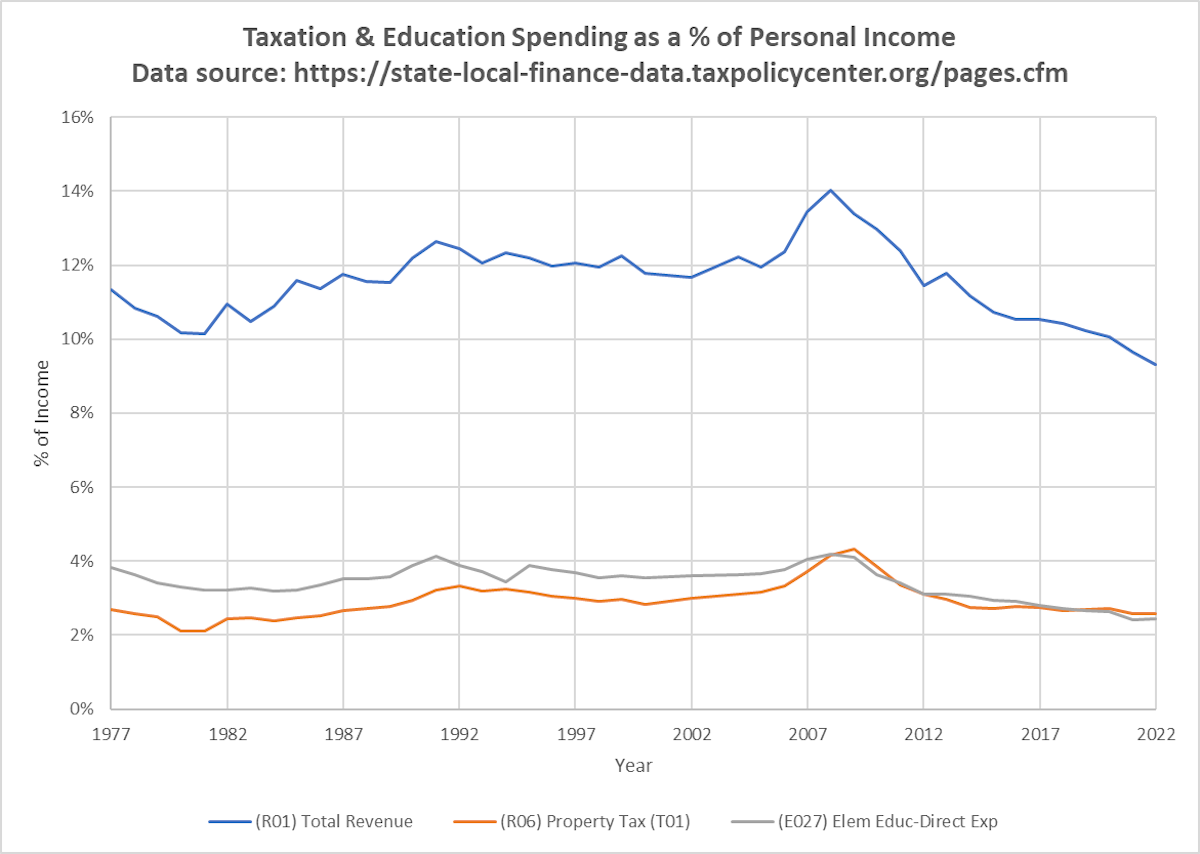
Bruce Baker, a University of Miami professor and public school financing expert, said data from 2017 to 2022 showed Florida’s K-12 education spending as a percentage of personal income declined faster than property taxation. This shows "school spending from property taxation is not creating the pressure," he told PolitiFact in an email.
(Bruce Baker, University of Miami)
Matthew Caldwell, the Lee County property appraiser and a former Republican lawmaker, said school taxes apply to a larger portion of a property’s value since they aren’t subject to certain exemptions, one reason they may appear outsized compared with other local taxes. Caldwell said districts can choose to roll back millage rates to prevent spikes in property taxes but typically don’t do that.
School districts say they are hamstrung by Florida’s decreasing public school investment and declining student enrollment, which reduce state funding.
Norín Dollard, a Florida Policy Institute senior policy analyst, said $4 billion, or 24.2%, of the state’s general revenue education funding is now going to private school tuition and homeschoolers, which "leaves county school districts responsible for a greater and greater share of support for public schools."
State revenue per pupil started to decline in 2000 and was replaced by increased local contributions, largely from property taxes, according to a 2025 study Baker conducted.
"The State Legislature has passed along much of the cost of operating elementary and secondary schools to local property taxpayers. Per pupil spending for Florida school districts is at or below where it was in 1993," Baker said.
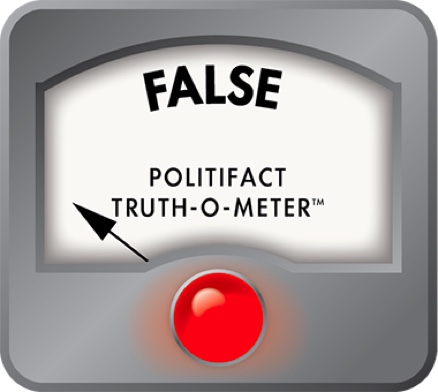
Donalds said Florida’s school districts are the "biggest" drivers of increased property taxes.
Higher property taxes are largely related to increased property values. Since 2020, property tax revenue in the state has increased by over 60% as home values soared.
Florida’s school districts received around 40% of the state’s property tax revenue in recent years. All school millage rates have some level of state control, including one the Legislature mandates that districts levy to qualify for state funding.
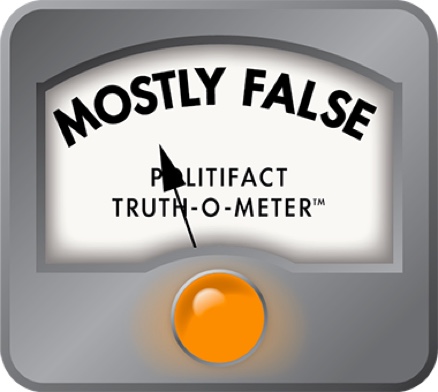
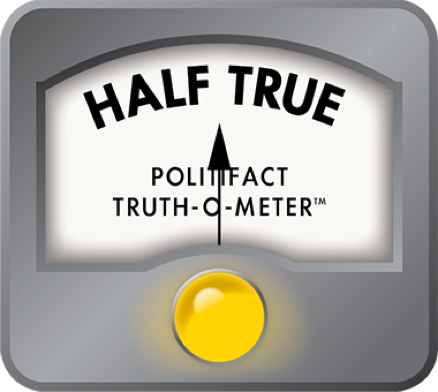
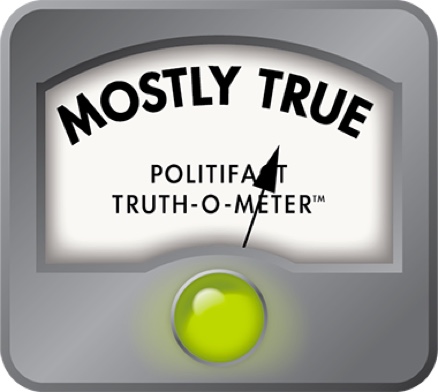
Donalds’ statement contains an element of truth because districts maintain some control over taxation; districts can choose to roll back millage rates to prevent spikes in property taxes but typically don’t do that. But his statement ignores critical facts that would give a different impression. We rate it Mostly False.
RELATED: Will Florida’s Supreme Court have to review lawmakers' property tax proposal? Only if someone sues
RELATED: Is DeSantis right that most Florida property tax dollars come from vacation homes, businesses?
CBS News Miami, Byron Donalds discusses past arrest, policy priorities and Florida governor’s race, March 8, 2026
Florida Department of Education, Funding & Financial Reporting, Accessed March 16, 2026
Florida Department of Education, Funding for Florida School Districts, 2024-25
Florida Department of Education, 2024-25 Florida Education Finance Program, June 12, 2024
Florida Department of Education, Florida Education Finance Program 2025-26, Accessed March 16, 2026
Florida Department of Revenue, Statewide Property Tax Overview (2024), Accessed March 13, 2026
Florida Department of Revenue, Statewide Property Tax Overview (2019), Accessed March 13, 2026
Florida Statutes, 1011.71 District school tax, Accessed March 13, 2026
Federal Reserve Bank of St. Louis, Average Sales Price of Houses Sold for the United States, Updated Feb. 20, 2026
Federal Reserve Bank of St. Louis, Housing Inventory: Median Listing Price in Florida, Updated March 6, 2026
Florida Policy Institute, Florida FY 2025–26 Budget Summary: Education, August 27, 2025
Florida Policy Institute, Bill Summary: HB 1 (2023), July 12, 2023
Florida House of Representatives, Select Committee on Property Taxes, Sept. 22, 2025
Tax Foundation, Property Tax Relief & Reform, Accessed March 16, 2026
The School Finance Indicators Database, The Adequacy and Fairness of State School Finance Systems - Florida, February 2026
Lincoln Institute of Land Policy, When Property Values Rise, Do Property Taxes Rise Too?, 2025
Miami New Times, South Florida Cities See Home Prices Surge at Historic Rate, Jan. 13, 2026
Florida Realtors, Fla.: Highest 2-Year Home Price Rise on East Coast, July 17, 2023
Pensacola News Journal, Are Florida's property taxes really that high? What the numbers say, Feb. 27, 2026
The Independent Alligator, Alachua County School Board sets 2025-2026 final budget, millage rates, Sept. 11, 2025
WFSU, The Leon County School District considers tax hike options as budget shortfall looms, Feb. 25, 2026
The Tampa Bay Times, 20 Florida school districts are asking for tax hikes on Election Day,
Realtor.com, Home Prices May Be Down in Some Areas, but Don’t Expect Your Property Taxes To Do the Same, July 3, 2025
Email interview, Byron Donalds’ campaign press office, March 12, 2026
Email interview, Matthew Caldwell, Lee County property tax appraiser, March 12, 2026
Email/Phone interview, Elmo Lugo, spokesperson for Miami Dade Public Schools,
March 13, 2026
Email interview, Nadine Drew, spokesperson for Broward County Public Schools, March 16, 2026
Phone interview, Abigail Hall, associate professor of economics at the University of Tampa, March 13, 2026
Email interview, Bruce Baker, University of Miami professor and expert on public elementary and secondary education financing, March 15-16, 2026
Email interview, Norín Dollard, senior policy analyst and KIDS Count director at THE Florida Policy Institute, March 16-17, 2026
Email/Phone interview, Nicole Fox, senior policy analyst at Tax Foundation, March 17, 2026









In a world of wild talk and fake news, help us stand up for the facts.