
The SAVE America Act “requires everyone to re-register to vote in person and your driver’s license, REAL ID, or military ID aren’t even good enough.”

Our only agenda is to publish the truth so you can be an informed participant in democracy.
We need your help.

Voters stand in line outside Madison Church, a polling place, on Election Day, Nov. 5, 2024, in Phoenix. (AP)

The SAVE America Act would not require everyone to reregister to vote. But those who move, even locally, or change their party registration or name, would likely need to update their registrations.
The bill requires people registering to vote to present documentary proof of citizenship, such as a passport or birth certificate.
The Trump-supported legislation passed the House in February and it’s up for debate in the Senate.
Sen. Mark Kelly, D-Ariz., said that if the SAVE America Act becomes law, it will present a major hurdle for everyone already on the voter rolls.
"The SAVE America Act doesn’t ‘Save’ America,’ Kelly said in a March 17 X post. "And this isn’t about voter ID. This bill requires everyone to re-register to vote in person and your driver’s license, REAL ID, or military ID aren’t even good enough."
After Kelly repeated the statement on MS Now’s "Morning Joe," Sen. Mike Lee, R-Utah, one of the bill’s authors, said Kelly was wrong.
"Nothing in the SAVE America Act requires currently registered voters to re-register," Lee wrote in an X post.
Millions of American voters newly register or update their registration each election and would face the new registration rules; but Kelly’s statement exaggerates the breadth of the bill’s effect. Lee’s comment, meanwhile, downplayed the measure’s potential impact on voters.
The House passed the proposal in February and the Senate is now debating it. The bill appears to lack the 60 votes needed in the Senate to proceed to a final vote.
President Donald Trump said lawmakers should not approve a deal to end the Homeland Security partial government shutdown until Democrats agree to pass the SAVE America Act — a priority of his during the midterm election year.
The legislation does not say that everyone currently registered must reregister to vote. It says someone seeking to register to vote in federal elections shall present "documentary proof of United States citizenship in person to the office of the appropriate election official."
Eliza Sweren-Becker, deputy director for the voting rights and election program at the liberal Brennan Center for Justice, previously told PolitiFact that the documentary proof of citizenship requirements would apply not only to new registrants and those who moved to a different state, but also potentially to a lot of people who wouldn’t consider themselves new registrants.
For instance, depending on how a state interpreted the bill’s language, moving to another county within the same state or to a new voting precinct could count as a new voter registration and trigger the citizenship proof requirement.
States’ decisions on how to classify residential moves will affect whether the documents are needed, Sweren-Becker said.
In 2024, about 26 million people relocated within the U.S., which is almost 8% of the total population, according to North American Moving Services, a moving company. That data is likely an undercount because it might not include people who made short-distance moves without hiring a moving company.
In the more than half of states where people register by party, people who want to change their party affiliation would have to update their registration. So would people who change their names after they get married.
Experts told us when major voting changes happen, there are bound to be errors that affect people’s registration. Such errors could force some voters to reregister.
Aaron Blacksberg, federal policy counsel at the Institute for Responsive Government, a group that works with election officials, told PolitiFact in an email that "it would not be correct to say that every voter would be required to re-register under the bill, but any registration update would require the voter to comply with the bill's proof of citizenship requirement."
Jacob Peters, a Kelly spokesperson, cited an article by the liberal Center for American Progress about the legislation. It said that "for a federal election cycle, approximately 80 million to 100 million Americans register to vote for the first time or for updates." The article said that means that every two years, 80 to 100 million Americans would be affected by the legislation. The center cited state voter registration data compiled by the U.S. Election Assistance Commission for the 2022 and 2024 elections.
In the 2024 election, there were about 211 million active registered voters.
University of California-Los Angeles election law professor Rick Hasen said some of the questions about who would need to reregister would be hashed out in the courts if the legislation becomes law. But, he said, "I think it’s unlikely to be read to require everyone to re-register."
Kelly also said "your driver’s license, REAL ID, or military ID aren’t even good enough" to register to vote. This is more accurate.
The legislation says people need government documentation showing U.S. citizenship to register, such as a passport or birth certificate. It allows a U.S. military identification card but only if it is accompanied by a U.S. military record of service document showing that the applicant was born in the U.S.
Military service members and veterans can obtain their service records. But a spokesperson for VoteVets, a liberal advocacy group, said that not every military service record lists a place of birth.
The legislation also accepts a form of identification consistent with the requirements of the REAL ID Act that shows U.S. citizenship. However, most states do not show such citizenship information on driver’s licenses or REAL ID.
A handful of northern border states offer an optional enhanced ID that is only available for U.S. citizens. For example, about 16% of Minnesota drivers have that ID.
Separately, a few states have passed laws since 2023 requiring that drivers licenses show citizenship, but not all drivers have them. For example, in Montana, all U.S. citizens will have a citizenship marker — a black eagle in flight — displayed on new or renewed driver’s licenses and ID cards starting in 2026. In South Dakota since July 1, 2025, all driver’s licenses and ID cards show the REAL ID designation and U.S. citizenship status. Florida drivers licenses will include whether someone is a U.S. citizen in 2027 if Gov. Ron DeSantis signs a bill as expected.
Kelly said the SAVE America Act "requires everyone to re-register to vote in person and your driver’s license, REAL ID, or military ID aren’t even good enough."
Many details about voter registration would depend on how states implement the legislation if it becomes law, which means many details remain unknown.
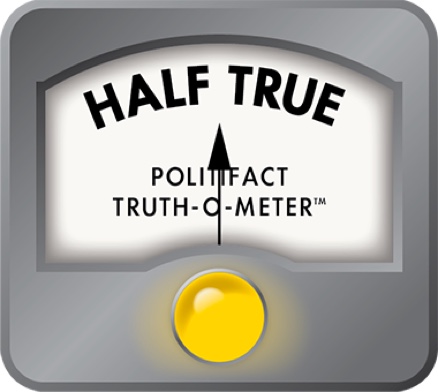
Based on the legislation, though, Kelly exaggerated the need for everyone to reregister. The legislation does not say that all registered voters need to reregister. However, every election cycle, tens of millions of Americans newly register or update their registrations when they move. This means they would be subject to the requirements of the proposed legislation.
Kelly was more accurate about driver’s licenses. REAL IDs do not automatically confirm U.S. citizenship; only a minority of states offer licenses that show citizenship. And military IDs must be accompanied by a military service record.
We rate this statement Half True.
Chief correspondent Louis Jacobson contributed to this fact-check.
RELATED: Fact-checking Chuck Schumer about SAVE America Act, how many Americans register to vote in person
RELATED: Voter suppression or little step? How the SAVE America Act affects married women who change names
RELATED: President Trump wants to slash voting by mail. About 1 in 4 Republicans voted that way in 2024
Sen. Mark Kelly, X post, March 18, 2026
Sen. Mike Lee, X post, March 18, 2026
MS NOW, The Tea, Spilled by Morning Joe: ‘The SAVE Act is horrible legislation’ March 18, 2026
North American Moving Services, Moving Statistics and Trends in Moving, 2024
Center for American Progress, The SAVE America Act Explained: How the New ‘Show Your Papers’ Voting Bill Is Even More Extreme Than the SAVE Act, Feb. 27, 2026
President Donald Trump, Truth Social post, March 22, 2026
Congress.gov, S.1383 - Veterans Accessibility Advisory Committee Act of 2025, 2026
Election Assistance Commission, Election Administration and Voting Survey 2024 Comprehensive Report, July 2025
Ballotmedia, Partisan affiliations of registered voters, August 2025
VoteBeat, Voters affected by citizenship-check error can cast a full ballot, Arizona Supreme Court rules, Sept. 20, 2024
North Dakota Monitor, Federal election bill not expected to affect North Dakota, Feb. 10, 2026
National Archives, About Military Service Records and Official Military Personnel Files (OMPFs, DD Form 214), August 2024
Homeland Security, Enhanced Drivers Licenses: What Are They? April 27, 2023
Montana Department of Justice, Citizenship marker, Accessed March 23, 2026
Email interview, Jacob Peters, Sen. Mark Kelly spokesperson, March 23, 2026
Email interview, Aaron Blacksberg, federal policy counsel with the Institute for Responsive Government, March 23, 2026
Email interview, Rick Hasen, UCLA law professor, March 23, 2026
Email interview, Eric Schmeltzer, spokesperson for VoteVets, March 23, 2026
Telephone interview, Eliza Sweren-Becker, deputy director for the voting rights and election program at the Brennan Center for Justice, March 23, 2026
Email interview, Brad Reiners, spokesperson, South Dakota Department of Public Safety, March 23, 2026














In a world of wild talk and fake news, help us stand up for the facts.