Get PolitiFact in your inbox.

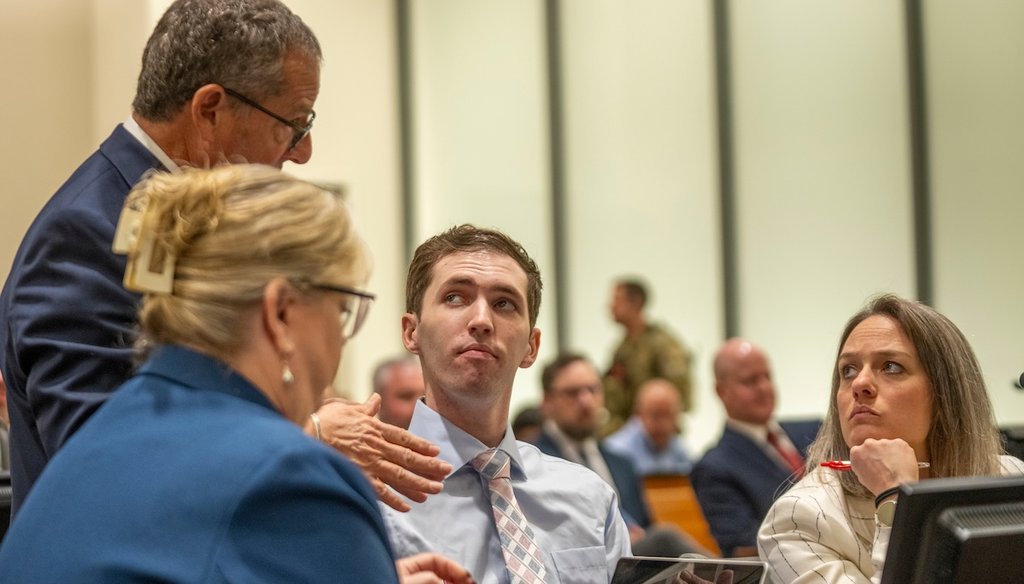
Tyler Robinson, who is accused of fatally shooting Charlie Kirk, appears during a hearing in Fourth District Court in Provo, Utah, Dec. 11, 2025. (AP)

New court filings in Utah’s case against Tyler Robinson, the suspect in Charlie Kirk’s murder, gave way to widespread claims that a bullet analysis exonerates him.
Robinson’s lawyers wrote in a March 27 court filing that the Bureau of Alcohol, Tobacco, Firearms and Explosives was "unable to identify the bullet recovered at autopsy to the rifle allegedly tied to Mr. Robinson."
In a previous court filing from March 10, lawyers for news media seeking public disclosure quoted an ATF report that the defense counsel had cited. The report compared a bullet jacket fragment from Kirk’s autopsy to a recovered rifle and determined the comparison to be "inconclusive."
These led to reports, including a March 30 Daily Mail headline that read, "Bullet used to kill Charlie Kirk did NOT match rifle allegedly used by suspect Tyler Robinson, new court filing claims."
On social media, former congresswoman Marjorie Taylor Greene, conservative commentator Candace Owens and others spotlighted the news and hinted that it showed far less is known about Kirk’s killing than has been reported.
The ATF report has not been made public.
PolitiFact spoke to forensic science and criminology experts who said an "inconclusive" finding on a bullet fragment like this is not uncommon, and it does not rule out that the weapon used in Kirk’s killing was the same one linked to Robinson.
"When the results of a bullet fragment analysis come back as ‘inconclusive,’ that does not mean that the rifle did not fire the bullet," Christopher Ballard, a spokesperson for the Utah Country Attorney’s Office and part of the prosecution team, wrote in an email to PolitiFact. "There just aren’t enough marks on the fragment to make a conclusion one way or the other as to whether the bullet fragment was fired by the particular rifle."
It is also incorrect to say that the bullet "did not match" the rifle, the experts said. The bullet may simply be too small or too deformed for examiners to provide an accurate analysis.
How ballistics examination works
To match a bullet to a suspected firearm, examiners look at shell casings and projectiles recovered from crime scenes and autopsies. They inspect these objects for points where the ammunition made contact with the firearm.
Bernard Zapor, retired ATF special agent in charge and faculty associate at Arizona State University’s School of Criminology & Criminal Justice, said the mechanical process of shooting a firearm leaves marks on the shell casing, the primer and the projectile.
"If there’s enough of the projectile recovered, then it can be examined," he said.
When a bullet leaves a rifle’s barrel, for instance, the rifle’s inside leaves marks on the outside of the bullet, said Stephanie Walcott, assistant professor at the Virginia Commonwealth University’s Department of Forensic Science.
Examiners run tests by firing the same type of ammunition from an identical weapon into a water tank, or other type of bullet recovery system, so the projectile will not be deformed.
Examiners can then compare the microscopic rifling marks between the crime scene bullet and the test-fired bullets to conclude that they originated from the same type of firearm, Walcott said.
Multiple factors can lead to an ‘inconclusive’ finding
An inconclusive result is "very common" especially with rifle bullets, Walcott said, because they travel with high energy and velocity and cause extreme damage to both the target and the bullet.
When a bullet is fired from a barrel, it interacts with internal rifling that includes spiral grooves. That spiral pattern spins the bullet as it travels down and exits. That pattern can vary according to the number of grooves, the width of those grooves, and the direction of the spiral.
If the bullet had a different type of rifling than the recovered firearm, then a match would be ruled out, Walcott said.
That’s why it’s "extremely misleading" to say that the "inconclusive" finding in the Kirk bullet analysis means the bullet "does not match" the rifle, Walcott said.
"In firearms and bullets, the rifling specification inside the barrel must be consistent with each other in order for an inconclusive to even be possible," she said. "If the bullet fragment showed a clear difference in the rifling characteristics, then it would have been an immediate elimination."
ATF firearms examiners are required to have two points of confirmation, Zapor said. They have to identify two marks to confirm that the projectile came from the round and was fired from the firearm, and they typically have to bring in another ballistics examiner to agree with their findings, he said.
"So it's a very high threshold to be able to say conclusively that the recovered projectile came from that shell casing, came from that firearm," Zapor said.
A 2022 study with a sample of 79 firearm and toolmark examiners found that the average participant reports an inconclusive examination in 20% of casework calls.
What other evidence is present in Robinson’s case?
The defense team wrote that, according to the prosecution, the FBI is conducting a second comparative bullet analysis and a bullet lead analysis.
Ballard said he cannot comment on the additional testing apart from what is in the public record, "but there are different tests that can be done to attempt to determine whether a particular rifle fired the bullet."
Zapor said the bullet analysis is only one piece of evidence that will be presented to a jury. The State of Utah’s charging document against Robinson included the following:
-
Robinson surrendered to police at the Washington County Sheriff’s Office the day after the Sept. 10 killing.
-
Robinson’s DNA was found on the rifle’s trigger, other parts of the rifle, the fired cartridge casing, two of the three unfired cartridges and the towel used to wrap the rifle.
-
Robinson instructed his roommate to delete text messages he’d sent regarding Kirk’s killing and to avoid talking to the police.
"This definitely leaves the question of the bullet open with no clear answer, which can be frustrating but the evidence is what it is," Walcott said. "Sometimes, a forensic analysis can't give a definitive answer. They will have to rely on other investigative information to answer all of the questions."
PolitiFact Researcher Caryn Baird contributed to this report.
Our Sources
Daily Mail, Bullet used to kill Charlie Kirk did NOT match rifle allegedly used by suspect Tyler Robinson, new court filing claims, March 30, 2026
X post by Marjorie Taylor Greene, March 30, 2026
X post by Candace Owens, March 30, 2026
Nicholas Scurich, Brandon L. Garrett, Robert M. Thompson, Surveying practicing firearm examiners, April 20, 2022
State of Utah vs. Tyler James Robinson, Sept. 16, 2025
Copies of documents in State of Utah v. Tyler James Robinson, uploaded by Andrea Burkhart, Oct. 24, 2025
USA Today, Does the bullet match? Key issue emerges in Charlie Kirk murder case, March 31, 2026
CNN, Lawyers for Charlie Kirk’s shooting suspect ask for hearing delay, citing analysis of bullet fragment and DNA evidence, March 31, 2026
Phone interview, Bernard Zapor, faculty associate at Arizona State University’s School of Criminology & Criminal Justice, April 1, 2026
Email interview, Stephanie Walcott, assistant professor at the Virginia Commonwealth University’s Department of Forensic Science, April 1, 2026
Email exchange, Brandon Garrett, law professor at Duke Law, April 1, 2026
Email exchange, Christopher Ballard, spokesperson for the Utah County Attorney’s Office, April 1, 2026