Get PolitiFact in your inbox.

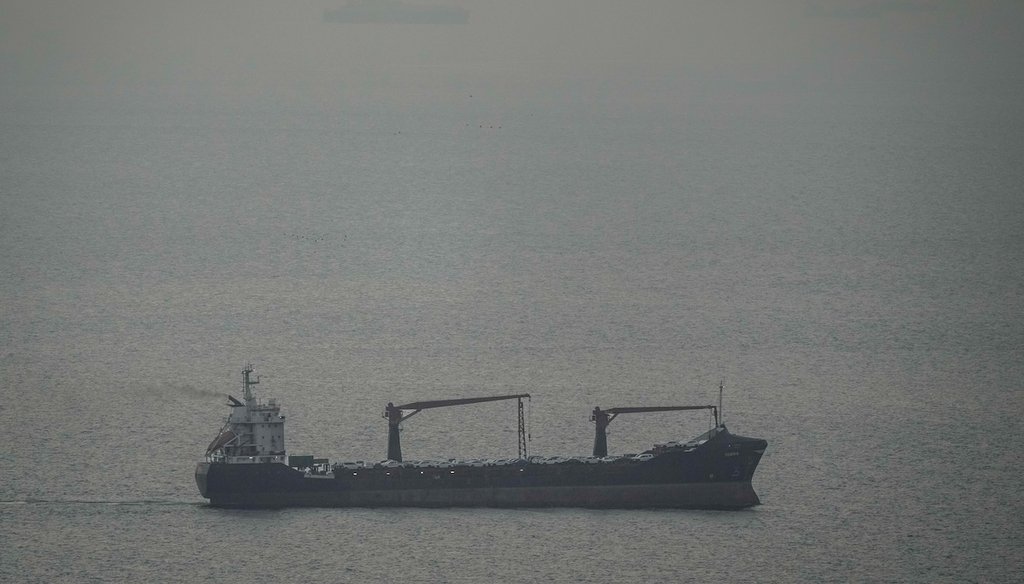
A cargo ship carrying vehicles sails toward the Strait of Hormuz on March 22, 2026. (AP)

If you’ve given even passing attention to current events, you know that the Strait of Hormuz is a key passageway for crude oil shipments. And you know that Iran blocking the strait in response to U.S. and Israel bombings has, in the words of the International Energy Agency, created "the largest supply disruption in the history of the global oil market."
But did you know that the U.S. depends on many other commodities that pass through the strait? From fertilizer to aluminum to helium, Americans could feel the effects of the war through higher prices and reduced economic growth beyond what it’s doing to gas prices.
"While the U.S. doesn’t purchase that many goods directly from the strait compared to other major economies, it is still seriously exposed to shortages and price rises in global commodity markets beyond oil and gas," said Noah J. Gordon, a fellow in the sustainability, climate and geopolitics program at the Carnegie Endowment for International Peace, a think tank.
In a worst-case scenario, certain commodities might not be available for any price.
The international consulting group Roland Berger projected that China, India, Japan and countries in southeast Asia stand to be hurt more by shortages of critical commodities than Europe or the Americas, given prevailing patterns of trade. However, the impact on the Americas could be noticeable for aluminum, the fertilizers urea and ammonia, and naphtha, an industrial byproduct of crude oil.
"When we start observing shortages in components … we will feel like it is on our doorstep instead of a far-off land," said Vidya Mani, a University of Virginia associate business professor.
Here’s a rundown of some of the blocked commodities that could have an impact on the U.S. and global economies.
Liquefied natural gas
When natural gas is compressed, it can be liquefied and transported in specialized ships. About one-fifth of the liquefied natural gas exported globally typically passes through the Strait of Hormuz.
Iranian attacks have knocked out 17% of Qatar's liquefied natural gas export capacity. Besides reducing supply for natural gas customers directly, this hinders the flow of natural gas byproducts, including fertilizer, plastics, detergents, cosmetics, paints and dyes.
Other petroleum byproducts
The supply of diesel, which is made from crude oil, is a major worry, Mani said, because it powers trucks, farm equipment and freight traffic. On April 3, the GasBuddy price app reported that the national average price of diesel had reached $5.52 per gallon, which is 30 cents short of all-time high.
"When diesel rises quickly, groceries, household basics, and building materials often follow," Mani said.
Another commodity from crude oil is liquefied petroleum gas, which is a mix of propane, butane and other gases often used for home appliances and manufacturing. Shortages in India have already forced millions of people to cook with coal, firewood and cow dung, Radio Free Europe/Radio Liberty reported.
Other products refined from crude oil include jet fuel, which affects air travel prices, and synthetic graphite, used in electric vehicle batteries.
Fertilizer
Fertilizer is vital for global agriculture, because it increases crop yields. Using less fertilizer can lead to food shortages and higher prices, though the timing can be uncertain because of staggered growing cycles.
The strait accounts for at least 20% of all fertilizer exported by sea; it accounts for 46% of one particular type of fertilizer, urea, and about 30% of another, ammonia. Unlike oil, fertilizer can not be rerouted through pipelines.
About half of fertilizer is not traded internationally, and the U.S., which is rich in natural gas, produces about three-quarters of the fertilizer it needs. As a result, the greatest risk to food security would be countries in Africa and South Asia; after Qatar’s natural gas production shuttered, fertilizer firms in India, Bangladesh, and Pakistan shut down production, according to the Carnegie Endowment.
Sulfur
Sulfur is an oil and gas byproduct that is a key input for producing certain types of fertilizer and for metal processing, particularly in the form of sulfuric acid. Nearly half of the world’s shipping of sulfur normally passes through the strait.
Sulfur shortages can affect the refining of nickel, cobalt and copper for the production of electric-vehicle batteries, semiconductors and renewable-energy storage. Sulfur also helps process uranium, lithium, titanium dioxide, zinc and rare-earth metals.
Chemicals like sulfuric acid "can determine whether the U.S. military can maintain industrial base production of electrical and digital systems needed to sustain the fight as munitions are expended and combat losses mount," Morgan D. Bazilian, a Colorado School of Mines professor, and two coauthors wrote recently. "It is one of those unglamorous industrial inputs that operators and planners ignore until a crisis hits, prices spike, and replacement capacity becomes nonexistent."
Helium
Qatar accounts for about one-third of the world’s helium, but that production is at a standstill after Iranian attacks.
Helium, which is extracted from natural gas, is used in semiconductor manufacturing — a necessary component of most consumer electronics — as well as the operation of MRI scanners, which use helium to keep superconducting magnets at low temperatures. Helium is also used for cold-chain transportation of perishable items such as insulin, Mani said.
Helium suppliers are already telling their U.S.-based customers, including semiconductor chip and electronics manufacturers, to expect shortages and price hikes, industry experts told CBS News.
The U.S. has substantial helium reserves stored in Amarillo, Texas, but the stockpile is much smaller than it was a decade ago, after a 2013 law encouraged stocks to be sold off.
The helium industry relies on roughly 2,000 expensive, cryogenic containers to shuttle supplies around the globe.
Aluminum
The Middle East accounts for about 9% of global production of aluminum, used heavily by the automobile and electronics industries, and in consumer packaging. The United States imports more than 20% of its aluminum from the Persian Gulf, requiring it to be shipped through the strait.
War-related disruptions in the United Arab Emirates and Bahrain have sent aluminum prices to a four-year high. "Any prolonged outage would further tighten an already constrained market, where restarting smelters is costly, complex, and time-consuming," the financial services firm ING said in an analysis.
Pharmaceutical and medical materials
The U.S. uses many generic pharmaceuticals manufactured in India, which in turn depend on chemicals that flow through strait. Shortages could curb drug production as well as polymer-based medical supplies manufacturing, including gloves, intravenous bags, catheters and syringes, Mani said.
Methanol
Methanol is an important chemical precursor for resins, coatings, paints, synthetic fibers and plastics; about one-third of the global methanol trade by sea passes through the strait.
Monoethylene glycol
The Gulf states shipped roughly 6.5 million tons of monoethylene glycol in 2025, which is used for making polyester fibers, packaging and textiles. It’s also a source of naphtha, a petroleum byproduct that is used for similar purposes.
Iron ore
The Gulf is also a significant source of iron ore pellets, which is needed for steelmaking. "Longer transit times and rising shipping costs are beginning to feed through to an industry already operating on tight margins," according to the World Economic Forum.
Our Sources
Roland Berger, "The Iran Conflict: Global Supply Implications Beyond Oil," March 2026
Patrick De Haan, X post, April 3, 2026
International Energy Agency, "New IEA report highlights options to ease oil price pressures on consumers in response to Middle East supply disruptions," March 20, 2026
BRG, "Dire Straits: The Hidden Supply Chains of the Strait of Hormuz," March 24, 2026
World Economic Forum, "The Strait of Hormuz crisis affects more than just oil. Here are 9 other commodities," April 1, 2026
ING, "The Commodities Feed: Oil eases as report suggests war could end without Hormuz reopening," March 31, 2026
Carnegie Endowment for International Peace, "The Other Global Crisis Stemming From the Strait of Hormuz’s Blockage," March 12, 2026
Center for Strategic and International Studies, "Iran, Fertilizer, and Food Security: Risks, Impacts, and Policy Responses," April 1, 2026
International Food Policy Research Institute , "The Iran war’s impacts on global fertilizer markets and food production," April 1, 2026
Soufan Center, "The Iran War: A Crisis for the Defense Industrial Base Now Too," March 25, 2026
Modern War Institute, "The Chokepoint We Missed: Sulfur, Hormuz, and the Threats to Military Readiness," March 13, 2026
Oregon Group, "Strait of Hormuz is chokepoint for sulphuric acid and critical metal processing," March 9, 2026
Mohammed Al-Hashemi, "The Strait of Hormuz is not just an oil chokepoint," March 27, 2026
American Farm Bureau Federation, "Agricultural Imports 101," May 6, 2025
New York Times, "Why Reopening the Strait of Hormuz Matters for the U.S. Economy," April 1, 2026
Scientific American, "The AI boom is dangerously dependent on helium," March 18, 2026
Science magazine, "Nitrogen, Ammonia, and the Strait of Hormuz," March 13, 2026
CBS News, "It's not just oil — the Iran war is disrupting helium and aluminum supplies. Here's the impact," March 31, 2026
Reuters, "Exclusive: Iran attacks wipe out 17% of Qatar’s LNG capacity for up to five years, QatarEnergy CEO says," March 19, 2026
Reuters, "Iran blows hole in US aluminium supply chain with smelter strikes," March 30, 2026
Reuters, "Iran war rattles the global aluminium supply chain," March 19, 2026
Radio Free Europe/Radio Liberty, "The Critical Commodities Caught in the Hormuz Blockade," April 2, 2026
Politico, "It's not just oil. Here comes Hormuz inflation," March 14, 2026
The Conversation, "The world’s supply of helium is being threatened by the Iran war," April 2, 2026
Chemistry World, "Iran conflict cuts off gulf oil and chemicals trade," March 6, 2026
Innovation News Network, "Why helium is essential to the future of semiconductor manufacturing," Dec. 5, 2025
Euronews, "Helium supply crunch puts MRI services at risk amid Qatar disruptions," March 25, 2026
PolitiFact, "Is the US a net exporter of oil? And does that matter for Iran war crude oil price spikes?" March 13, 2026
Email interview with Joely Virzi, program coordinator for the Center for Strategic and International Studies’ Global Food and Water Security Program, April 3, 2026
Email interview with Clark Williams-Derry, energy finance analyst at the Institute for Energy Economics and Financial Analysis, April 3, 2026
Email interview with Morgan D. Bazilian, public policy professor at the Colorado School of Mines, April 3, 2026
Email interview with Noah J. Gordon, fellow in the sustainability, climate and geopolitics program at the Carnegie Endowment for International Peace, April 3, 2026
Email interview with Vidya Mani, University of Virginia associate business professor, April 3, 2026
Browse the Truth-O-Meter
More by Louis Jacobson