Stand up for the facts!
Our only agenda is to publish the truth so you can be an informed participant in democracy.
We need your help.
I would like to contribute

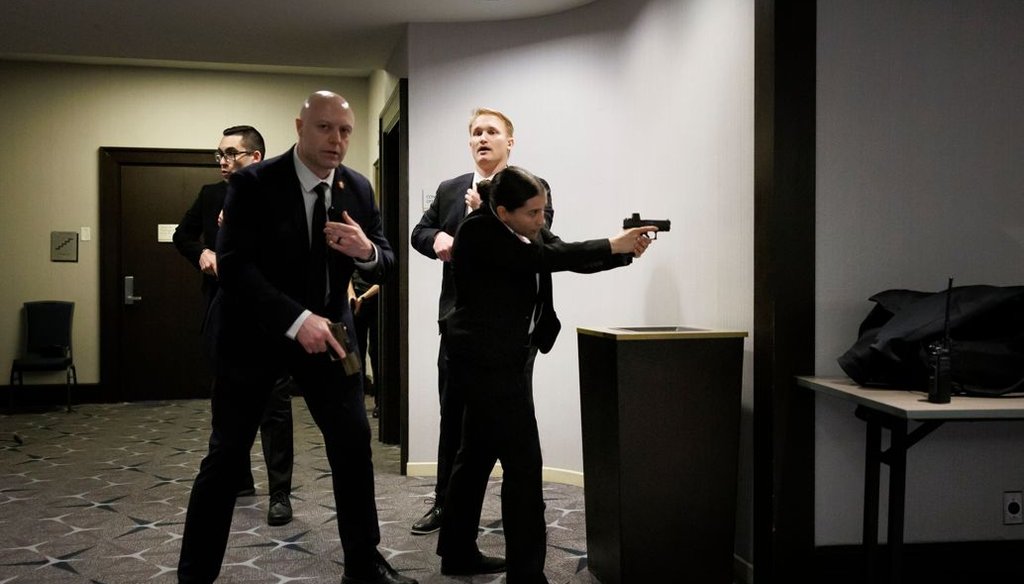
Members of law enforcement respond during the White House Correspondents' Association dinner on April 25, 2026. (AP)

About an hour after a shooting inside the venue hosting the White House Correspondents’ Association dinner, President Donald Trump — who attended and was quickly evacuated — said the incident showed why the White House should have its own secure ballroom.
Ignoring standard procedures such as seeking approval from the National Capital Planning Commission, Trump has moved forward with construction of a 90,000-square-foot structure on what had been the East Wing of the White House, which he bulldozed last year. He has said the ballroom is being privately financed with $400 million in donations.
At a White House press conference April 25 after the correspondents’ dinner was postponed due to the shooting, Trump said, "We need the ballroom."
The following morning, Trump reiterated the point in a Truth Social post: "This event would never have happened with the Militarily Top Secret Ballroom currently under construction at the White House. It cannot be built fast enough!"
He also touted the ballroom April 26 on Fox News' "The Sunday Briefing," calling the White House "the most secure ground probably in the world" and saying for such an event, "the president doesn't have to leave the premises."
Trump received quick and enthusiastic support from elected officials (including Louisiana Republican Gov. Jeff Landry, Rep. Randy Fine, R-Fla., and John Fetterman, D-Pa.) and from several pro-Trump people.
Rep. Chip Roy, R-Texas, also floated the idea of taxpayers funding the ballroom, posting that "any consideration" of a bill to end the Department of Homeland Security shutdown "should provide for construction of a secure ballroom on White House grounds."
A White House Correspondents’ Association dinner hosted by the White House, regardless of who is president, presents an array of ethical challenges. As a longtime member of the association who attended the dinner each year from 2012 to 2019, I was struck by the idea that a journalists’ event might be hosted at the White House.
The White House Correspondents’ Association represents White House reporters, and its dinner — held annually since 1921 — funds scholarships for college journalists, some of whom I have mentored. The dinner also is an occasion for giving awards for journalistic excellence, and a general celebration of press freedom. (Such goals led some journalists to criticize the dinner for hosting Trump in person this year, citing his criticism of the press and lawsuits against it.)
While every modern president has attended at least one correspondents’ dinner, that’s because the association invites the president — not because it’s a White House event.
If the event were held at the White House, it would proceed at the pleasure of the president, who could block the event at any time and for any reason. This leverage also could be used to coerce favorable press coverage.
Kelly McBride, who chairs the Craig Newmark Center for Ethics and Leadership at the Poynter Institute for Media Studies, which is PolitiFact’s parent organization, wrote an April 16 column critical of this year’s dinner. McBride told me that a dinner held at a future White House ballroom would be "even worse than the current optics."
"It would be a horrible idea," said McBride. "The answer is clear: It has to be held in a neutral location."
Tom Rosenstiel, who has written media criticism books and teaches journalism at the University of Maryland, agreed.
"When you have an event put on by the WHCA, it should be controlled by that organization," he said. "Having it on federal property gives the government undue control over it."
It would be possible to host the event at a non-hotel, non-White House venue. For example, the Walter E. Washington Convention Center is large enough to host the event.
Another issue that could undercut the dinner’s move to the White House is that the ballroom is currently slated to hold about 1,000 people, about one-quarter of the size of the Washington Hilton’s ballroom.
I reached out to both the White House and the White House Correspondents’ Association for thoughts on whether the dinner should be moved to a White House ballroom, but neither responded.
White House Correspondents’ Association President Weijia Jiang released an April 26 statement that said in part, "The WHCA board will be meeting to assess what happened and determine how to proceed. We will provide updates as soon as any are available."
Rosenstiel said he wouldn’t expect the push from the idea’s supporters to fade away any time soon: "I don’t think there’s any logic here, except for grasping at reasons to support the ballroom."
Our Sources
Interview with Kelly McBride, chair of the Newmark Center for Ethics at the Poynter Institute, April 26, 2026
Interview with Tom Rosenstiel, media critic who teaches at the University of Maryland, April 26, 2026
Other sources linked in article