Stand up for the facts!
Our only agenda is to publish the truth so you can be an informed participant in democracy.
We need your help.
I would like to contribute

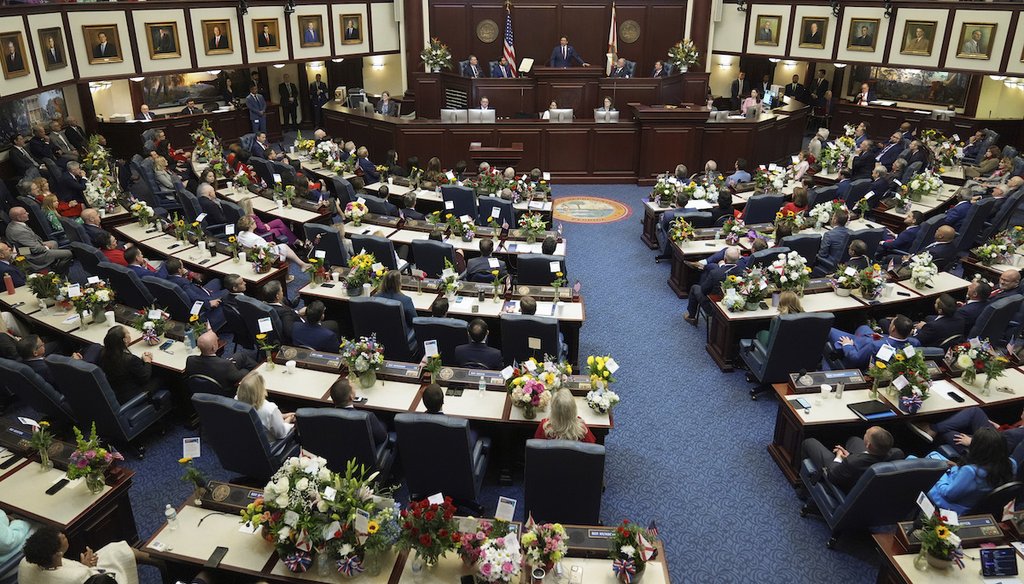
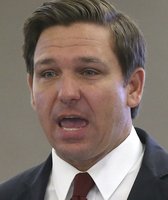
Florida Gov. Ron DeSantis addresses the Florida Legislature in his 2025 State of the State on March 4, 2025, at the state capitol in Tallahassee (AP)

If Your Time is short
-
In Florida, citizen-backed initiatives are the only ballot measures that trigger an automatic review by the state Supreme Court. The review ensures the initiative covers one subject and that its ballot summary is not confusing or deceptive.
-
A legislatively-passed ballot measure goes straight to voters without the court’s review, unless someone files a lawsuit to try to remove it.
-
From 1978 to 2019, the court removed eight legislative proposals from the ballot in reviews spurred by lawsuits, a political science professor found. It hasn’t removed any since 2020.
After a contentious debate with Democrats, Florida House Republicans passed their version of a property tax overhaul that would eliminate non-school property taxes for Floridians’ primary residences.
As the House neared a vote on the proposed amendment Feb. 19, Rep. Toby Overdorf, R-Palm City, dismissed legislators’ concerns that the tax cut would strip local governments of money for services, saying municipalities’ budgets have increased sharply over the last several years.
Then he turned to Florida’s ballot amendment approval process.
"What we pass today will eventually go, hopefully, to the Supreme Court," Overdorf said on the statehouse floor. "And they will review that language and then it goes to the voters. The voters will make that choice."
The tax proposal is a legislative ballot measure that will require voters to weigh in. The Florida Supreme Court doesn’t automatically review that type of proposal.
The state Supreme Court typically reviews citizen-led initiatives before they go to voters, not ones passed by the Legislature. In this case, the court would review the proposal’s language only if anyone files a lawsuit challenging it. Given the controversial nature of the property tax proposal, experts believe it is likely to face legal challenges.
University of Central Florida political science professor Aubrey Jewett found that from 1978 to 2019 the Florida Supreme Court removed eight legislative proposals from the ballot in reviews spurred by lawsuits. In each case, the court declared the amendments or their ballot summaries confusing, misleading or incomplete.
Overdorf told PolitiFact he was referring to the possibility of a lawsuit, saying that his use of the word "hopefully" was meant toward the measure passing the Legislature. The Senate has not taken up the measure and is working on its own property tax proposal with Gov. Ron DeSantis, who floated the possibility of a special session later in the year to get it done.
"I have to be conservative as I go through this process, and the measure is subject to review if somebody challenges the ballot language," Overdorf told PolitiFact in a phone interview. "According to the statutes, anyone that disagrees with the language and files an action, which they have to do within 30 days, that would have to be reviewed by the court and it takes precedence of any other action by the court."
The different ways Florida handles ballot measures
There are five ways an amendment can be placed on Florida’s election ballots: citizen-led initiative petition, legislative proposal, constitutional revision commission, taxation and budget reform commission and a constitutional convention. At least 60% of voters must approve of a measure for it to become a Florida law.
Florida has never had a constitutional convention, but it has utilized the four other methods over the years to put ballot measures before voters.
For citizen-led initiatives, "after a certain percentage of required signatures is reached, a supreme court review of the amendment is officially requested, and the court must agree that the initiative covers only one subject and that the ballot summary is not confusing or deceptive," Jewett said. "If the court finds that it fails either of those tests, then it will not go on the ballot."
Florida’s Republican lawmakers have taken steps to make it harder for ballot initiative backers to get measures approved.
In 2020, they passed a bill raising the number of signatures initiatives need to spur review by the state’s highest court, increasing it from 10% to 25% of the total signatures required to get on the ballot. The law also raised the requirement for signatures to be collected in at least half of the state’s congressional districts, instead of one-fourth of them.
DeSantis signed another law in 2025 that requires petition circulators to be Florida residents and U.S. citizens, prohibits felons who haven’t had their voting rights restored from circulating petitions and requires all circulators to register with the Florida Division of Elections. (Petition circulators gather signatures for ballot initiatives.) The state can now levy a $50,000 fine against an organization that allows ineligible people to handle petitions, per violation.
The tougher restrictions can be seen in real time: DeSantis’ administration recently announced that no citizen initiatives made the November 2026 ballot. Legislative proposals, meanwhile, must pass as a joint resolution by a three-fifths vote in both the House and Senate, and are not subject to a governor’s veto.
Since Republicans currently have the supermajority, any measure the party wants to put on the ballot has a good chance of getting there. Once passed, barring a lawsuit, the proposals typically go straight to the ballot.
"The legislative majority typically resents having its legislative proposals removed or revoked and believes the Florida Supreme Court should not interfere with its ability to place constitutional changes before the voters," Jewett wrote in his book, "Politics in Florida." "In several cases, the legislature has simply rewritten its proposal and put the issue back before the voters."
For example, when the Florida Supreme Court removed a 2007 proposal to reduce property taxes and increase exemptions, the Legislature called a special session and got the rewritten proposal back on the ballot, where it passed easily.
The court, which now has six conservative DeSantis-appointees, has not removed any legislative proposals from the ballot in 2020, 2022 or 2024.
RELATED: Florida's Amendment 4 on abortion is short. Does a lack of definitions mean no rules?
Our Sources
The Florida Channel, 2/19/26 House Session, Accessed Feb. 23, 2026
FLSenate.gov, HJR 203: Elimination of Non-school Property for Homesteads, Accessed Feb. 23, 2026
Florida Phoenix, Florida House passes proposed amendment to immediately phase out property taxes, Feb. 19, 2026
FLSenate.gov, CONSTITUTION OF THE STATE OF FLORIDA
Florida Division of Elections, Constitutional Amendments/Initiatives, Updated Nov. 5, 2025
WUSF, How do proposed constitutional amendments work in Florida? We explain, March 28, 2025
Northwest Florida Daily News, It will be a lot harder to put proposed constitutional amendments on the 2022 ballot, Dec. 21, 2020
News from the States, Federal ruling in Florida ballot initiative restriction challenge could have national implications, Feb. 20, 2026
Politics in Florida 5th Edition, 2019
Legislative Special Session 2007 B Summary Property Tax Reform, Accessed Feb. 25, 2026
Email interview, Aubrey Jewett, political science professor at the University of Central Florida, Feb. 25, 2026
Phone interview, Toby Overdorf, representative for Florida’s 85th district, Feb. 25, 2026