Get PolitiFact in your inbox.

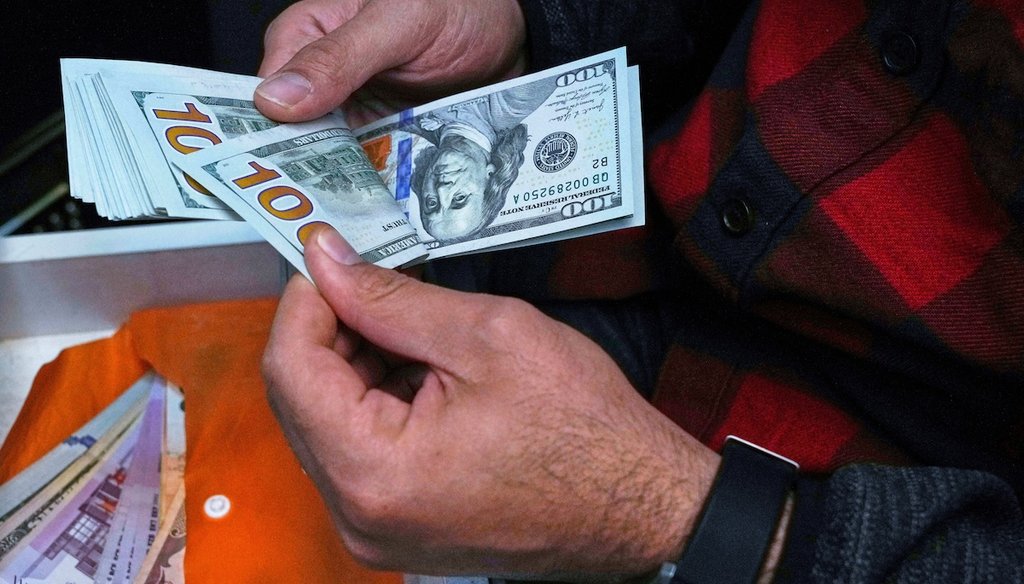
A currency exchange bureau worker counts U.S. dollars at Ferdowsi square, Tehran's go-to venue for foreign currency exchange on April 5, 2025. (AP)

As the United States assembles a large military force for a potential strike on Iran, a PolitiFact reader asked us about Treasury Secretary Scott Bessent’s recent comments that the U.S. engineered a run on the Iranian currency and contributed to upheaval in the country.
In both a Jan. 20 interview with Fox Business anchor Maria Bartiromo at the World Economic Forum in Davos, Switzerland, and in Feb. 5 testimony to Congress, Bessent said the U.S. has triggered a currency crisis in Iran, damaging its economy and putting the country’s decades-old theocratic leadership in peril.
"What we have done is created a dollar shortage in the country," Bessent told the Senate Banking Committee. "It came to a swift and, I would say, grand culmination in December, when one of the largest banks in Iran went under. The central bank had to print money. The Iranian currency went into free fall. Inflation exploded, and hence we have seen the Iranian people out on the street."
At Davos, Bessent characterized the effort as "economic statecraft. No shots fired."
How did the U.S. go about creating a dollar shortage in Iran? U.S. policies on financial transfers and trade sanctions worked together to starve the Iranian economy of inflow of U.S. dollars, which are needed to purchase vital goods on the international market.
Experts we interviewed broadly agreed that targeted U.S. pressure on Iran succeeded in weakening an already weak economy, driving citizens into some of the most widespread street demonstrations in years. The resulting government crackdown has killed between 7,000 to 30,000, according to estimates.
What actions has the U.S. taken?
While the U.S. has imposed economic sanctions for decades, Trump has upped the ante in his second term.
One U.S. tactic has been to threaten purchasers of Iranian oil with trade or economic sanctions. Oil is the main source of U.S. dollars for Iran; countries usually want to have widely accepted currency in their reserves rather than only their own currency, because not all trading partners will accept their currency.
Under threat of U.S. sanctions, potential customers for Iran’s oil are usually willing to buy it only at a discount, thus reducing the flow of dollars to Iran, said Nader Habibi, a Brandeis University economist who specializes in the Middle East.
The U.S. also has placed restrictions on dollar transactions with Iran, said Torben G. Andersen, a finance professor at Northwestern University’s Kellogg School of Management.
For example, several billion dollars of Iran's oil export revenues are sitting in its bank accounts in China, South Korea and several other countries, with Iran unable to transfer the money back home, Habibi said. This further starves Iran’s economy of U.S. dollars. Some transactions in dollars have been carried out informally but at the risk of the intermediaries embezzling the funds, Habibi said.
What has the impact been?
The U.S. pressure has "hastened the economic crisis" for ordinary Iranians, Andersen said.
The uncertainties associated with U.S. sanctions "have reduced the appetite of Iranian households and investors to make productive investments in manufacturing or other productive activities," Habibi said. "Instead, they are converting their savings into gold and hard currency, which means the demand for dollars is even stronger than in normal conditions."
This can be seen in recent record lows of Iran’s currency against the U.S. dollar — it took 1.5 million rials to buy a dollar in January, compared with 700,000 a year earlier.
It was also apparent in 40% overall inflation and 70% inflation for food, Adnan Mazarei, a senior fellow at the Peterson Institute for International Economics and the former deputy director of the International Monetary Fund’s Middle East and Central Asia department, told CNN International.
This economic turmoil has become a "major reason" for the Iranian protests, Mazarei said. The protests began in December 2025 with shopkeepers in Tehran’s Grand Bazaar and soon spread to other locations throughout Iran.
"The sanctions have played an important role in creating mass discontent, causing inflation, unemployment and loss of income," Habibi said.
Even before the latest U.S. actions, Iran’s economic health was poor, because of existing sanctions by the U.S. and other nations. Research by Habibi and Mohammad Reza Farzanegan, an economist at Marburg University in Germany, found that Iran’s middle class would have expanded between 2012 and 2019 without sanctions, but instead the middle class shrunk by 28% during that period.
What’s next?
The White House says it has not made any decisions about a strike on Iran, and negotiations continue in Geneva.
The United States’ goals during the current negotiations have focused on ending Iran’s nuclear program, having the country give up its ballistic missiles and stopping its arming of proxies that threaten neighboring countries. But Trump has informally gone further, saying regime change is "the best thing that could happen" in Iran.
Mazarei said the United States’ economic sanctions have put "considerable pressure" on Iran’s leaders to reach a deal, but "not if the agreement will undermine their continuation as a regime."
Our Sources
Scott Bessent, interview with Fox Business anchor Maria Bartiromo at the World Economic Forum in Davos, Switzerland, Jan. 20 2026
Scott Bessent, testimony before the Senate Banking Committee, Feb. 5, 2026
Reuters, "Iran's rial hits new low after unrest sparked by economic crisis," Jan. 27, 2026
Associated Press, "More than 7,000 dead in Iran's crackdown on protests, activists say," Feb. 12, 2026
Time Magazine, "Iran Protest Death Toll Could Top 30,000, According to Local Health Officials," Jan. 25, 2026
NPR, "Trump's sanctions on Iran have dramatically affected its economy and led to protests," Feb. 23, 2026
BBC, "Trump says Iran regime change is 'best thing that could happen,'" Feb. 13, 2026
Adnan Mazarei, interview with CNN International, Feb. 27, 2026
Axios, "U.S.-Iran nuclear talks were "positive," senior U.S. official says," Feb. 26, 2026
Al Jazeera, "US says it caused dollar shortage to trigger Iran protests: What that means," Feb. 13, 2026
PolitiFact, "Has the dollar had its biggest decline in 50 years under Donald Trump?" July 25, 2025
Email interview with Adnan Mazarei, senior fellow at the Peterson Institute for International Economics, Feb. 26, 2026
Email interview with Torben G. Andersen, finance professor at Northwestern University’s Kellogg School of Management, Feb. 26, 2026
Email interview with Nader Habibi, Brandeis University economist who specializes in the Middle East, Feb. 26, 2026
Browse the Truth-O-Meter
More by Louis Jacobson