Stand up for the facts!
Our only agenda is to publish the truth so you can be an informed participant in democracy.
We need your help.
I would like to contribute

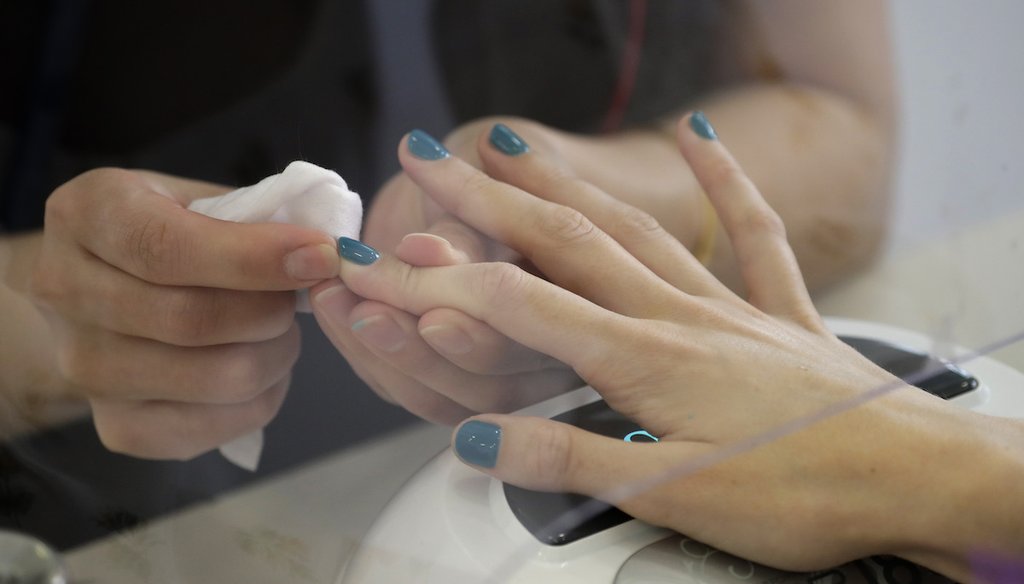
A customer receives a gel manicure at Lily's Nails & Beauty on Clerkenwell Road in London, Monday, July 13, 2020. (AP)

If Your Time is short
-
Current evidence shows skin cancer risk from UV gel-drying lamps is low — but not zero. For those with repeated exposure, experts recommend using sunscreen.
-
The gel nail polish ingredient trimethylbenzoyl diphenylphosphine oxide, or TPO, was banned in the European Union after animal studies showed it to be toxic when ingested in large amounts. It is not banned in the U.S.
-
Experts say that human exposure to TPO during manicures is very different. The amount of TPO in gel polish is small and it is not well absorbed through the nailbed. After the polish is cured, the chemical is no longer present on the nail.
Getting a gel manicure always feels like a treat — it dries instantly and usually doesn’t chip for weeks!
But is it safe?
Concerns about ultraviolet lights and "toxic" ingredients that are banned abroad may have you wary. We dug into the research and spoke with cosmetic scientists to get the facts.
Does the UV light cause skin cancer?
Unlike traditional nail polish, which dries slowly like paint, gel nail polish requires a UV light for the polish to cure and harden into a plastic-like film.
Experts at the MD Anderson Cancer Center took a closer look at skin cancer risk from these gel manicure lamps in September. Research is limited, but evidence so far shows the risk to be low, they wrote.
A 2009 study linked hand skin cancers to UV nail lamps in two women, but it did not conclusively determine that the manicures were the cause, saying more research was needed.
A 2014 study looked at 17 different salon nail lamps and found that the amount of ultraviolet A light emitted varied widely, but the exposure wasn’t enough to cause DNA damage in a single visit. Researchers did not test multiple exposures but said their data showed the cancer risk remains low.
A 2023 study found that UV-nail polish dryers can damage DNA in cells, but the research was conducted on animal tissues and human skin cells in a lab.
A 2024 study found that the UV dose from one manicure session was equivalent to three to a 6-minute summer sun exposure in Spain at noon.
Despite the low risk, the American Academy of Dermatology says "moderation is the key when it comes to gel manicures." Consider only getting gel nails done for special occasions. In addition to skin cancer risk, it can cause aging in the skin.
People who are taking medications that make them sensitive to UV light may want to limit their exposure.
If you don’t want to give up your manicures, experts recommend wearing fingerless gloves or putting sunscreen on your hands before heading to the salon.
Is gel nail polish toxic?
American salon goers began asking that question after the European Union banned a common ingredient used in gel nail polish last year.
Trimethylbenzoyl diphenylphosphine oxide, also known as TPO, was classified as a "reproductive toxicant," by European regulators meaning it has the potential to cause harm to sexual function, fertility or offspring development.
The ingredient is not banned in the U.S.
TPO is what is known as a photoinitiator: "It absorbs UV light and triggers the polymerization reaction that turns the liquid gel into a hard, durable coating," said Kelly Dobos, cosmetic chemist and adjunct professor at the University of Cincinnati.
When the gel liquid transforms to a solid, the TPO is consumed by the chemical reaction and becomes part of a different chemical structure. That means that the exposure time is brief — it lasts only from the moment it is applied to the nail to the point at which it is cured under the lamp. The TPO is not sitting on your nail for weeks after you have gotten your nails done.
In 2021, the European Chemicals Agency recommended that TPO be classified as a reproductive toxicant, and the ban on the ingredient’s use in cosmetics went into effect on Sept. 1. The classification was based on animal studies in which rats were fed large amounts of TPO for weeks at a time.
But unless you are chugging gel nail polish, this is not how humans are exposed to TPO.
"These models are designed to identify intrinsic hazard, not real‑world consumer risk. No consumer would ever experience exposure remotely comparable to an injected or high‑dose oral study," Dobos said. Because human nails are hard and non-porous, it would be hard to absorb such chemicals through them.
TPO makes up a small fraction of the polish formula, less than 5%. "You'd need to expose yourself to at least 100x the amount of TPO that's allowed in nail polish to even potentially see negative effects," cosmetic scientist Julien Sass wrote in an email.
Why did the EU ban TPO if it’s safe in nail polish?
TPO’s ban has a lot more to do with the way that the EU regulates chemicals in cosmetics. It tends to regulate ingredients based on whether any level of exposure could result in any harm at all, Sass said.
The U.S., by contrast, takes into account risks based on exposure level.
U.S. manufacturers are responsible for making their products and ingredients safe, but don’t need Food and Drug Administration approval before they take their products to market, except for color additives. It is illegal to use an ingredient that makes a cosmetic harmful when used as intended. And the FDA can take action if a manufacturer breaks the law.
How can I tell if a nail polish has TPO?
Other chemicals can serve as photoinitiators, so it is possible to find a TPO-free gel polish in Europe and the U.S.
Check a nail polish’s ingredient list on its packaging label or online.
At a salon, you may have to ask whether a polish contains TPO.
Experts also reminded nail enthusiasts to use products as intended. Nail polishes aren’t meant to be applied directly to skin, and repeated skin exposures over a long period of time can cause adverse reactions in some people.
Our Sources
Email interview with Kelly Dobos, cosmetic chemist and adjunct professor at the University of Cincinnati, Feb, 25, 2026
Email interview with Julian Sass, PhD, cosmetic scientist, Feb. 25, 2026
Email interview with Doug Schoon, cosmetic scientist, Feb. 25, 2026
Email statement from FDA spokesperson, Feb. 25, 2026
Instagram post, Feb. 9, 2026
CNN, "Europe bans chemical used in some gel nail polishes, classifying it as a ‘reproductive toxicant’" Sept. 4, 2026
European Commission, "TPO in Nail Products – Questions & Answers - Internal Market, Industry, Entrepreneurship and SMEs," Aug. 7, 2025
Professional Beauty Association, "Gel Polish Isn’t Banned in the EU: PBA’s NMC Explains TPO," Sept. 3, 2025
Professional Beauty Association, "UV Lamps for nail gels facts, science, and common sense," accessed Feb. 27, 2025
Today, "Certain Gel Nail Polishes Have Been Banned in Europe. Is It Still Safe to Use?," Sept. 5, 2025
PBS, "Why did the EU ban gel nail polish? 3 things to know," Sept. 5, 2025
Ohio State Health, "Skin cancer risk from UV nail dryer," Feb, 8, 2025
MD Anderson Cancer Center, "Is your gel manicure safe?," Sept, 16, 2025
Nature Communications, "DNA damage and somatic mutations in mammalian cells after irradiation with a nail polish dryer," Jan. 17, 2023
Archives of Dermatology, "Occurrence of nonmelanoma skin cancers on the hands after UV nail light exposure," 2009
JAMA Dermatology, "Further Investigation Into the Risk of Skin Cancer Associated With the Use of UV Nail Lamps," July 2014
GoodRx, "Are Gel Manicures Bad for You? Understanding the Risks," Nov. 1, 2024
Journal of Clinical and Aesthetic Dermatology, "Ultraviolet Light Gel Manicures: Is There a Risk of Skin Cancer on the Hands and Nails of Young Adults?," July 2020
European Journal of Dermatology, "A systematic review of the risk of cutaneous malignancy associated with ultraviolet nail lamps: what is the price of beauty?," Feb 1. 2024
Actas Dermo-Sifiliográficas, "Discussion Abounds on the Potential Carcinogenic Risks Associated With the Use of UV Curing Lamps for Permanent Nail Polish," April 21, 2024
Environmental Protection Agency, "Ultraviolet (UV) Radiation and Sun Exposure," March 20, 2025
Skin Cancer Foundation, "Ask the Expert: Are the UV Lamps in the Dryers at the Nail Salon Safe to Use?," Jan. 24, 2023
Cleveland Clinic, "You Guessed Right: Gel Nail Polish Is Bad for Your Nails," April 6, 2023
Health Products Regulatory Authority, "TPO added to European Union list of prohibited ingredients," Aug. 29, 2025
European Chemicals Agency, "Committee for Risk Assessment," Sept. 16, 2021
European Commission, "Trimethylbenzoyl diphenylphosphine oxide (TPO)," March 27, 2014
Mass General Brigham, "Preventing Skin Damage From UVA and UVB Rays," Sept. 22, 2023
American Cancer Society, "Does UV Radiation Cause Cancer?," June 16, 2024
European Commission, "CMR substances - Internal Market, Industry, Entrepreneurship and SMEs," accessed Feb. 27, 2025
European Chemicals Agency, "Reproductive toxicity – classification under CLP," Sept. 4, 2017
AIM at Melanoma, "Nailing Down on the Ultraviolet Exposure Occurring During the Curing and Drying of a Manicure," Oct. 8, 2024
Journal of American Academy of Dermatology, "Acrylic nail curing UV lamps: High-intensity exposure warrants further research of skin cancer risk," 2013
Science Reports, "Influence of UV nail lamps radiation on human keratinocytes viability," Dec. 18, 2023
International Journal of Dermatology, "Assessing the Health Implications of UV/LED Nail Lamp Radiation Exposure During Manicure and Pedicure Procedures: A Scoping Review," Feb. 11, 2025
Nebraska Medicine, "You asked, we answered: Can UV gel nail polish dryers cause skin cancer?," Oct. 27, 2025
GoodRx, "13 Medications That Increase Sun Sensitivity," July 16, 2025
Women’s Health Magazine, "Do Gel Manicures Cause Cancer? Here's What The Research Says," Oct. 17, 2025
Browse the Truth-O-Meter
More by Grace Abels